Command Palette
Search for a command to run...
If Vehicle Faults Can Be Detected by Voiceprint, Is There Still a Need to Complain About Mercedes-Benz's Rights Protection Incident?
There are many ways to manually diagnose vehicle faults, but the process is relatively cumbersome and time-consuming. Based on big data, using computer vision technology and sensor monitoring methods to diagnose vehicle faults can reduce manual work time and detection accuracy.
This morning, the news that Notre Dame Cathedral was on fire instantly swept the screen, and the whole world felt sad for it.
But at this time, Mercedes-Benz may be thanking Notre Dame de Paris for the fire that helped it get out of the spotlight.
The hot spots will eventually pass, but the problems will still exist.Car owners' rights disputes are not isolated casesSince many consumers lack car-buying experience, it is common for them to discover problems with a new car shortly after purchasing it.
Many previous cases were caused by non-standard vehicle inspection procedures and lack of transparency in consumer information.
Can modern technology be used to improve this situation?
Buying a Mercedes-Benz for 660,000 yuan, the fault was exposed before leaving the store
To this day, the incident in which the female Mercedes owner cried out for her rights has not been resolved.
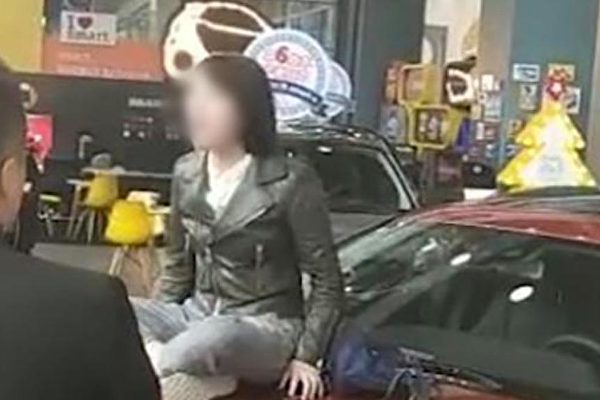
In fact, in order to reduce costs, many 4S stores do not conduct PDI testing seriously, but just go through the motions.
A car often travels thousands of kilometers and is parked for a long time from the manufacturer to the 4S store. In order to ensure the original performance and safety of the new car to the customer, PDI testing is essential. However, in the actual sales process, the necessary testing has become dispensable, or just a formality of repeatedly ticking the test report and having the car owner sign it.
So are we just going to let things like this go?
Maybe AI doesn’t agree.
Although there has long been a nearly mature manual detection method for vehicle fault detection, the process is still relatively cumbersome, and the right of interpretation is only in the hands of the user.
Let’s imagine that if everyone has an AI car inspection software, the process of buying a car in the future may be:
Enter the store, test drive the car, open the AI vehicle inspection software, and find various potential faults/no faults in the vehicle. In this way, information transparency can be achieved, the store will not deceive, the rights of customers will be protected, and the number of rights protection incidents will be reduced...
Currently, many companies are trying to use AI to diagnose vehicle failures.
Deep learning to identify faults through listening
A company called 3DSignals**Using "deep learning" technology, car faults can be determined through sound detection.**This is like an experienced master who can tell where the problem lies just by listening when the equipment is running.
The company's founder said that the use of sound data, except for speech recognition, has not yet been sufficiently developed.
3DSignals uses sound data collected by ultrasonic sensors to detect abnormal noise from the car, and classifies and labels the monitored abnormal sounds to determine the specific type of fault problem.

In judgment analysis, in order to make predictions more accurate, it is necessary to collect sufficient data in advance and**Effectively train the AI model to accurately label specific sounds to distinguish corresponding fault issues.**In this way, sound can be collected to investigate and maintain problem areas to avoid disasters.
According to reports, after training, 3DSignals' deep learning algorithm can achieve98% accuracy.
 Moreover, this technology has been reused in heavy industry, such as training computers to "listen" and diagnose abnormal problems in facilities such as hydropower plants and steel mills.
As for the accuracy of automobile failures, we are still developing it to provide a better user experience.
Imagine that for a luxury SUV, a computer can be used to "listen" and diagnose mechanical problems. When the car is sold, both the buyer and the seller can get actual and authentic inspection reports, thus avoiding the existence of fraudulent activities.
In addition to listening to the sound, you can also look at the picture to determine the damage
In addition to detecting vehicle faults, the application of computer vision technology can also assess damage to vehicles involved in accidents, making the damage assessment process faster and more accurate.
British startup Tractable recently announced a technology that uses AI to estimate vehicle repair/replacement decisions and predict repair time.
Based on the principles of computer vision, and trained with hundreds of millions of vehicle damage photos and a large amount of repair instance experience, the AI model can complete vehicle damage assessment and repair estimation within 30 seconds.

For example, images of the 2013 Chevrolet Cruze LT1, Hyundai, and Audi were selected as demonstration objects. Tractable also invited Lisa Monzon, operations vehicle evaluation manager, to analyze the pictures at the same time to compare the AI evaluation and manual evaluation results.

A repair company using traditional manual diagnosis came up with a result that the bumper cover, side fenders, headlights, hood and fenders (and emissions sticker) needed to be replaced, and included more work than the original estimate. Its estimated insurance amount was $3,981.49.
Tractable's AI assessment required the Cruze's fenders, headlights, hood, and grille to be replaced. Its diagnosis was clearly more in line with human judgment.
It also troubleshoots modern photos:
 A close-up of the right rear door led the AI to diagnose that it needed to be replaced. Monzon said the scratch on the door looked like it could be repaired, but the presence of the dents meant the door needed to be replaced.
The photo does not capture the scratches on the adjacent body panels, probably because the image capture is limited and the edges cannot be identified.
Diagnosing Audi's case:
 The system concluded that the Audi needed a new fender but that the bumper panel could be fixed, although the latter only had a 67 percent confidence level.
Monzon agreed with the system's assessment and said the "minor damage" to the bumper panel was repairable.
In addition, this AI system can give a predicted repair time for faults, allowing users to make corresponding preparations.
Will AI make the world a better place?
Is it reliable to use artificial intelligence to diagnose vehicle failures?
As mentioned above, the accuracy of the vehicle fault diagnosis software by listening to the sound can reach 98%. At the same time, it is reported that the artificial intelligence damage assessment software can**Reduce the workload of surveyors and loss assessors 50%.**More importantly, it will effectively help private car insurance claims, reduce disputes between consumers and 4S stores, and the proportion of insurance company claims leakage.
Although the data seems to be basically satisfactory, the accuracy and universality of this technology still need to be improved. We hope that in the near future, AI technology will be able to help us accurately judge these faults.
Back to the Mercedes-Benz owner's rights protection incident. In such a long process, the lack of transparency of information makes the road to rights protection and mediation seem endless. Perhaps, the advancement of technology will allow us to see an era of information sharing, and there will be no secrets between consumers and stores. At that time, there will no longer be a need to sit on the hood of the engine and cry in order to protect rights.