Jonathan Ho Chitwan Saharia William Chan David J. Fleet Mohammad Norouzi Tim Salimans
Abstract
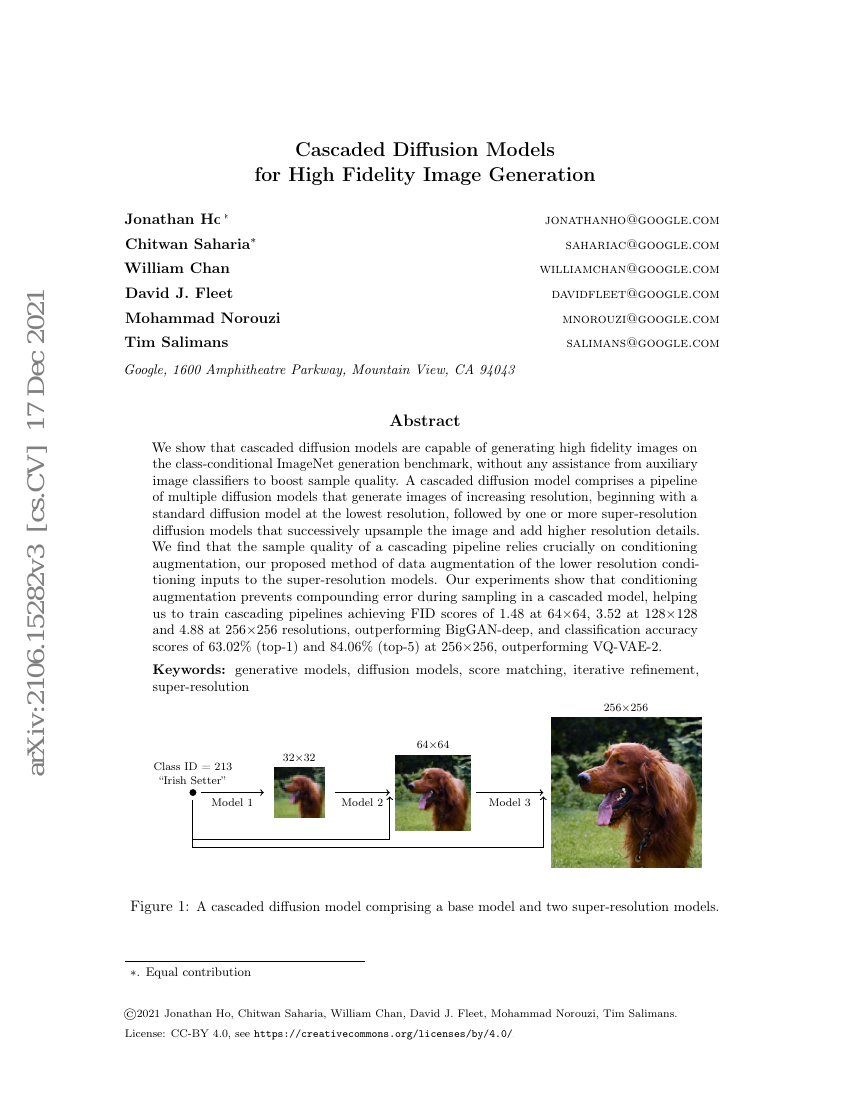
We show that cascaded diffusion models are capable of generating high fidelity images on the class-conditional ImageNet generation benchmark, without any assistance from auxiliary image classifiers to boost sample quality. A cascaded diffusion model comprises a pipeline of multiple diffusion models that generate images of increasing resolution, beginning with a standard diffusion model at the lowest resolution, followed by one or more super-resolution diffusion models that successively upsample the image and add higher resolution details. We find that the sample quality of a cascading pipeline relies crucially on conditioning augmentation, our proposed method of data augmentation of the lower resolution conditioning inputs to the super-resolution models. Our experiments show that conditioning augmentation prevents compounding error during sampling in a cascaded model, helping us to train cascading pipelines achieving FID scores of 1.48 at 64x64, 3.52 at 128x128 and 4.88 at 256x256 resolutions, outperforming BigGAN-deep, and classification accuracy scores of 63.02% (top-1) and 84.06% (top-5) at 256x256, outperforming VQ-VAE-2.
Code Repositories
Benchmarks
| Benchmark | Methodology | Metrics |
|---|---|---|
| image-generation-on-imagenet-128x128 | CDM | FID: 3.52 |
| image-generation-on-imagenet-256x256 | CDM | FID: 4.88 |
| image-generation-on-imagenet-64x64 | CDM | FID: 1.48 |
Build AI with AI
From idea to launch — accelerate your AI development with free AI co-coding, out-of-the-box environment and best price of GPUs.