Command Palette
Search for a command to run...
Northwestern University Publishes Monkey Face Recognition Paper and Makes Public 10 Animal Face Datasets
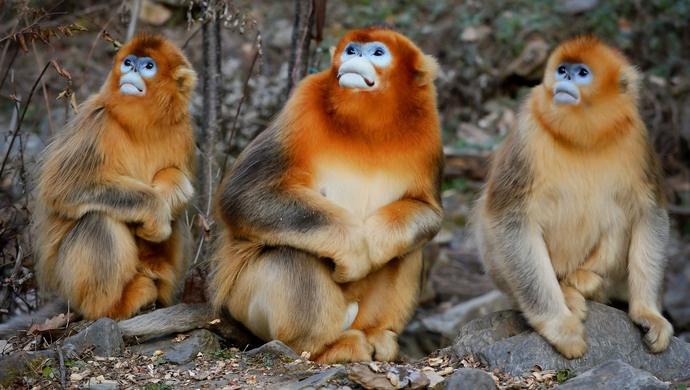
As human face recognition becomes more mature, researchers have begun to expand this technology to animal research. Recently, a research team from Northwestern University proposed a "monkey face recognition technology" that can not only identify golden snub-nosed monkeys, but also identify which monkey it is. This is of great significance for the protection of golden snub-nosed monkeys.
Deep in the mountains and forests of Sichuan, Shaanxi and Gansu in China, there lives a group of rare species. They are named "golden monkeys" because of their golden fur.
However, the beautiful fur makes the golden monkey family a target for poachers. In addition, human production activities such as tree felling and deforestation have also had a serious impact on the survival of golden monkeys, putting them in an endangered situation.

Using AI to get to know every golden monkey
According to investigations and estimates by relevant departments, there are currently about 39 wild golden snub-nosed monkey groups living in the Qinling Mountains, with a total number of about 5,000 individuals. It can be regarded as a star species second only to the national treasure giant panda.
The golden monkey research team of Northwest University has been conducting field tracking research on Qinling golden monkeys for a long time.
Although there are not many golden snub-nosed monkeys, research on them is fraught with difficulties. Most golden snub-nosed monkeys live in dense forests in high mountains, where their living environment is hidden and difficult to be discovered. They are also very sensitive to human approach and are difficult to approach. Therefore, there are still many unknown areas about golden snub-nosed monkeys.
How to accurately, quickly and non-destructively identify individual golden monkeys in the wild, and carry out further protection and research work based on this, is a difficult problem that zoologists around the world have always been eager to overcome.
Why is individual identification necessary? Professor Li Baoguo from the team explained:"Accurate individual identification is a key step in animal behavior research. Only by identifying the individual clearly can we observe individual behavior for a long time and then analyze social behavior."
Previously, the team had been relying on pure manual observation, going out early and returning late every day, and the observation time was as long as 10 hours. For a golden monkey, at least 600 hours of observation are required.

Who are the monkeys in the tree? Monkey face recognition can tell you
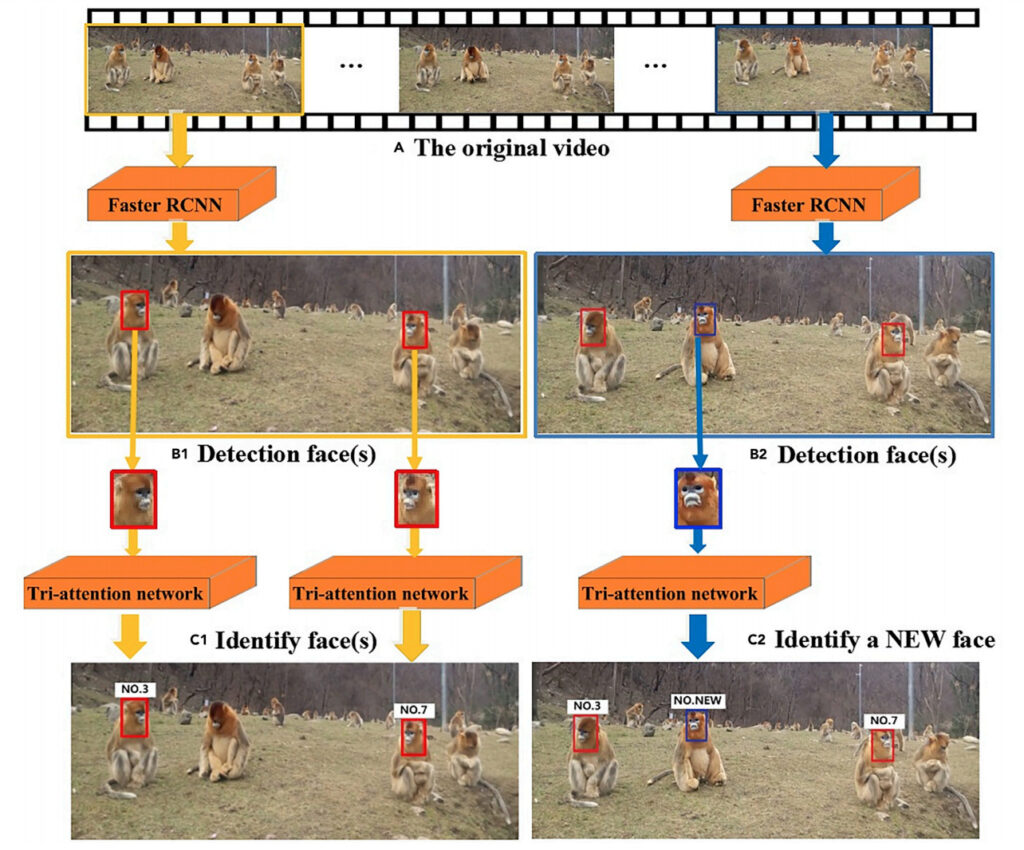
Based on the long-term research results on the characteristics of golden monkey species,The golden monkey research team of Northwestern University used the principles of neural networks to propose a deep neural network model with an attention mechanism, and developed the first animal individual recognition system - the Tri-AI system, which realizes automatic animal facial detection, recognition and tracking using animal videos or pictures.
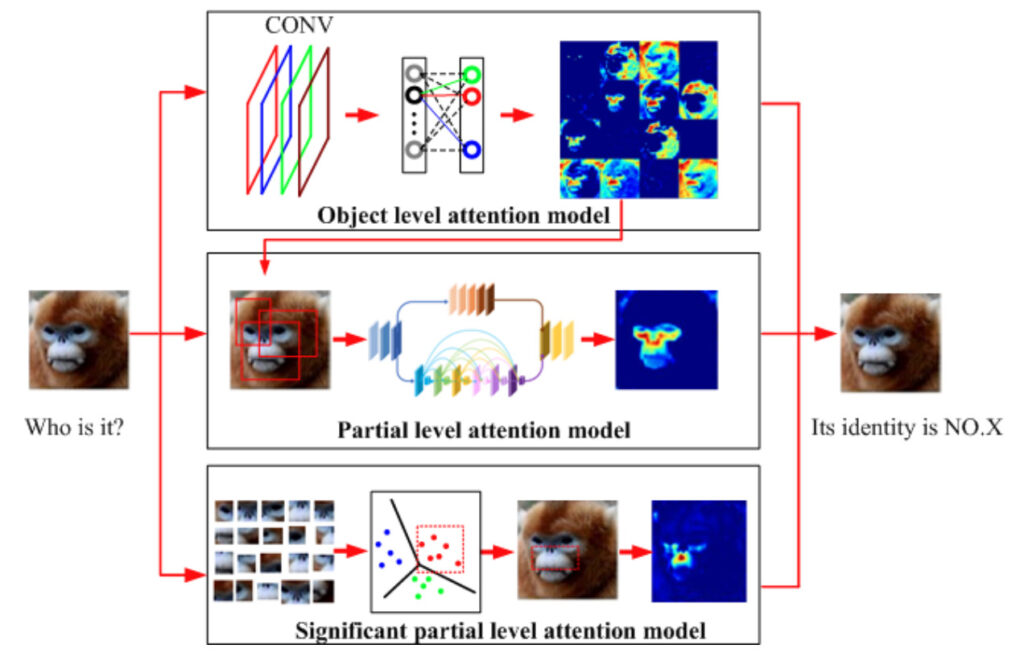
The former is limited to the characteristics of specific species and is difficult to use across species; the latter is not only costly, but also poses certain risks to animals and is not applicable to endangered species.
Different from these traditional methods,**The Tri-AI system achieves the functions of accurate identification and continuous tracking sampling of wild individuals "under ideal conditions and without interference from observers".**And the system has been proven to be scalable to multiple species, such as meerkats, lions, red pandas and tigers.
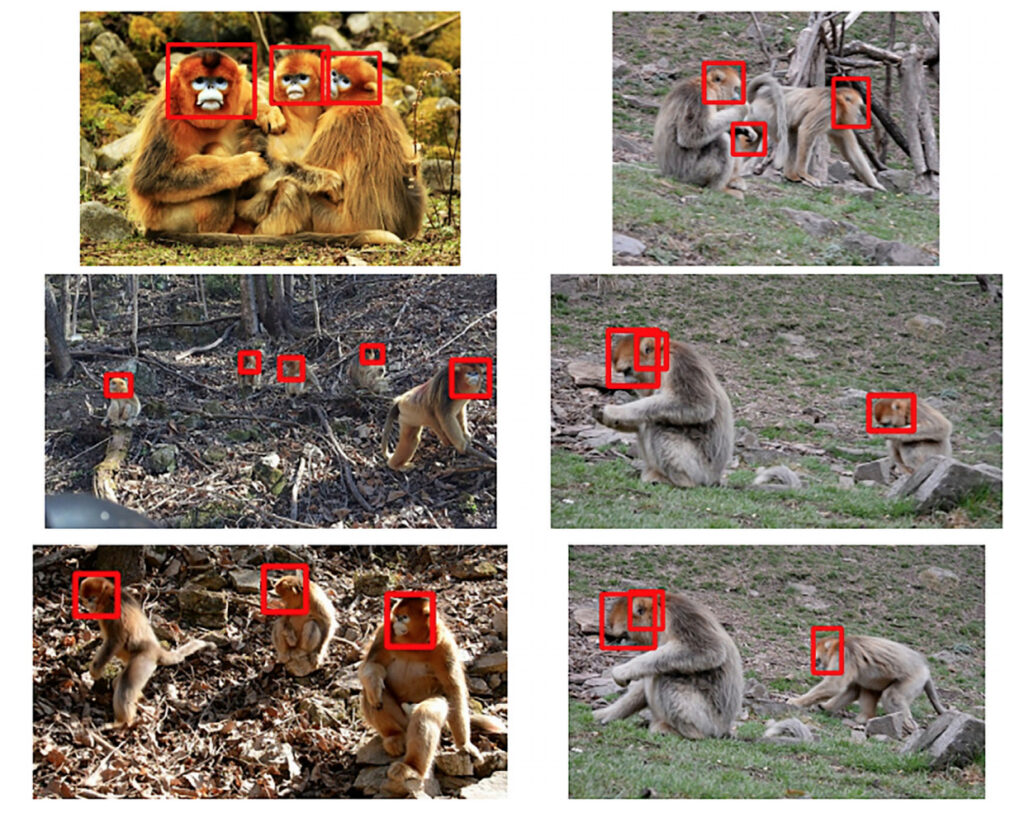
**At present, this research has entered the stage of application promotion.**On the one hand, the development of the "Animal Individual Identification" system (V1.0) has been preliminarily completed and used to identify and record multiple populations and thousands of individuals in many Qinling golden snub-nosed monkey distribution areas, and the work of establishing an individual information database for Qinling golden snub-nosed monkeys has begun;
On the other hand, this work further expands the application industry and scope, combines the different application scenarios and needs of identifying animals in the wild and in captivity, and develops personalized identification functions. It will also achieve refined management of animal protection, breeding, reproduction and research based on accurate animal identification.
41 species of primates, trained with over 100,000 images
In order to realize the function of this system, the most important thing is to provide a large amount of data for training.
According to the introduction,The training data they used included 102,399 images of 41 species of primates, with a total of 1,040 individuals; the test set included 6,562 images, including 4 species of carnivores and 91 individuals.
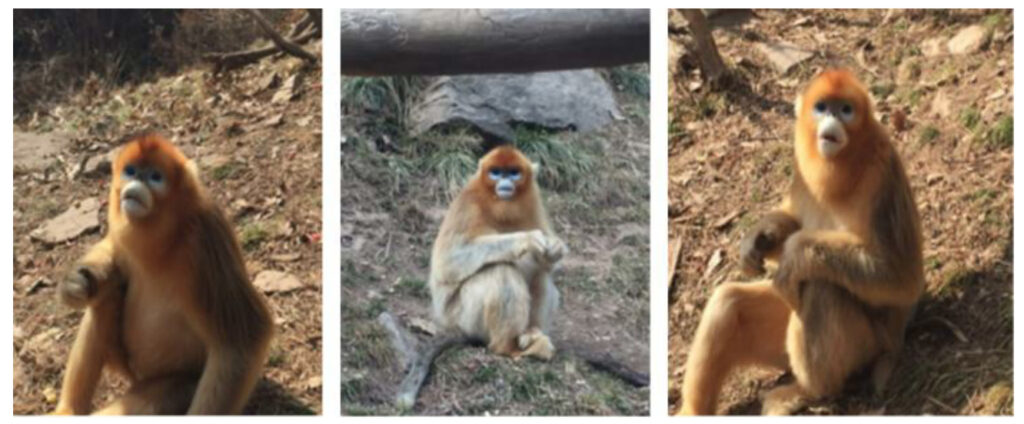
Here are the details of the dataset:
AFD Animal Face Dataset
**Publishing Agency:**Northwestern University
Release time: 2020
Data format:.jpg
**Data size:**377MB
**Animal Types:**10 types
Download address:https://orion.hyper.ai/datasets/14657
In addition to static images, the team also used 10 videos of golden snub-nosed monkeys to test the system. There were 22 golden snub-nosed monkeys in these 10 videos. The system detected and identified the golden snub-nosed monkeys frame by frame.
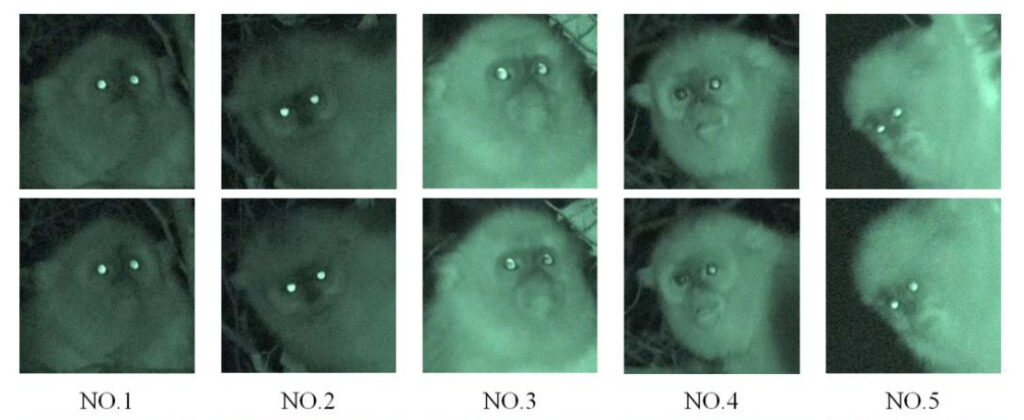
The Tri-AI system can not only be applied to different species in multiple groups, but can also process color and grayscale images, so whether it is daytime or nighttime photos, it can be observed unimpeded to meet the needs of researchers.
Animal facial recognition has a bright future
While human facial recognition has become ubiquitous, animal facial recognition technology has also quietly emerged.
Over the past decade, countries around the world have launched various animal face recognition research projects, including chimpanzees, tigers, giant pandas, cows and even fish (for fish face recognition, see"Japan's "AI Fish Face Recognition" project recognizes 100 fish faces per minute").
The use of artificial intelligence not only helps zoologists save a lot of time and experience, but also helps them understand the lives of these animal groups more comprehensively.
In addition, for farmers, AI technology can help them better monitor the health status of each animal, thereby reducing breeding costs and improving production efficiency.

But based on existing research, animal facial recognition has great potential in the future, whether it is applied to aquaculture or wildlife protection.