Command Palette
Search for a command to run...
Interviewed Three Students: They Write Code, Born After 1995, From Mainland China and Taiwan
The post-90s and post-00s were lucky enough to grow up in a favorable environment. They had the opportunity to access and understand the Internet in their youth, and grew up with the mobile era. As Internet natives, they have better learning resources, convenient development tools, and an open ecological environment, which also allows them to know what they want to do earlier and work hard for it.
Heroes have always emerged from youth, and the same is true in the field of technology.
1969UnixIt was born in AT&T Bell Labs, and soon after two UCBGraduate students****Bill Joy and Chuck Haley Improve it to the BSD version;
In 1991, aLinus Torvalds of Finnish boys return to school after military service and are studyingJunior yearHe publishedLinuxAn early version of
In 2004,Aaron Swartz, 18Together with John Gruber, he designed and published Markdown, which has become the most popular lightweight markup language on the Internet.
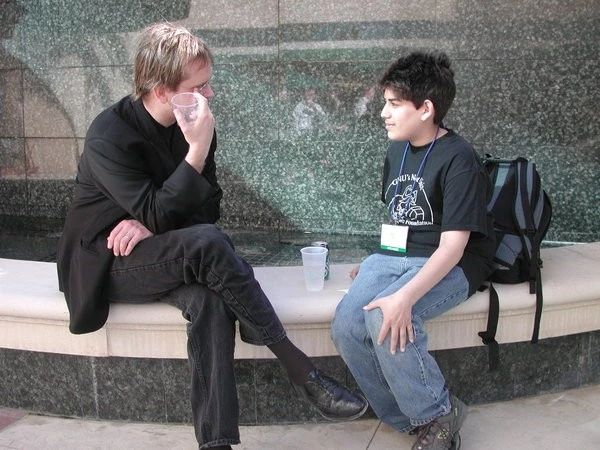
We interviewed three students born after 1995. They are obviously different: they are from the mainland and Taiwan, one is male and the other is female, and they have different research directions and personalities.
But they also have a lot in common: they are all young people born after 1995, all study computer science-related majors, and all love their research directions.
Tongji University's Wu Shaoling: Linus Torvalds is my idol
Wu ShaolingIntroduction
School: Tongji University
Department: Department of Computer Science, School of Electronic and Information Engineering
Research direction: Cloud computing and virtualization
Year of Birth: 1995
We passX-Lab Open Laboratoryproject, and saw Wu Shaoling from the vast crowd.
This is an innovation laboratory jointly founded by Tongji University and East China Normal University. The team is mainly composed of graduate students and doctors from the two schools. They hope to synchronize the world through open source and create valuable products.
Wu Shaoling is involved in the open source digital sociology project at X-Lab, in which he is involved in building aOpen Source RoboticsThe goal is to transfer all matters in open source projects that were originally managed by humans to robots. "We hope that this project can promote the development of open source, make open source work more automated, and lower the threshold for participating in open source."
In addition, he is responsible forGitCourse Open Source Work.
GitCourse is an online training tool that innovatively uses a Git-based content creation system and a Docker-based training environment system. It has been used on the Kung Fu Programming (kfcoding.com) platform. Now,He and his team members hope to open source GitCourse so that more people can experience interactive course learning..


Wu Shaoling said with emotion,Open source has been a great help to his learningHe gave an example, "I am currently building a FaaS platform. One reason is to meet the needs of graduate students' academic research, and the other is to build a FaaS platform that can support large-scale practical training scenarios and actually apply it to Kung Fu programming.
During this process, I read some papers, tried the FaaS services of AWS, Azure, and Alibaba Cloud, and built and tried some open source FaaS frameworks. Imagine if there were no open source frameworks, my understanding of FaaS would only stay at the level of theories in papers and usage documents of commercial platforms.With an open source framework, I can gain a deeper understanding of its principles and learn the design concepts behind it.”
As an open source participant, Wu Shaoling**I admire the legendary Linus Torvalds the most.**He said: "Linus's contribution to the Linux kernel is obvious to all, which is already a remarkable achievement. In addition, the development of open source Git has promoted the development of open source. These two contributions are enough to be admired."
In the future, Wu Shaoling said that he will continue to work in containerization and function computing in his current research field.
Taiwan cute girl Lin Jinghua: A post-95s who studies cryptocurrency
About Lin Jinghua
School: National Cheng Kung University, Taiwan
Department: Department of Information Engineering
Research direction: Cryptocurrency
Year of Birth: 1995
In Taiwan, where the open source community is booming, many students have also joined in.Lin Jinghua from National Cheng Kung UniversityandWang Zanjun from National Taiwan UniversityIs one of them.
Lin Jinghua, who has served as a volunteer for many open source annual conferences, occasionally likes to visit open source communities or participate in discussions. "It was a great experience to follow COSCUP to HKOSCON in Hong Kong in June this year!"
She and her classmate Wang Zanjun will also give a speech at COSCon'19 on the themeEnsure data integrity and trade your dataspeech.
According to Lin Jinghua, the reason for choosing this topic is that they have been studyingData trading and data market architecture designTherefore, we hope to take this opportunity to promote the concept of data market and analyze the current challenges.
In addition, they will explain to attendees how they use distributed ledgers to solve problems.

"We look forward to exchanging and discussing with experts from all walks of life, which may inspire better ideas," said Lin Jinghua.
Lin Jinghua said,**Open source has helped her a lot both in terms of technology and academics.**Whether it is the IOTA Foundation or the National Cheng Kung University Distributed Ledger Lab (DLTcollab), both teams attach great importance to community interaction and open source. Most projects are open source, and any problems can be discussed directly with engineers.
“I contributed to one of the IOTA Foundation projects last summer, entangled. It was also my first time to actually participate in a project that was not part of my course or my own. I was very nervous every time I submitted it, including the wording. Although I still made mistakes, the engineers were very patient in pointing them out and discussing them, which made meImprove your programming and collaboration skillsAt the same time, I also felt full of warmth. ”
At present, Lin Jinghua's learning direction mainly revolves around the application of cryptocurrency IOTA and the underlying distributed ledger technology. For example, the data market to be shared this time is built on IOTA.

Perhaps, every open source contributor is the same, full of gratitude to the predecessors. It is with their selfless sharing, guidance and encouragement that the younger generations have made continuous progress and breakthroughs, and have more powerful products.
Wang Zanjun of National Taiwan University: Refuse to be boastful and write code in a practical way
Introduction to Wang Zanjun
School: National Taiwan University
Department: Department of Information Engineering
Research direction: Blockchain and Internet of Things
Year of Birth: 1996
Like Lin Jinghua, Wang Zanjun also saw the COSCon call for papers on the COSCUP Open Source Annual Conference website. At that time, he and his team had achieved preliminary results in their research on decentralized data markets, and wanted to use this opportunity to communicate with more people and get more inspiration. So, in his words, "I am honored to be accepted."
He has participated in COSCUP events as a listener, and next month, he willFirst time attending the 2019 Open Source Annual Conference as a speaker"I am looking forward to meeting more experts and the latest technologies from home and abroad."
Wang Zanjun's current research interests focus onBlockchain and IoT, and open source has undoubtedly brought great help to his research. **“Most blockchain projects are open source.**It can help me understand the details of blockchain consensus algorithms, data structures, etc. Many IoT applications are also open source.It allows me to avoid reinventing the wheel during development and build on the foundation of my predecessors.”

At the end of the interview, Wang Zanjun thanked Professor Huang Jingqun of National Cheng Kung University and Professor Liao Shiwei of National Taiwan University for their guidance during his undergraduate and graduate school years, which enabled him to remember the basic attitude of being a person and doing things while learning new knowledge and doing research.
With such a grateful attitude, we conduct research and invest in open source projects. We have reason to believe that open source technology will develop more rapidly and the open source field will have a brighter future.
A generation will eventually grow old, but there will always be someone young.
As young people gradually enter the stage, perhaps one of them will be the next Linus.
Super benefits: 50 two-day tickets, all free
Do you want to get to know these students and learn about their work?
This weekend, the Open Source Annual Conference is about to take place. This two-day conference has invited more than 100 guests, includingThomas Dohmke, Vice President of GitHub , Vice President of Community Development, Apache Software Foundation Sharan Foga,General Manager of Microsoft China Cloud Computing and AI DivisionMak Chiu Chun, Founder & Chairman of CSDNJiang Tao and other important industry experts gave nearly a hundred in-depth content sharing sessions.
 As the fifth annual China Open Source Conference, it includes the following topics:Open source software, open source hardware, community operation and governance, open source educationThe conference also invited friends from various free/open source related companies and academia to attend this feast.Get the Super Neuro Collaboration Two-Day Ticket: Click to read the original article/scan the QR code to register directly (limited to 50 tickets)
 -- over--