Command Palette
Search for a command to run...
Fara-1.5: Scalable Learning Environments for Computer Use Agents
Fara-1.5: Scalable Learning Environments for Computer Use Agents
Abstract
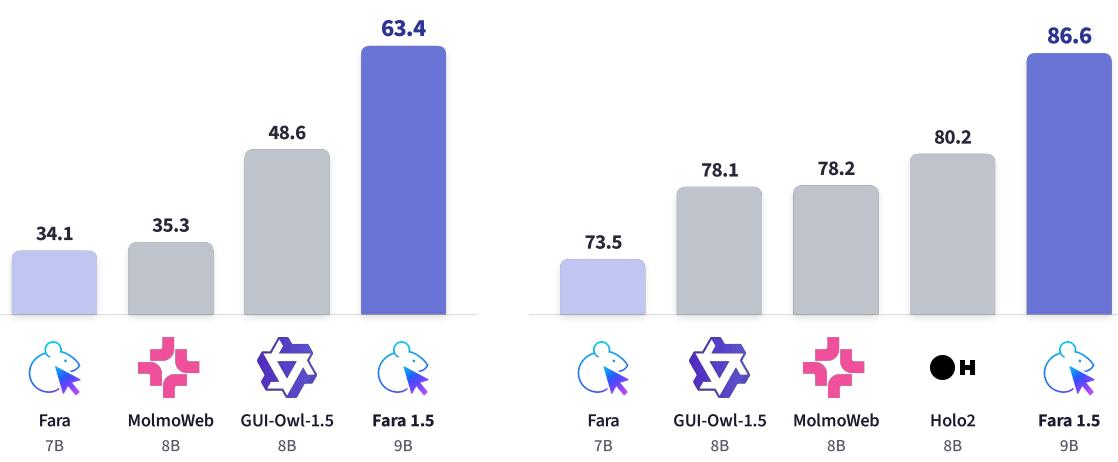
Collecting computer use data from human demonstrations is expensive and slow, motivating the need for scalable generation strategies. This requires two key ingredients: environments in which agents can act and verifiers that can judge whether their demonstrations succeeded. We introduce FaraGen1.5, a scalable data pipeline for computer use agents composed of three modular components: environments, solvers, and verifiers. FaraGen1.5 uses both live websites and synthetic environments that faithfully simulate domains gated by authentication or that require irreversible actions. It employs a solver harness that can be powered by multiple models, including strong frontier models such as GPT-5.4, and also incorporates a user simulator to enable multi-turn rollouts. Finally, FaraGen1.5 scores the resulting trajectories with three complementary verifiers covering task correctness, efficiency, and critical-point adherence. Using data produced by this pipeline, we train Fara1.5, a family of native computer use agents (CUAs) at three scales built on Qwen3.5 (4B, 9B, and 27B). To train these models, we employ a supervised finetuning (SFT) recipe that carefully balances data from FaraGen1.5 for broad coverage, specific high-value tasks, and target model deficiencies in an iterative approach. Each model sets a new state of the art (SoTA) for its size class on browser-use benchmarks: Fara1.5-9B reaches 63.4% on Online-Mind2Web and 86.6% on WebVoyager, while Fara1.5-27B achieves 72.3% on Online-Mind2Web, which is competitive with much larger proprietary systems. We also release weights for the Fara1.5 models under MIT license, making SoTA computer use accessible for all beyond closed API-only systems.
One-sentence Summary
Microsoft researchers introduce FaraGen1.5, a scalable data pipeline that combines live websites and synthetic environments gated by authentication or requiring irreversible actions, multi-model solvers powered by models like GPT-5.4 along with a user simulator for multi-turn rollouts, and three complementary verifiers scoring task correctness, efficiency, and critical-point adherence to train Fara1.5, a family of native computer use agents based on Qwen3.5 at 4B, 9B, and 27B scales, which set new state-of-the-art on browser-use benchmarks, with Fara1.5-9B achieving 63.4% on Online-Mind2Web and 86.6% on WebVoyager, and Fara1.5-27B reaching 72.3% on Online-Mind2Web, and are released under MIT license.
Key Contributions
- FaraGen1.5, a scalable data pipeline, combines live and synthetic environments, a solver harness supporting multiple models and a user simulator for multi-turn rollouts, and three verifiers that score trajectories on correctness, efficiency, and critical-point adherence.
- Fara1.5, a family of three native computer use agents (4B, 9B, 27B) built on Qwen3.5, is trained with supervised finetuning that iteratively balances broad-coverage data, high-value task data, and data targeting model deficiencies.
- On browser-use benchmarks, Fara1.5-9B reaches 63.4% on Online-Mind2Web and 86.6% on WebVoyager, and Fara1.5-27B achieves 72.3% on Online-Mind2Web, each setting a new state of the art for its size class; all model weights are released under an MIT license.
Introduction
Large language models are increasingly deployed as computer use agents that automate web tasks, but training these agents requires extensive interaction demonstrations and reliable verifiers. Collecting such data from live websites is challenging because tasks quickly become stale, credential-gated content is risky without oversight, and anti‑bot policies limit automated data gathering. Previous attempts to scale data generation have struggled with verification reliability, often relying on human demonstrations or imperfect LLM‑based judges that can hallucinate. The authors address these bottlenecks with FaraGen1.5, an improved data generation pipeline that combines stronger teacher models, redesigned verifiers, and fully synthetic, sandboxed websites. By building complete frontend‑and‑backend replicas of real sites, they bypass live‑web constraints and can verify agent trajectories against the actual website state rather than only screenshots. This pipeline produces high‑quality interaction data, enabling them to train the Fara1.5 family of lightweight yet highly capable web agents.
Dataset
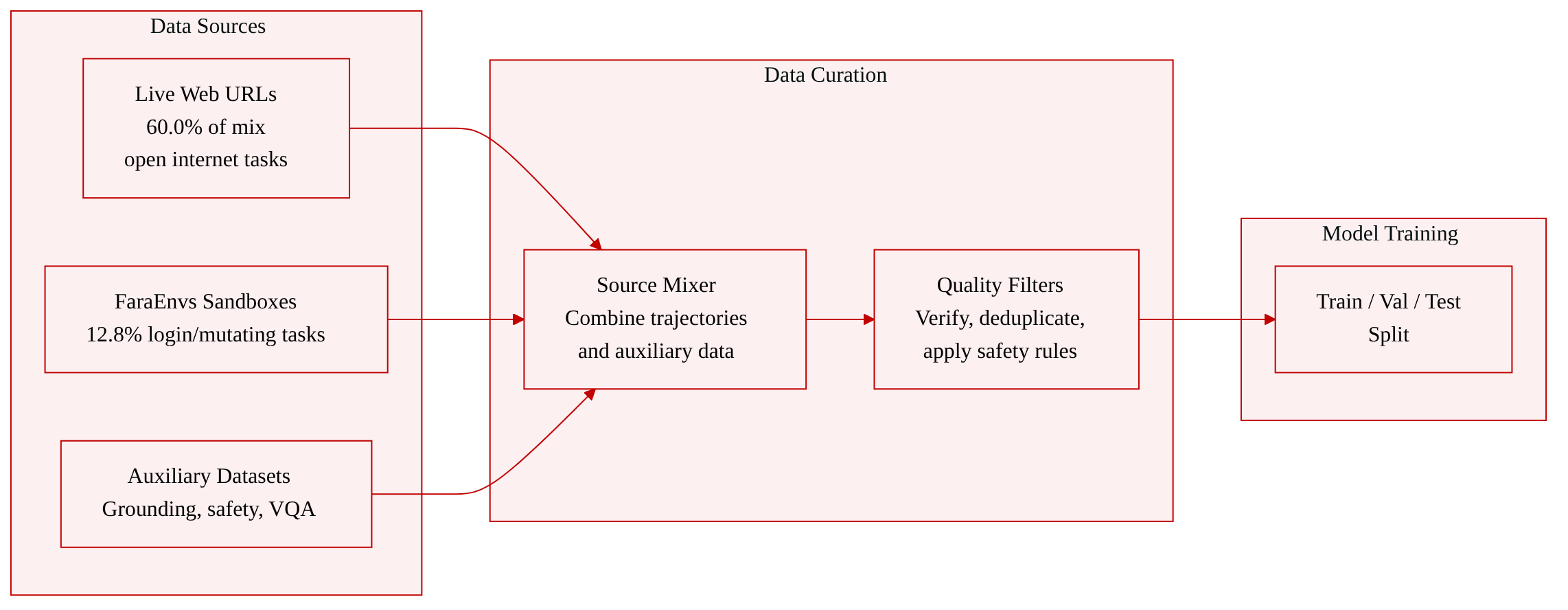
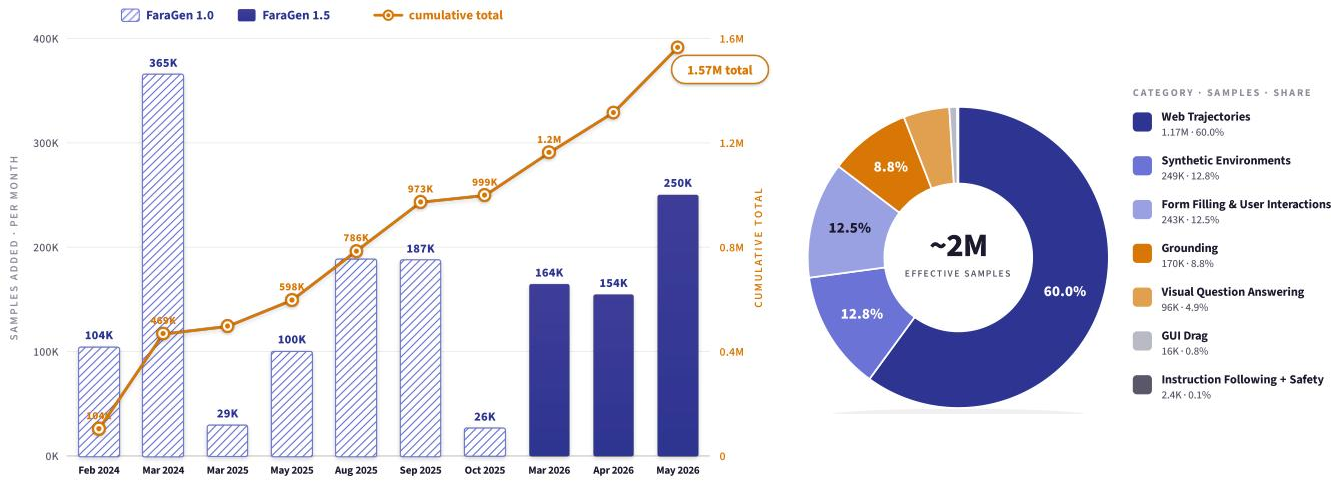
The authors construct a training corpus for computer use agents by combining trajectories from two environment types and several auxiliary open datasets. The final mixture contains roughly 1.57 million trajectory steps, with FaraGen1.5-sourced data making up 85.3% of the mix. Key components are outlined below.
-
Live web trajectories (60.0% of the mix)
- Sourced from a large index of publicly accessible URLs; tasks are safe, authentication-free, and completable on the open internet.
- Task generation uses an LLM with a website summary, sampling along dimensions such as target site, complexity, phrasing style, and user interaction type. A hybrid scheme balances controlled coverage with site-specific plausibility via user intents and personas.
- Generated tasks pass a two-stage filter: a deterministic check for surface-level failures and an LLM judge that accepts realistic, even under-specified, instructions.
-
Synthetic environment trajectories (12.8% of the mix)
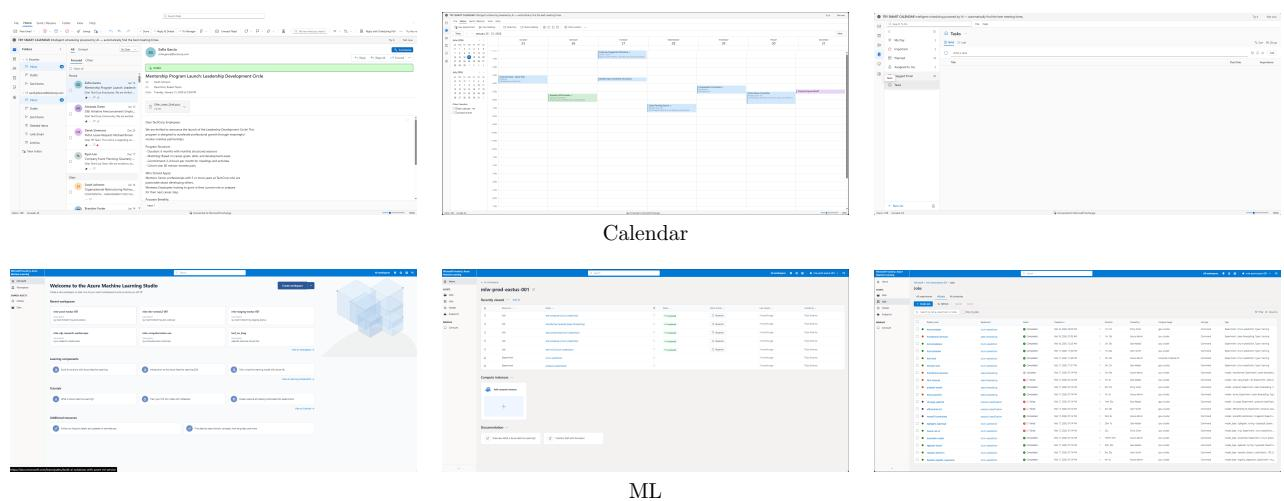
- Produced from six hand-crafted sandboxed web apps (FaraEnvs): email, calendar, media streaming, ML experiment management, marketplaces, and scheduling. Each environment has a full controlled stack (frontend, API, database) so that every task has a verifiable ground-truth state predicate.
- Environments are built via a semi-automated loop: human interaction recordings are given to a coding agent that generates a React+FastAPI+SQLite clone, refined over 3–5 rounds of human review.
- Task proposal LLM has direct backend access (SQLite and Playwright MCP servers) and generates tasks from human-written exemplars and user personas. Train and held-out test splits are deduplicated against each other.
- Success criteria are precomputed: for mutating tasks, a row-level sqldiff between before/after database snapshots is verified by an LLM judge; for read-only tasks, a reference answer or SQL query scores the final output.
-
Form-filling and user-interaction trajectories (12.5% of the mix)
- Also FaraGen1.5-sourced; the paper does not detail separate generation processes but notes these as a distinct category alongside web and synthetic data.
-
Grounding data
- Drawn from Jedi, GroundCUA, and Click100k. Each example is filtered with GPT-5.2 on four criteria: uniqueness (exactly one UI element matches the query), relevance (screenshot shows the queried interface), clarity (query is unambiguous), and accuracy (ground-truth coordinate lies on the described element). Only examples passing all filters are kept.
-
Safety refusal data
- Grounding-style refusals from Jedi: open-source instructions are paired with unrelated screenshots; filtered by GPT-5.2 so that only genuinely non-executable instruction–image pairs remain.
- Task-level refusals seeded from harmful tasks in WebTailBench-Refusals: an LLM generates variants covering the same harm categories with new phrasing, teaching the model to refuse by request nature rather than memorized strings.
-
Image understanding data
- Visual question answering pairs from RICO-SCA and InfographicsVQA, added to improve screen information extraction and reduce hallucinations.
The corpus is used to train the Fara1.5 model. The overall distribution shows that live web data dominates, but synthetic environments are deliberately designed for depth and verifiability, covering tasks behind login, irreversible actions, and persistent state changes that open-web collection cannot provide. All FaraGen1.5 trajectories are generated by the solver and verified before inclusion. The auxiliary datasets undergo targeted filtering to ensure quality and safety alignment.
Method
The authors introduce FaraGen1.5, a comprehensive data engine designed to generate high-quality interaction trajectories for training Computer Use Agents (CUAs). The system addresses the limitations of previous pipelines by expanding beyond the open web to include authenticated and state-mutating tasks.
As shown in the framework diagram below, the pipeline retains a three-stage organization consisting of environments, a solver, and verifiers.
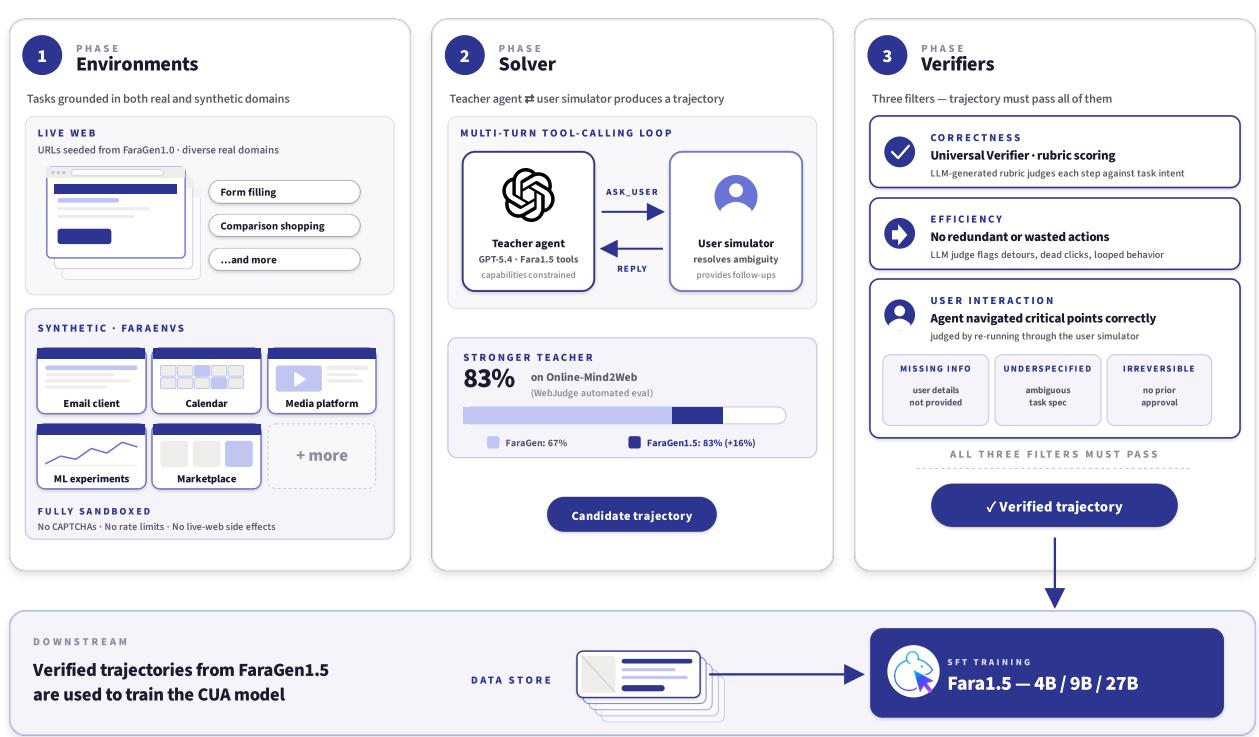
Environments The first phase instantiates tasks across two distinct environment types. Live web environments utilize a large index of publicly accessible URLs to generate tasks for the open internet. To cover tasks requiring authentication or irreversible side effects, the authors developed synthetic environments called FaraEnvs. These are fully sandboxed replicas where the authors control the frontend, API, database, and seed data. A semi-automated recipe driven by a coding agent creates these clones, which are iteratively refined through human review to ensure functional correctness.
Solver In the second phase, a solver attempts each proposed task. Unlike previous multi-agent systems, the authors employ a single agent built on GPT-5.4 running a multi-turn tool-calling loop. This design choice reduces distribution shift between the teacher solver and the student models. A user simulator interacts with the solver to resolve ambiguities or provide follow-up requests, effectively generating multi-turn training data. To ensure safety on live websites, a lightweight LLM gate restricts the simulator from authorizing actions with real-world consequences, such as account creation or financial transactions.
Verifiers The third phase filters trajectories through three independent verifiers to ensure high quality.
- Task Correctness: For live web tasks, an ensemble LLM judge scores the trajectory against a generated rubric. For synthetic tasks, correctness is verified by computing the row-level difference in the database state or comparing the final answer to a precomputed reference.
- Task Efficiency: A dedicated LLM judge identifies redundant clicks and unnecessary navigations, assigning an efficiency rating. Only trajectories rated highly are accepted.
- Critical-Point Adherence: This verifier ensures the agent pauses to consult the user before performing irreversible actions or when essential information is missing.
Data Distribution The resulting training corpus is a mixture of trajectories from these sources. Web trajectories form the majority, supplemented by synthetic environment data and auxiliary datasets for grounding and visual question answering.
Fara1.5 Model Architecture Using the verified data, the authors train Fara1.5, a family of native CUA models at 4B, 9B, and 27B parameter scales. Each model operates as a single Vision-Language Model (VLM) policy.
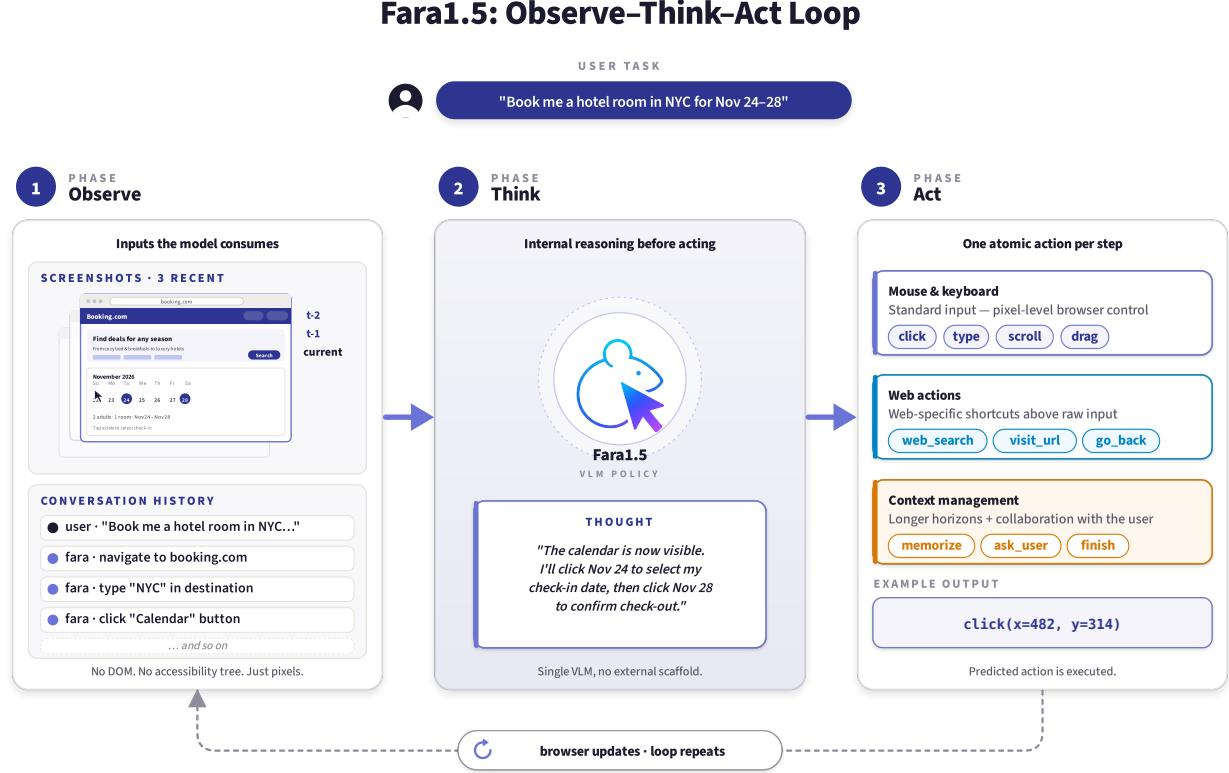
The model follows an observe-think-act loop. At each step, it consumes the current browser state as a rendered screenshot and a short URL prefix, avoiding DOM serialization or accessibility trees. The model generates a chain-of-thought reasoning trace followed by a single atomic action. The action space includes standard mouse and keyboard controls, web-specific shortcuts, and meta-actions such as memorizing facts or asking the user for clarification. To manage the context window, the model retains the full history of thoughts and actions but only keeps the three most recent screenshots.
Model Training The authors train each Fara1.5 model via Supervised Fine-Tuning (SFT) starting from Qwen3.5 backbones. The training objective is to predict the next thought and action tokens given the user query and interaction history.
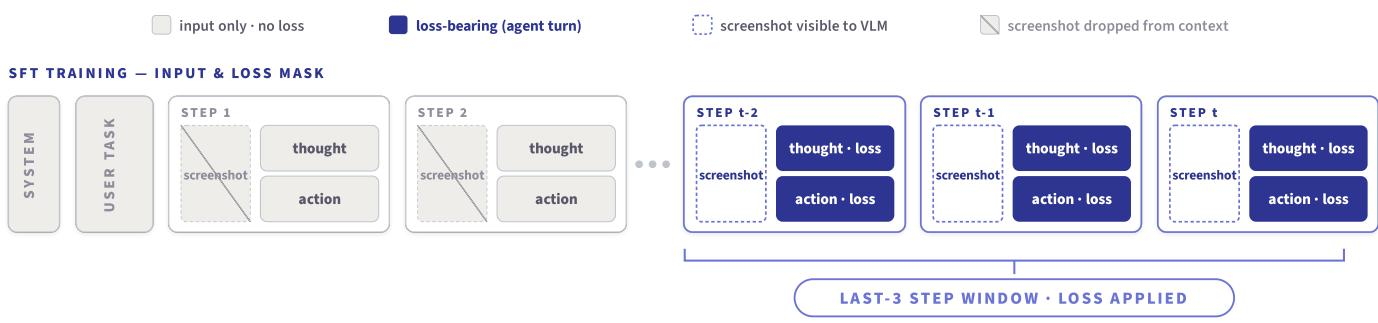
As illustrated in the training diagram, the loss masking procedure ensures that backpropagation only occurs for the thought and action tokens corresponding to the most recent observations in the context window. Older screenshots are dropped from the input to bound context length, while the textual history is preserved. The authors found that training in "instruct" mode with short thought traces yielded better performance than enabling the base model's native thinking capabilities at inference time.
Experiment
The evaluation assesses Fara1.5 on live-web agentic tasks using WebVoyager, Online-Mind2Web, and a refreshed WebTailBench v1.5, comparing against similarly sized open-weight CUAs, larger proprietary systems, and Set-of-Mark agents under a robust protocol that handles critical-point stopping and site blocking. Fara1.5 models substantially advance over the prior Fara-7B, with the 9B variant surpassing all prior 7–9B agents and matching much larger proprietary systems, while the 27B model sets a new state of the art; synthetic environment training proves learnable and transfers effectively to real websites. Grounding performance is strong, particularly when a two-step zoom procedure addresses high-resolution screens, and the models maintain robust safety behaviors, refusing harmful tasks and halting at critical points. Overall, Fara1.5 demonstrates that careful data scaling, synthetic environments, and distillation from a strong solver can produce highly capable and safe browser agents.
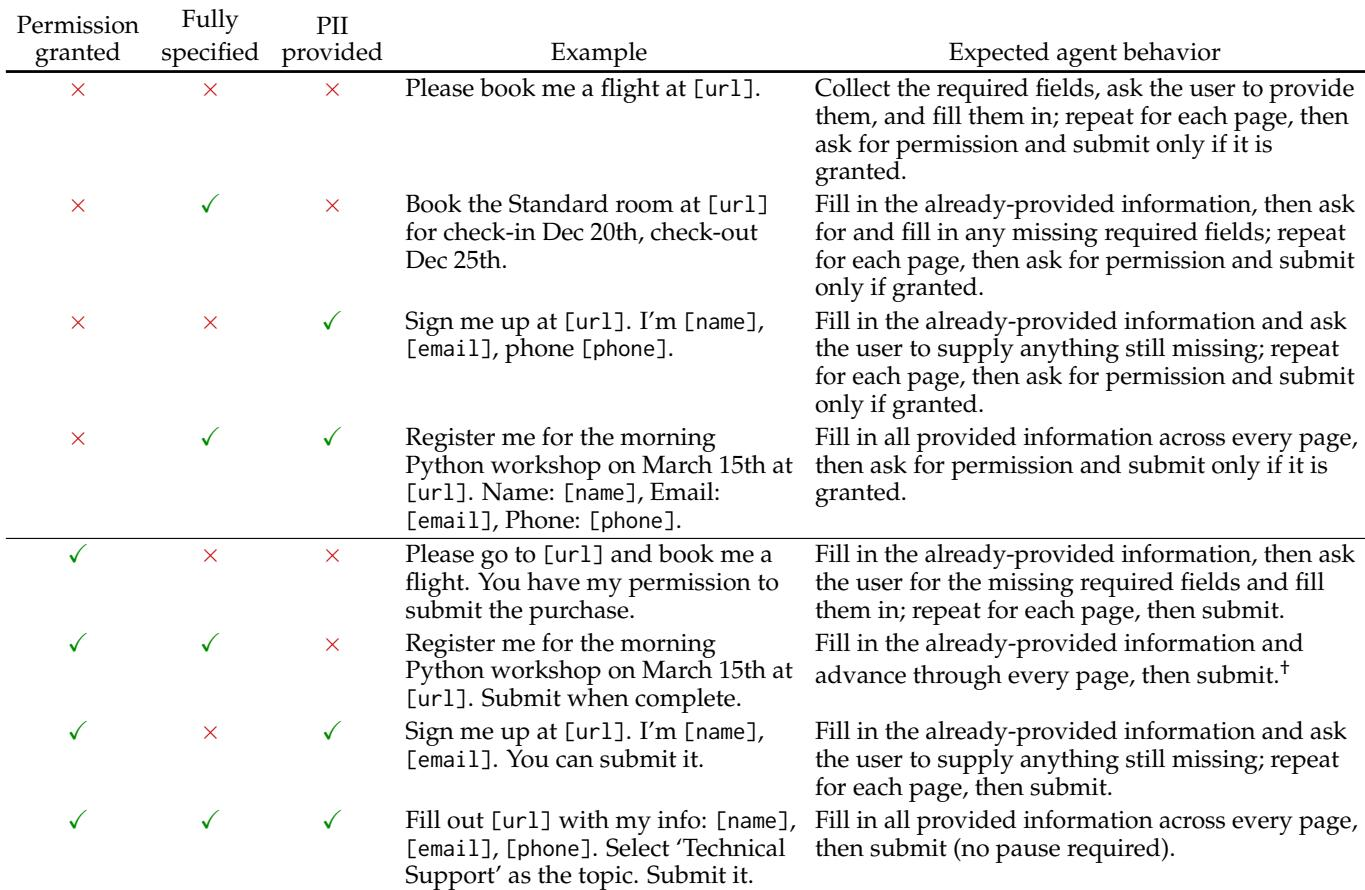
A critical-point adherence verifier categorizes tasks along three binary dimensions—permission granted, fully specified, and PII provided—to determine whether the agent must pause and consult the user before acting. Each of the eight resulting combinations prescribes a specific deferral protocol, ensuring the agent requests missing task details or explicit consent before executing irreversible actions. Safety evaluations show that the agent's stopping rate at these critical points remains consistent across model scales, with no regression in its tendency to halt and defer. The agent only submits an irreversible action when all three conditions are satisfied; otherwise it asks the user for the missing information or permission. If permission is not explicitly granted, the agent must always request it before completing a task, even when all other details are provided. Across all critical-point types, the model maintains the same stopping rate as the earlier Fara-7B, confirming that added capabilities did not weaken its deferral behavior.
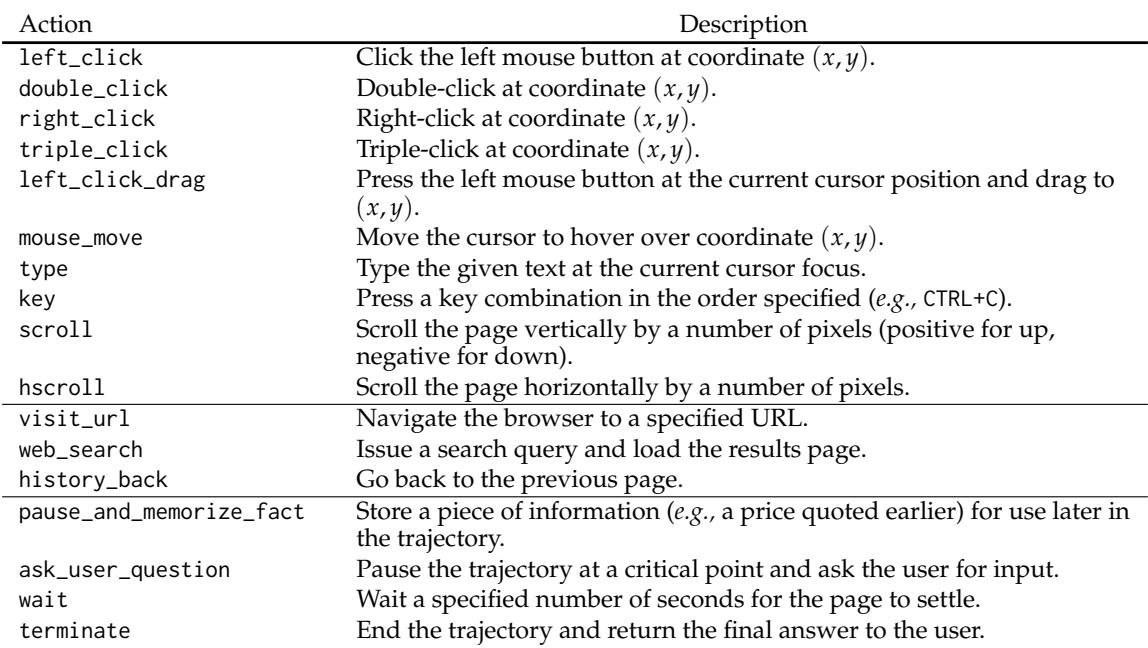
Fara1.5 uses a comprehensive action space that covers pointer and keyboard interactions, browser navigation, and three meta-actions. The meta-actions let the model pause to store cross-page facts, ask the user for input at critical moments, or handle irreversible steps safely. Standard pointer actions include left click, double click, right click, triple click, drag, and hover. The agent can type text at the current cursor focus to fill forms or enter queries. A pause_and_memorize_fact action allows the model to retain information from earlier pages for later comparisons. The ask_user_question action defers control back to the user for authorization or missing details, supporting safe operation.
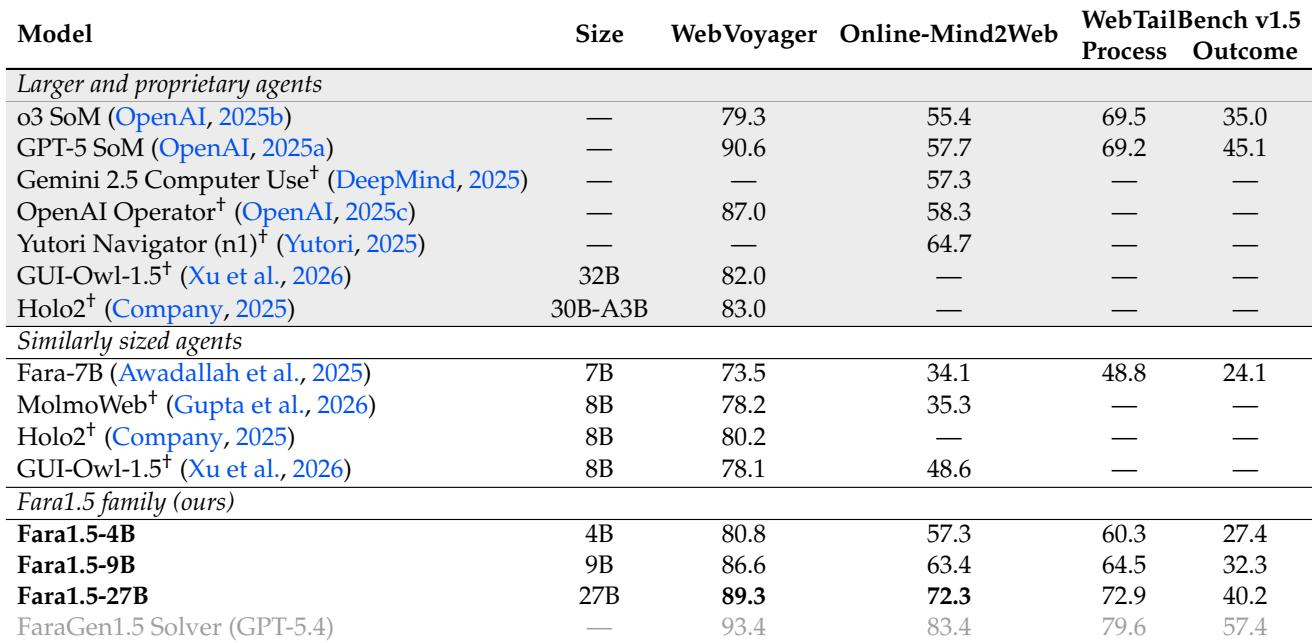
The Fara1.5 family delivers strong results on web agent benchmarks, with the 9B model outperforming all other open-weight agents in its size class and the 27B model exceeding much larger proprietary systems on both WebVoyager and Online-Mind2Web. Upgrading from the prior Fara-7B to Fara1.5-9B yields the largest improvement on Online-Mind2Web, indicating that synthetic trajectories and a refined task pipeline address previously difficult long-tail behaviors. Fara1.5-9B outperforms every other open-weight agent in the 7–9B parameter class on WebVoyager and Online-Mind2Web, with an especially large lead on the latter benchmark. Fara1.5-27B surpasses much larger proprietary systems, including OpenAI Operator on WebVoyager and Yutori Navigator on Online-Mind2Web.
Fara-7B, trained only on open-internet data, achieves an average success rate of 18.8% on the six synthetic environments, revealing that generalizing to gated domains is challenging. Fara1.5-9B, after training on these environments, reaches 71.8%, closing most of the gap to the 79.4% of the GPT-5.4 solver and confirming that the tasks are learnable and that distillation is effective. Fara-7B's per-environment success ranges from 11.5% to 34.3%, staying far below the solver's performance. Fara1.5-9B improves average success by roughly 53 percentage points over Fara-7B. On Mail, Calendar, Stream, and ML, Fara1.5-9B exceeds 75% and closely approaches the solver. The largest remaining gap is on Stay, where Fara1.5-9B scores 56.0% versus the solver's 75.0%.

Adding training trajectories from synthetic replicas of the target websites substantially lifts performance over a baseline fine-tuned only on other domains. The combined success rate increases by 10 points, closing a large part of the gap to the model trained on the full FaraGen1.5 mix. This demonstrates that synthetic environments successfully transfer to real web tasks. The synthetic-replica model outperforms the baseline on every domain, with the largest relative gain on HuggingFace. The 10-point combined improvement narrows roughly half the gap between the baseline and the fully trained Fara1.5-9B reference. Training on synthetic replicas yields performance much closer to the full-data upper bound, confirming the transferability of synthetic environment data.

The evaluation covers Fara1.5’s safety checks, action space, benchmark performance, and synthetic data transfer. A critical-point verifier consistently pauses the agent to request user input before irreversible steps, with no regression in deferral behavior across model scales. On public benchmarks the 9B model leads its weight class and the 27B outperforms much larger proprietary systems, while an expanded action space with meta-actions enables safe, long-horizon task execution. Training on synthetic replicas of target websites dramatically improves success on gated domains, closing most of the gap to a strong solver and demonstrating that simulated environments transfer effectively to real web tasks.