Command Palette
Search for a command to run...
Words Caught in the Heart: Simulating Person-Specific Expression for Self-Opaque Clients in Psychotherapy
Words Caught in the Heart: Simulating Person-Specific Expression for Self-Opaque Clients in Psychotherapy
Abstract
Psychotherapy clients may experience distress before they can coherently describe it, and their expression changes with emotion, perceived safety, and trust. Large language model-based client simulators often rely on clinically organized case descriptions, which can encourage responses explaining the client’s dificulties more clearly than their current understanding warrants. We propose Pandora, a psychotherapy client simulation framework that models how psychological experience becomes situated, individual expression. Pandora updates psychological and relational states in response to therapist interventions, constructs subjective appraisals and attributions, and plans response content and strategy. A separate expression planner combines these decisions with language patterns distilled from the client’s utterances to guide linguistic realization. We evaluate Pandora against five baselines on 115 cases from four counseling and motivational interviewing datasets. It achieves the highest expression similarity and overall disclosure-alignment score among the compared systems. In a four-evaluator study of 45 matched disclosure items, Pandora receives AI-like judgments in 7.2% of ratings, compared with 43.3–67.2% for the baselines and 35.6% without expression planning. The ablation also reduces expression similarity. These results support explicit expression planning in client simulation to improve alignment with individual language patterns and reduce perceived AI-like expression in the evaluated setting.
One-sentence Summary
Researchers at Wuhan University and collaborating institutions propose Pandora, a psychotherapy client simulation framework that models situated individual expression by updating psychological and relational states, constructing subjective appraisals and attributions, and using a separate expression planner distilled from client utterances; evaluated on 115 cases from four counseling and motivational interviewing datasets against five baselines, Pandora achieves the highest expression similarity and overall disclosure-alignment score and, in a four-evaluator study of 45 matched disclosure items, receives AI-like judgments in 7.2% of ratings, compared with 43.3 to 67.2% for the baselines and 35.6% without expression planning.
Key Contributions
- Pandora is a psychotherapy client simulation framework that updates psychological and relational states in response to therapist interventions, constructs subjective appraisals and attributions, and plans response content and strategy.
- A separate expression planner combines these decisions with language patterns distilled from the client’s utterances to guide linguistic realization, separating what the client understands and intends to communicate from how that understanding is expressed in each exchange.
- In evaluations on 115 cases from four counseling and motivational interviewing datasets, Pandora achieves the highest expression similarity and overall disclosure-alignment score among five baselines; human assessment of 45 matched disclosure items rates Pandora as AI-like in 7.2% of ratings, compared with 43.3–67.2% for baselines and 35.6% without expression planning, while ablation also reduces expression similarity.
Introduction
Realistic client simulation matters for psychotherapy training and evaluation because clients often express concerns tentatively, incompletely, or through concrete incidents before they can articulate a coherent explanation. Prior client simulators typically rely on clinician-oriented case formulations, cognitive and relational profiles, or style labels, which can make simulated responses more explanatory and coherent than a real client's current understanding. The authors propose Pandora, a framework that explicitly models the transition from psychological experience to situated individual expression. It separately plans subjective appraisal and attribution, response content and stance, and linguistic realization using language patterns distilled from the client's own utterances. In evaluations across 115 counseling and motivational interviewing cases, Pandora achieves higher expression similarity and disclosure alignment while reducing perceived AI-like expression compared with five baselines, and removing expression planning degrades fidelity.
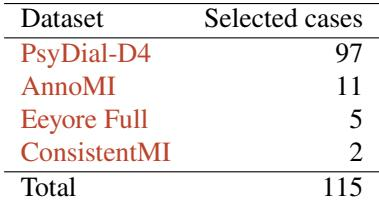
Dataset

The authors collect an evaluation dataset from existing counseling dialogue resources, selecting material that can reveal both client disclosure content and how disclosure unfolds through interaction.
- Total composition: 115 cases, with 97 Chinese dialogues and 18 English dialogues.
- Source breakdown:
- 97 cases from PsyDial-D4
- 11 cases from AnnoMI
- 5 cases from Eeyore Full
- 2 cases from ConsistentMI
- Filtering and processing: after semantic screening, exact duplicates and near duplicates are removed from the collected material.
- Purpose in the paper: the selected dialogues provide reference trajectories for evaluating disclosure timing, content organization, and individual expression across turns.
- Documentation: Table 1 summarizes the source composition and the full retrieval and assessment procedure is detailed in Appendix C.
Method
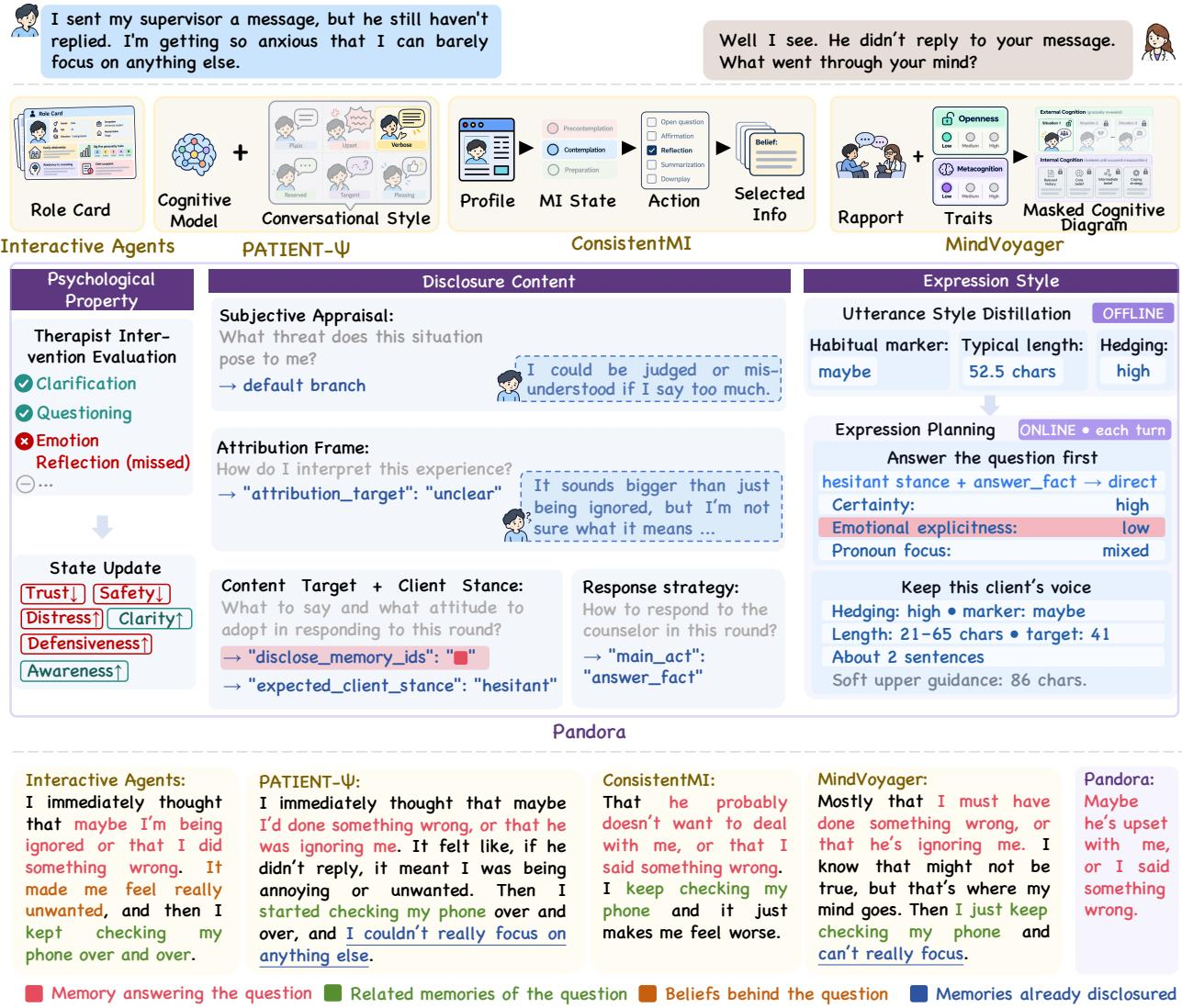
The authors propose Pandora, a psychotherapy client simulation framework that models the transformation of psychological experience into situated speech. Drawing on the distinction between conceptual preparation and linguistic formulation in speech production, the framework connects three modeling tasks: representing the client's evolving experience, planning a response from the client's subjective perspective, and realizing that response in the client's individual voice. At turn t, the inputs include the therapist utterance xt, preceding dialogue Ht−1, previous psychological state st−1, case material Mt, and an individual language profile ρ. The case material contains memories and events available at the current dialogue point, separating the case information from the client's evolving understanding and manner of expressing it.
Refer to the framework diagram below:
The modular process begins with Therapist Intervention Evaluation and State Update. This module provides a persistent representation of the client's experience of the interaction. A rule-based evaluator identifies opportunities for clarification, questioning, and emotional reflection, along with their use in the therapist's utterance. The resulting intervention signal represents the techniques used and how they address the conversational context, including opportunities left unaddressed. The state distinguishes affective, relational, defensive, and reflective dimensions, allowing willingness to disclose and capacity to articulate an experience to vary separately. Bounded rule-based transitions combine intervention-related and memory-related increments with the preceding state to guide subsequent planning.
Next, the Subjective Appraisal and Attribution module turns the updated state and case material into the perspective from which the client speaks. Subjective appraisal at represents what an experience means to the client, including its emotional significance, perceived threat, and implications for the self. Attribution bt represents how the client currently explains the experience. Both are constructed using the updated state, case material, and intervention signal, distinguishing the explanatory information in a case from the account the client can currently formulate.
The Content Target, Client Stance, and Response Strategy module organizes the subjective account into a response to the current therapist turn. A content plan dt represents available case content and client stance, while a response-act plan rt specifies the immediate conversational purpose:
Ct=(at,bt,dt,rt).The content plan carries memory identifiers and a stance such as hesitant, defensive, or open, determined by the updated state and intervention signal. The response strategy makes the plan responsive to the therapist's utterance. Factual questions favor an answer first with limited introspection, while reflections invite confirmation. Separating response purpose from stance allows a hesitant client to answer a question directly while expressing uncertainty about its psychological meaning.
Individual Expression Planning translates the semantic plan into realization guidance for the particular client. It combines a stable individual language profile distilled offline from the client's utterances with the psychological and conversational conditions of the current turn:
Lt=Frealize(st,Ct,Ht−1,ρ).Offline utterance style distillation summarizes habitual discourse markers, hedging, emotional explicitness, and length distributions. Online expression planning specifies speech style, pronoun focus, certainty, and length targets based on the client stance and response strategy. This combination preserves the client's voice while adapting expression to the current exchange.
Finally, in Response Generation and Execution, a client LLM realizes the intermediate plans as a natural language utterance. Its prompt combines the psychological context, subjective appraisal, content plans, and linguistic realization plan with the client profile and interaction instructions. Content targeting and claim verification track the expression of case material across turns to support the next planning cycle.
Experiment
Across 115 automatically scored cases and 45 human-judged disclosure items, the study tests whether Pandora’s explicit expression planning improves client voice, what it adds beyond preceding psychological and content planning, and whether disclosure structure remains faithful. The full system achieves the highest expression similarity and the lowest AI-like judgment rate, while ablating expression planning preserves disclosure organization but sharply reduces expression fidelity and increases perceived AI-like style. The results indicate that content and expression planning serve distinct roles and that coordinating disclosure timing, dependencies, and individual linguistic realization is necessary for more authentic client simulation.
The curated case collection contains 115 dialogues after semantic screening and cross-source deduplication. PsyDial-D4 dominates the selection, with smaller contributions from AnnoMI, Eeyore Full, and ConsistentMI. The set includes mostly Chinese cases plus a smaller English subset, providing reference trajectories for evaluating disclosure timing, content organization, and individual expression. PsyDial-D4 contributes the large majority of selected dialogues, while the other three sources add smaller case counts. The final collection is predominantly Chinese, with a smaller English subset drawn from the selected sources.
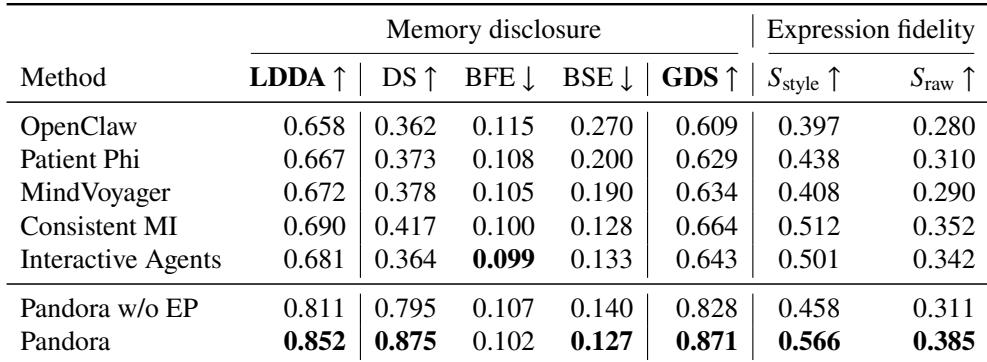
Across the evaluated implementations, Pandora with expression planning achieves the strongest combined disclosure organization and expression fidelity, outperforming baseline systems and its own ablation in timing, dependency, and style similarity. Removing expression planning preserves much of the structured disclosure quality but causes expression similarity to fall below the strongest baseline, supporting a separation between semantic planning and individual voice realization. The main baselines show trade-offs: Consistent MI leads baseline expression similarity, while Interactive Agents has the lowest bundling frequency error, but neither combines these properties as effectively as Pandora. Pandora achieves the highest overall disclosure organization and expression similarity, exceeding the strongest baseline on content-reduced and raw style similarity while also improving timing and dependency fidelity. The expression planning ablation retains high disclosure timing and dependency scores but drops below the strongest baseline in content-reduced style similarity, indicating that separate realization planning preserves client voice. Among baselines, Consistent MI leads expression similarity and Interactive Agents has the lowest bundling frequency error, but neither matches Pandora's combined disclosure and expression performance.
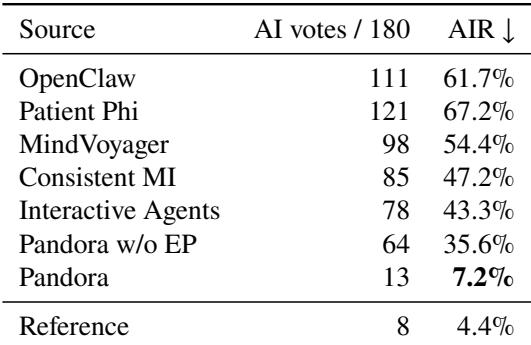
Human judges rated Pandora as the least AI-like generated system by a wide margin, with 7.2 percent AI-like votes compared with 43.3 to 67.2 percent for baselines and 35.6 percent for the expression-planning ablation. Removing expression planning produced a clear increase in AI-like judgments, and Pandora had the lowest rate among generated systems in both evaluator groups. The reference condition had a slightly lower rate but is not a uniformly verified human control. Pandora received fewer AI-like judgments than every baseline and its ablation. Removing expression planning raised AI-like judgments from 7.2 percent to 35.6 percent. Interactive Agents had the lowest AI-like rate among baselines, but still far higher than Pandora. Pandora's lower AI-like rate held across counselor and synthetic-data researcher evaluators. No Pandora candidate received a strict majority of AI-like votes.
The evaluation uses a curated collection of 115 dialogues, mostly Chinese with a smaller English subset, to assess disclosure timing, content organization, and individual expression. Quantitative comparisons show that Pandora with expression planning combines structured disclosure quality and expression fidelity better than baselines and its ablation, while removing expression planning lowers style similarity and shows that semantic planning and voice realization are separable. Human judgments further validate this advantage, as Pandora is rated AI-like far less often than baselines and the ablation, with the effect consistent across evaluator groups.