Command Palette
Search for a command to run...
G-STAR: Group-Scaled Token Capacity for Deeply Compressed Autoregressive Generation
G-STAR: Group-Scaled Token Capacity for Deeply Compressed Autoregressive Generation
Abstract
Discrete autoregressive models ofer a scalable framework for image generation. However, they face a fundamental trade-of: long token sequences preserve representation quality but slow generation, while aggressive spatial compression reduces representation capacity. Based on product quantization, we show that, under a fixed nominal information budget, group size should scale quadratically with the per-axis spatial compression factor. Building on this principle, we propose GSTAR, a spatial–group co-scaling framework that enables 32× and even efective 64× compression while preserving strong reconstruction, understanding, and generation performance. Since larger groups introduce intra-group dependencies that must be modeled eficiently, we analyze their impact on inference latency and generation quality and introduce a semi-autoregressive decoder that combines parallel feature computation with lightweight causal modeling. With these designs, our highly compressed models perform competitively with leading models across five representative text-toimage benchmarks (GenEval, DPG-Bench, PRISM, LongText-Bench, and Qwen-Image-Bench). At 1024 × 1024 resolution, our model delivers a 20× speedup over prior discrete autoregressive models, generating each image in 2.5 seconds on a single NVIDIA H200. Together, these results show that highly compressed discrete representations can enable high-quality autoregressive generation at low latency.
One-sentence Summary
Researchers from Peking University, Meituan Longcat, Shanghai Jiao Tong University, and other institutions propose G-STAR, a spatial-group co-scaling framework that scales group size quadratically with per-axis spatial compression and uses a semi-autoregressive decoder to preserve generation quality at 32× and effective 64× compression, achieving competitive text-to-image benchmark performance and a 20× speedup by generating 1024×1024 images in 2.5 seconds on a single NVIDIA H200.
Key Contributions
- The paper introduces GSTAR, a spatial-group co-scaling framework based on product quantization, showing that under a fixed nominal information budget, group size scales quadratically with per-axis spatial compression; this enables 32× and effective 64× compression while preserving strong reconstruction, understanding, and generation performance.
- The paper presents a lightweight semi-autoregressive depth decoder that computes representations for all group slots in parallel and uses a single-layer causal Transformer for intra-group dependencies, with an optimized inference implementation; it generates a 1024×1024 image in 2.5 seconds on a single NVIDIA H200 and delivers a 20× speedup over prior discrete autoregressive models.
- The paper validates the approach by training GSTAR-Pro-8B and GSTAR-Flash-1.7B at 32× and effective 64× compression, achieving performance competitive with leading models on GenEval, DPG-Bench, PRISM, LongText-Bench, and Qwen-Image-Bench.
Introduction
The authors address discrete visual tokenization for autoregressive image generation, where images are represented as discrete symbols and modeled with next-token prediction, providing a scalable route toward unified visual generation and multimodal understanding. Prior discrete autoregressive models face quantization error from finite codebooks and slow sequential inference, especially at high resolutions; increasing spatial compression reduces the number of global steps but worsens information loss, while existing multi-code decoders either add serial latency or risk multimodal collision. The authors propose combining multi-codebook quantization with a lightweight semi-autoregressive depth decoder to preserve representation capacity under 32x and 64x spatial compression. Their GSTAR-Pro-8B and GSTAR-Flash-1.7B models achieve competitive large-scale text-to-image generation and a 20x inference speedup over prior discrete autoregressive models, generating a 1024x1024 image in 2.5 seconds on a single NVIDIA H200.

Method
The authors propose a framework that combines a deeply compressed discrete tokenizer with a hierarchical autoregressive generator. To increase the capacity of each spatial token and preserve the nominal information budget while shortening the global sequence, they develop a spatial-group co-scaling principle.
First, the authors train a discrete tokenizer to map an input image to a compact grid of group-wise codes and reconstruct it. As shown in the framework diagram, the semantic encoder is initialized from Qwen-ViT to produce a spatially compressed latent grid. Group-wise quantization then represents each position with G discrete codes. To preserve the semantic structure of the pretrained representation after quantization, the quantized features are aligned with the corresponding Qwen-ViT features. Additionally, a Gram loss is employed to match second-order feature correlations between the input and its reconstruction. The overall training objective is formulated as:
Ltok=Lrec+λvqLvq+λsemLsem+λgramLgram+λcommitLcommitwhere Lrec collects standard pixel, perceptual, and adversarial reconstruction terms, Lvq is the quantization objective, Lsem is the semantic alignment objective, and Lcommit encourages encoder features to remain close to their assigned codebook embeddings.
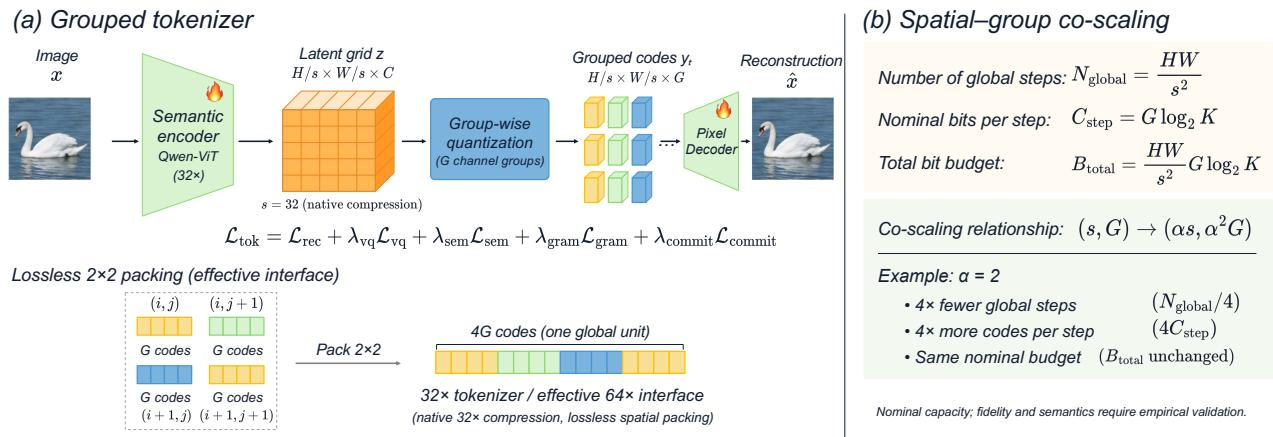
To further compress the sequence without losing information, the authors introduce a spatial-group co-scaling principle. Group-wise quantization allows increasing the discrete capacity assigned to each spatial token without lengthening the global sequence. Let s denote the effective per-axis spatial compression factor and G the number of codes generated at each global position. With a fixed codebook size K, the number of global steps is Nglobal(s)=s2HW, the nominal bits per step is Cstep(G,K)=Glog2K, and the total bit budget is Btotal(s,G,K)=s2HWGlog2K. By scaling s by α and G by α2, the total bit budget Btotal is preserved while the number of global steps is reduced by a factor of α2. Guided by this relation, the authors construct an effective 64× tokenizer from the native 32× tokenizer through lossless 2×2 spatial packing. Each neighborhood of four quantized positions is packed into one global unit, increasing the codes per step from Gq to 4Gq while shortening the global sequence by a factor of four. The packed codes are restored to the native grid before image decoding.
Finally, to efficiently model the correlated codes within each global step, the authors design a semi-autoregressive depth decoder. Generating a tuple of correlated discrete codes at each step using a fully causal autoregressive head incurs high inference latency, while a fully parallel head sacrifices generation quality by ignoring intra-group dependencies. To reconcile these objectives, the semi-autoregressive head combines a parallel trunk with a lightweight causal module. The parallel trunk first computes representations for all group slots in a single pass:
bt,1:G=Pψ([MASK]1:G;ht)Then, a lightweight, single-layer causal Transformer generates each code conditioned on both its parallel representation and the previously sampled intra-group codes:
pSAR(yt∣ht)=g=1∏Gp(yt,g∣ht,bt,g,yt,<g)This design evaluates the parallel trunk only once per global position, keeping most computation parallel while retaining causal conditioning through the single-layer, KV-cached causal Transformer.
Experiment
The experiments evaluate two models, GSTAR-Pro-8B and GSTAR-Flash-1.7B, on text-to-image generation and image editing benchmarks, and further examine group scaling, intra-group prediction heads, and inference efficiency. Larger group sizes improve reconstruction and semantic representation but slow early convergence, yet with enough training they catch up or outperform smaller groups. The Semi-AR prediction head substantially reduces inference latency while preserving generation quality comparable to the causal AR head and outperforming parallel prediction. Efficiency analysis shows that combining compressed visual representations, the Semi-AR head, and system-level optimizations leads to significant end-to-end decoding speedups.
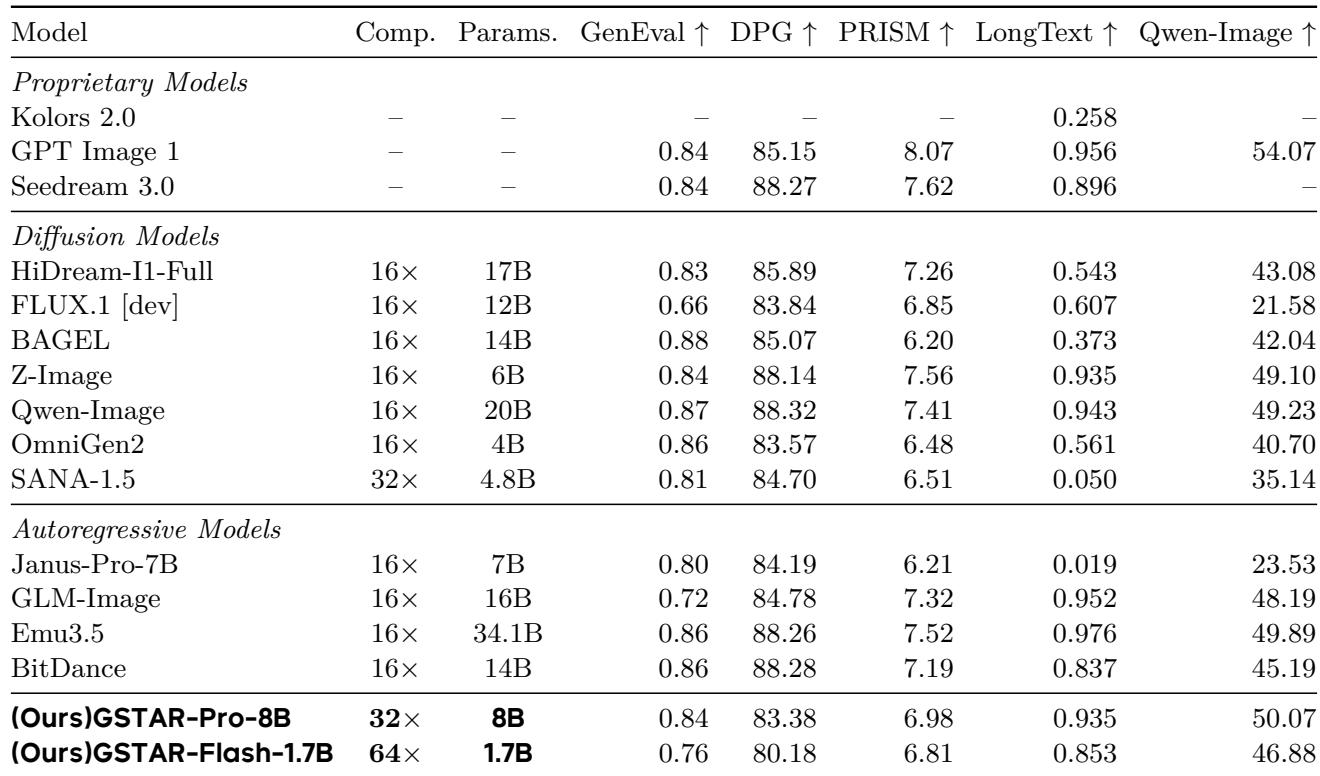
Selected proprietary models, especially GPT Image 1 and Seedream 3.0, lead most text-to-image metrics, with particular strength on long-text and prompt-following benchmarks. Among diffusion models, HiDream-I1-Full outperforms FLUX.1 [dev] on GenEval, DPG-Bench, PRISM, and Qwen-Image-Bench, while FLUX.1 [dev] retains an advantage on the LongText English subset. Kolors 2.0 reports only a lower LongText result, limiting broader comparison. GPT Image 1 and Seedream 3.0 achieve the strongest results overall, with Seedream leading DPG-Bench and GPT Image leading PRISM and LongText. HiDream-I1-Full surpasses FLUX.1 [dev] on most quality and prompt-following metrics, but FLUX.1 [dev] records a higher LongText score.
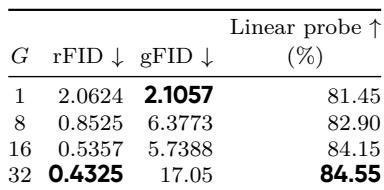
With codebook size fixed, increasing group size from 1 to 32 steadily improves reconstruction and semantic representation, shown by lower reconstruction FID and higher linear probe accuracy. Generative modeling quality is non-monotonic: generation FID worsens from group size 1 to 8, improves at group size 16, and degrades substantially at group size 32. Larger groups therefore appear to provide richer representational capacity, but the resulting space can be harder to model. Larger group sizes consistently improve reconstruction FID and linear probe accuracy. Generation FID does not follow a monotonic trend: group size 16 outperforms group size 8, while group size 32 is substantially worse. The largest tested group size achieves the best reconstruction and semantic scores but the worst generation FID.
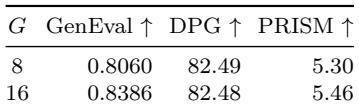
In text-to-image generation with a fixed codebook and spatial compression, increasing the group size from 8 to 16 yields comparable or slightly better overall quality. The larger group improves GenEval and PRISM scores while DPG remains nearly unchanged. This supports the view that larger groups provide a richer representational space that benefits generation when training is sufficient. Increasing group size from 8 to 16 improves GenEval and PRISM, while DPG stays essentially flat. The larger group setting achieves comparable or slightly better text-to-image performance, consistent with late-stage generation trends.
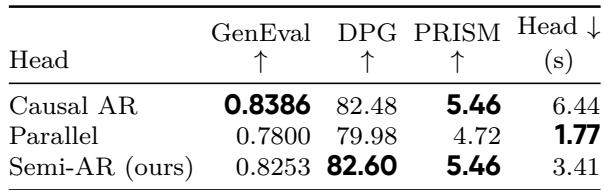
The Semi-AR prediction head reduces per-image latency substantially compared with the Causal AR head while maintaining broadly comparable generation quality. It matches PRISM, slightly improves DPG, and shows only a small GenEval decrease relative to Causal AR. The Parallel prediction head is faster but consistently lower on all quality metrics. The Semi-AR head matches the Causal AR PRISM score and records slightly higher DPG, with only a small GenEval decrease. The Parallel head is fastest but trails both other heads on GenEval, DPG, and PRISM.
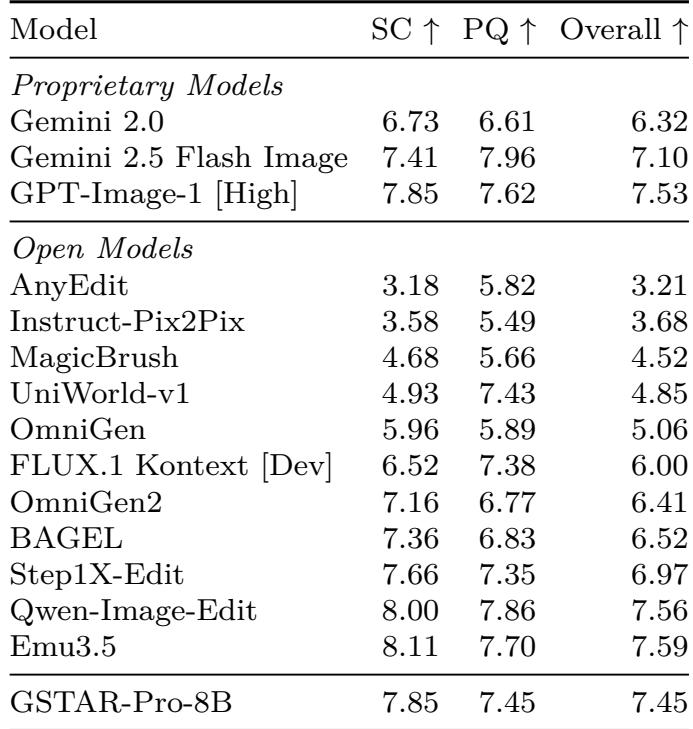
On the GEdit-Bench English full set, proprietary image editing models achieve higher semantic consistency, perceptual quality, and overall scores than the listed open models. GPT-Image-1 leads semantic consistency and overall score, while Gemini 2.5 Flash Image leads perceptual quality. The open models trail across all three reported metrics. Proprietary models outperform the listed open models on semantic consistency, perceptual quality, and overall score. GPT-Image-1 has the highest semantic consistency and overall score, while Gemini 2.5 Flash Image has the highest perceptual quality.
The experiments cover text-to-image generation, codebook design, prediction heads, and image editing. Proprietary models such as GPT Image 1 and Seedream 3.0 lead most text-to-image metrics, while HiDream-I1-Full outperforms FLUX.1 [dev] on most quality and prompt-following benchmarks with FLUX retaining a long-text advantage; larger codebook group sizes consistently improve reconstruction and semantic scores but generation quality is non-monotonic, with group size 16 yielding better text-to-image results. The Semi-AR prediction head reduces latency while maintaining comparable quality, and proprietary editing models outperform open models on semantic consistency, perceptual quality, and overall score.