Command Palette
Search for a command to run...
Non-penetrating World Models
Non-penetrating World Models
Yuhang Dai Yinwei Wu Ziyue Lin Han Ji Xingyi Yang
Abstract
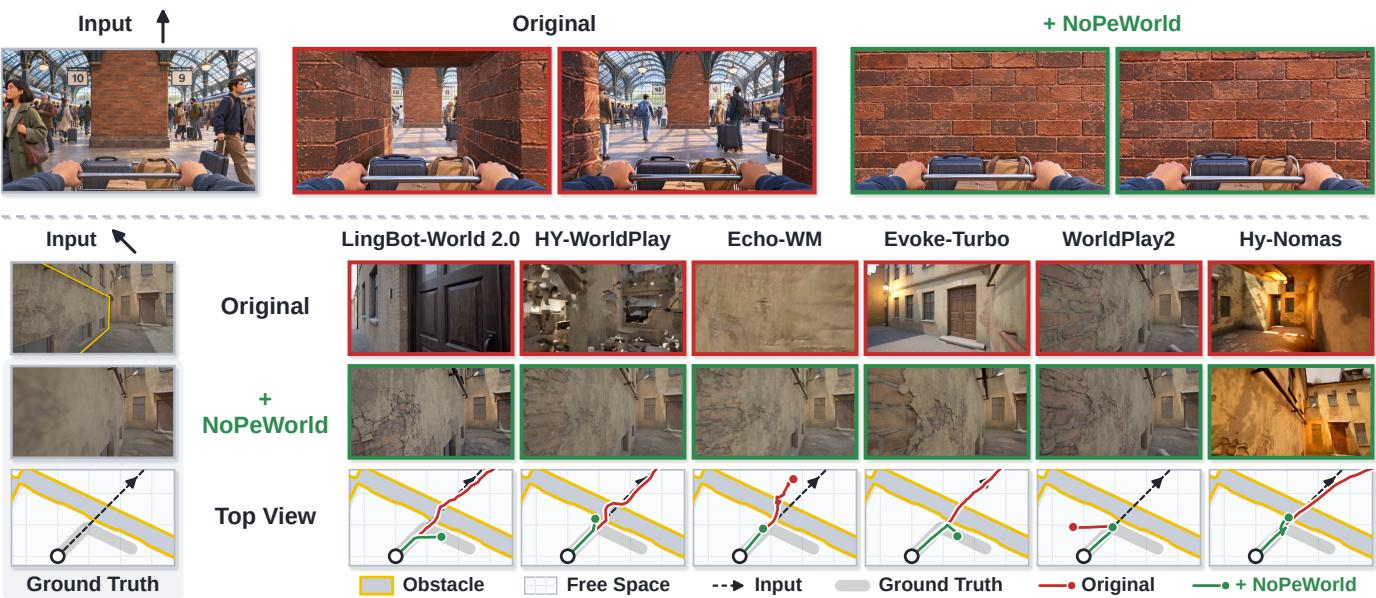
We study a new problem of preventing object penetration in interactive video world models. To understand how existing models handle this, we introduce NoPeBench, a benchmark that evaluates how world models respond to physical obstacles. Our evaluation reveals that none of the open-source models can reliably prevent such failures. Surprisingly, however, these models already encode the information needed to predict such violations. We find that the hidden states of diffusion transformers (DiTs) can predict whether a candidate action will penetrate an obstacle. Building on this, we introduce NoPeWorld, a lightweight framework that detects and prevents penetration. Specifically, we train a small prediction head on top of a frozen DiT's hidden states to read out if a candidate action is safe or not. Unsafe actions are then replaced with safe ones that best preserve the original intent. Despite its simplicity, NoPeWorld substantially reduces the physical violation rate, averaged over six video world models, from 74% to 16%. Remarkably, our method shows zero-shot generalization to open-domain imagery, third-person viewpoints, and moving obstacles. We publicly release our code, the NoPeBench benchmark, and model weights at the links above.
One-sentence Summary
Researchers at G Learning & Generation Lab, The Hong Kong Polytechnic University, introduce NoPeBench, a benchmark for evaluating how world models respond to physical obstacles, and NoPeWorld, a lightweight framework that trains a small prediction head on frozen diffusion transformer hidden states to detect unsafe actions and replace them with safe alternatives, reducing physical violation rates across six video world models from 74% to 16% with zero-shot generalization to open-domain imagery, third-person viewpoints, and moving obstacles.
Key Contributions
- Introduces NoPeBench, a benchmark that evaluates non-penetration in interactive video world models across teacher-forced, closed-loop, and open-domain settings, using verified 3D reconstruction and human-validated VLM judges.
- Finds that frozen diffusion transformer hidden states can predict whether a candidate action will penetrate an obstacle, and introduces NoPeWorld, a lightweight framework that trains a small cross-attention head on those states to detect unsafe actions and replace them with safe intent-preserving alternatives before chunk synthesis.
- Shows that NoPeWorld reduces the physical violation rate from 74% to 16% averaged over six frozen video world models and transfers zero-shot to open-domain imagery, third-person viewpoints, and moving obstacles.
Introduction
Interactive video world models generate frames conditioned on camera poses or key inputs, but unlike graphics simulators they do not enforce solid non-penetration. As a result, commanded motions can pass through walls or make obstacles disappear; this is hard to catch because training videos rarely show blocked actions and existing benchmarks mostly use collision-free trajectories. Prompting the model or adding an external depth estimator has limited effect, sacrifices intended motion, or requires costly per-frame post-processing. The authors introduce NoPeWorld, which reads hidden states from a frozen diffusion transformer to predict collision risk and obstacle distance, then replaces unsafe actions with safe alternatives that best preserve user intent. They also contribute NoPeBench, a benchmark for evaluating non-penetration across teacher-forced, closed-loop, and open-domain scenes.
Dataset
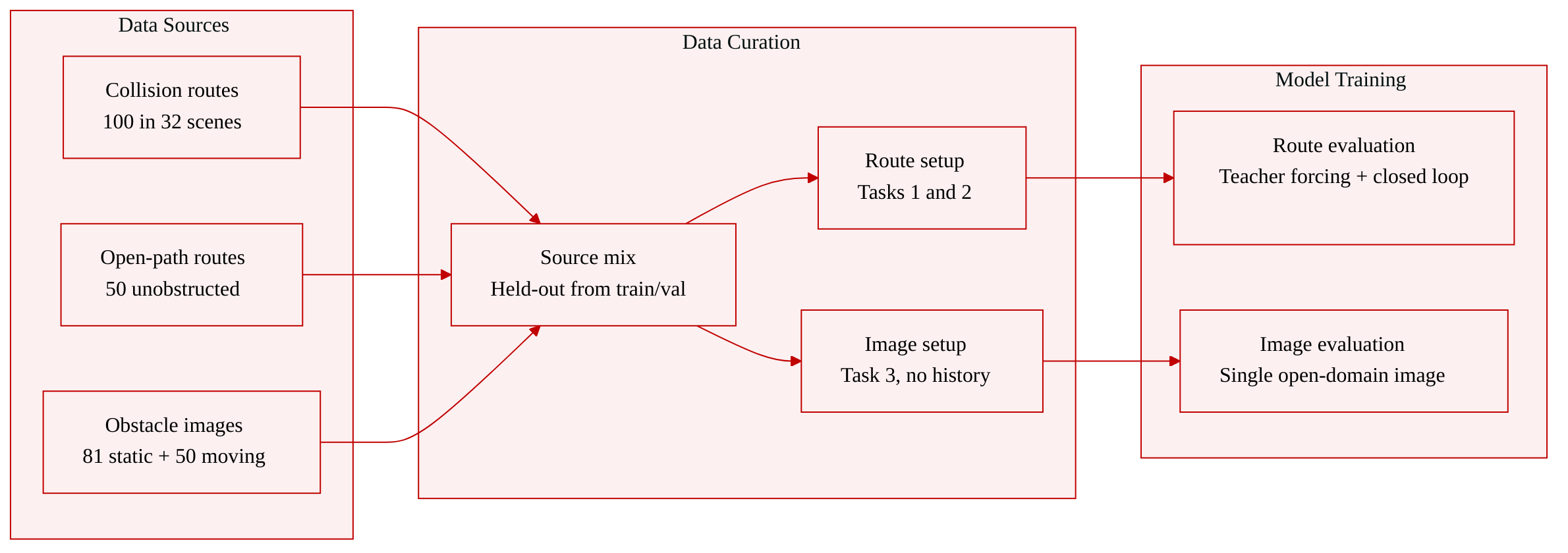
The authors present NoPeBench as a held-out benchmark for testing non-penetration without overly cautious intervention.
-
Sources and composition:
- 100 obstacle-bound collision routes in 32 held-out UnrealZoo scenes.
- 50 unobstructed open-path routes for checking unnecessary intervention.
- 131 obstacle-bound images for open-domain testing: 81 static obstacle images from WBench and 50 moving obstacle images, in first- and third-person views.
- All scenes, assets, and images are held out from training and validation.
-
Task-specific use:
- Task 1 uses the 100 collision routes in teacher forcing mode, with ground-truth histories, and evaluates the action chosen at each chunk.
- Task 2 uses the same 100 routes in closed loop for 5 seconds, starting from a pre-contact hand-off on true frames.
- Task 3 uses the 131 obstacle-bound images as single open-domain images without history.
- The 50 open-path routes are used to detect false intervention or needless halting, while the collision routes detect clipping.
-
Processing details:
- The excerpt does not describe cropping or metadata construction.
- No training mixture ratios are given; NoPeBench is used only for evaluation.
Method
The authors formulate interactive video world model synthesis as a constrained generation problem to enforce non-penetration against scene geometry. Given past frames and a user command, a diffusion transformer samples the next video chunk. To prevent the model from crossing solid obstacles or hallucinating them away, the authors adapt principles from computer graphics, requiring a unilateral constraint on the signed obstacle gap along a swept path. This recasts chunk synthesis as optimizing the executed action to balance generation likelihood with a collide-and-slide response, formulated as:
(xk⋆,ak⋆)=xk,akargmaxlogpθ(xk∣x<k,ak)−λϵS(ak,uk)2s.t.ρmingS(γ(ρ;ak))≥0.Since the video generator lacks explicit geometry, the authors reduce this to selecting the best candidate motion from a discrete set that satisfies a safety margin while minimizing intent deviation.
To evaluate these constraints without explicit geometry, the authors leverage the intermediate hidden states of a frozen video DiT, which inherently encode 3D scene structure and impending contact.
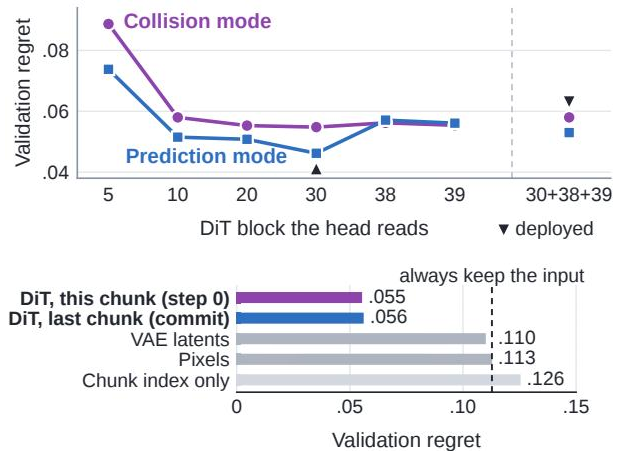
As demonstrated by the validation regret analysis, probing these DiT hidden states yields significantly lower regret compared to using VAE latents, decoded pixels, or chunk indices alone. Building on this property, NoPeWorld trains a compact prediction head on mid-to-deep DiT blocks while keeping the base model weights entirely frozen.
Refer to the framework diagram for the overall training and inference pipeline.
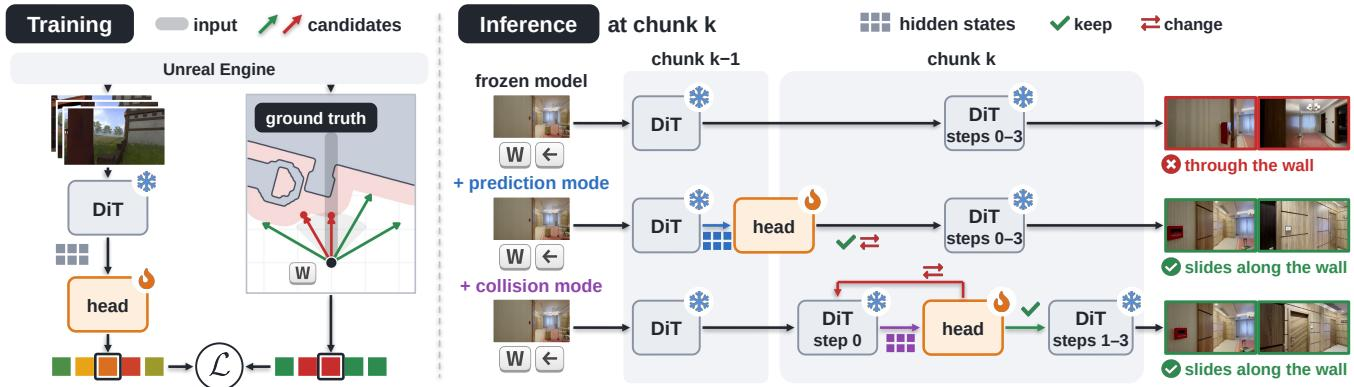
During training, the authors replay simulator videos through the frozen DiT via teacher forcing. They compute ground truth clearance and intent error by sweeping a collision disc over the simulator's true occupancy map. A token projector compresses the tapped DiT tokens, and candidate motions are encoded by the generator's frozen control encoder. A learned query attends over these action-conditioned state tokens via cross-attention to predict a safety logit, swept clearance, and intent score per candidate:
(ℓi,g^i,A^i)=CrossAttnϕ(q,H~i),H~i=ψH(H)+ψc(E(ci),E(uk)).The head is supervised using smooth safety and intent targets derived from the ground truth, optimizing a multi-task loss that combines binary cross-entropy, Huber regression, and listwise ranking:
L(ϕ)=i∑ωi[BCE(σ(ℓi),Pi)+21Huber(g^i,gi)+BCE(A^i,Ai)]+KL(π(R)∥π(R^)).At test time, the trained head solves the constrained optimization before any frame of the chunk is decoded. Given calibrated safety probabilities, candidates above a threshold form a feasible set, and the raw command is projected onto the closest admissible motion:
ak⋆={uk,argmaxi∈SkA^i,if 0∈Sk,maxi∈SkA^i≤A^0+δ,otherwise,defaulting to a stop when the feasible set is empty. The authors implement this closed-loop inference in two distinct modes depending on where the hidden states are tapped. In Prediction mode, the head reads the cached state from the previous chunk's commit pass, allowing the safe motion to be chosen between chunks without adding any DiT passes. In Collision mode, the head taps the first denoising pass of the current chunk where the command already interacts with memory. If the command is deemed unsafe and changed, Collision mode reruns only the initial denoising step with the corrected action before completing the remaining steps.
Experiment
NoPeBench evaluates whether world models enforce non-penetration without overriding safe user intent, using three progressive tasks that isolate single-step decisions, closed-loop obstacle-bound rollouts, and zero-shot transfer to open-domain scenes. Across six frozen generators, NoPeWorld intercepts unsafe commands while mostly preserving safe ones, yielding safer videos with better safe-intent scores than raw generation, text prompts, or an external depth guard, and it transfers to novel views and moving obstacles. Analysis shows that frozen diffusion transformer states encode upcoming contact before pixels are generated, and reading these states adds only modest inference cost.
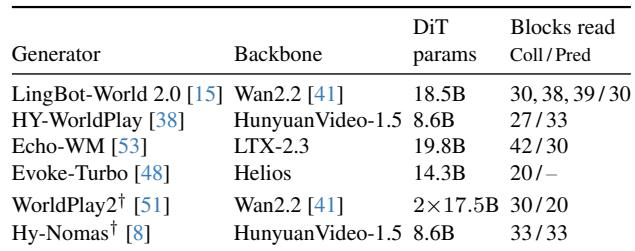
A single compact head is shared across six frozen open-source video generators spanning four backbones and a wide range of model sizes. The head reads mid-to-deep DiT blocks for collision and intent predictions, with collision readout present for all six generators and intent readout absent only for one memoryless model. Readout depths vary by generator, but the design works without updating any generator weights. Collision and intent predictions use mid-to-deep DiT blocks rather than early or shallow layers. One shared head configuration serves six frozen generators across four backbones, with readout block choices varying by model and a memoryless generator supporting collision readout only.
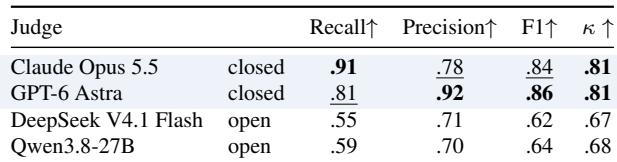
On majority-labeled videos, the two closed judges detect violations more reliably than the two open judges, with higher recall, F1, and agreement with the geometric evaluator. The closed judges show a recall-precision trade-off, with one stronger on recall and the other stronger on precision. Open judges trail across reported metrics and agree less strongly with the geometric evaluator. Closed judges reach markedly higher recall than open judges, while also achieving stronger agreement with the geometric evaluator. Among the judges, Claude Opus 5.5 has the highest recall and GPT-6 Astra has the highest precision and F1.
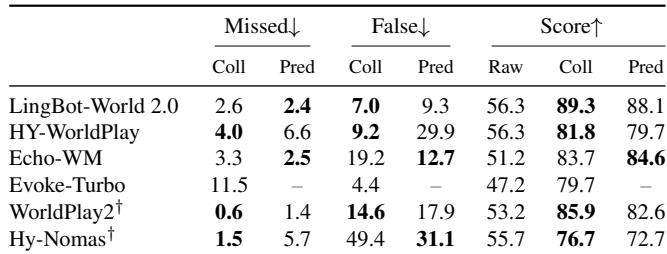
On ground-truth histories, NoPeWorld reduces missed unsafe commands from all cases to a small fraction across every generator and lifts decision scores substantially. The prediction mode tracks the collision mode closely on most generators despite reading before the unsafe input enters, while collision mode usually produces fewer false alterations of safe inputs. The main cost is a modest false intervention rate on safe commands, with one generator showing a notably higher rate. Raw models miss every unsafe command on true histories, whereas both NoPeWorld modes cut missed detections to a small fraction across all six generators. Decision scores improve substantially for every generator, with prediction mode often close to collision mode despite using earlier information. False interventions on safe inputs remain modest in most cases, though Hy-Nomas shows a much higher false alteration rate under collision mode.
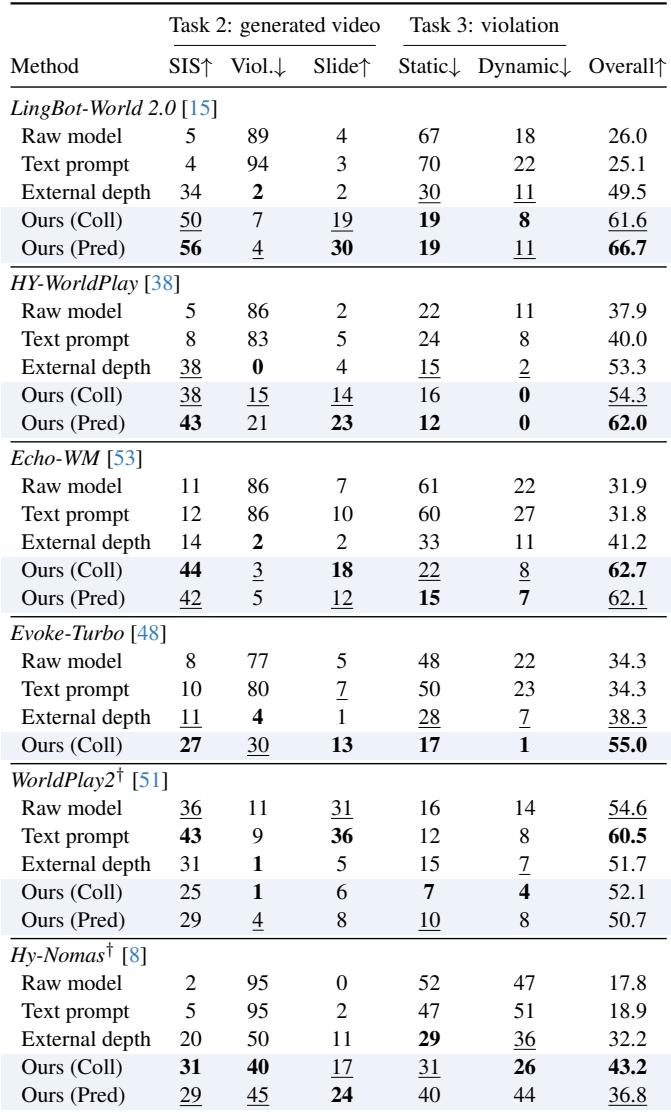
For the LingBot-World 2.0 generator, raw and text-prompted baselines largely fail closed-loop non-penetration, showing very low safe-intent scores and high violation rates with almost no wall sliding. An external depth baseline suppresses violations but does so by halting, which nearly eliminates sliding and yields only moderate overall performance. The proposed method, especially in prediction mode, achieves the highest safe-intent and overall scores while reducing static and dynamic violations and retaining more slide than the external depth baseline. Raw and text-prompt baselines show high violation rates and near-zero slide, with text prompting adding little over the raw model. External depth reduces violations but nearly eliminates sliding, limiting its overall score. The proposed prediction mode achieves the highest safe-intent and overall scores, and collision mode reduces violations relative to raw while preserving more slide than external depth. In open-domain transfer, the proposed method cuts static and dynamic violations well below raw and text-prompt baselines, with collision mode competitive with or better than external depth.
On LingBot-World 2.0, reading cached DiT states for prediction adds very little inference cost, while collision reruns and external depth estimation are substantially more expensive. Pred adds about one percent to a raw route, compared with roughly eighteen percent for collision mode and twenty-seven percent for external depth. The cost gap reflects that external depth decodes pixels and runs depth analysis per chunk, whereas prediction scores candidates from an already cached pass. Prediction from cached DiT states is far cheaper per route than collision reruns or external depth estimation, adding about one percent versus eighteen percent and twenty-seven percent relative to the raw route. External depth is the most expensive option because its per-decision cost includes both pixel decoding and depth analysis, whereas the collision method only reruns step zero when the chosen action differs from the input.
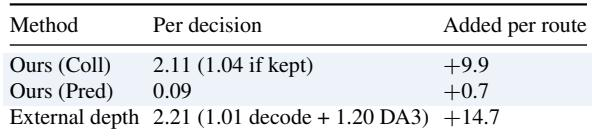
The evaluation covers a shared compact probing head over six frozen open-source video generators, judge reliability on majority-labeled videos, offline safety detection, closed-loop and transfer control, and inference cost. The probe generalizes across backbones without updating generator weights by reading mid-to-deep DiT blocks, and closed judges detect violations more reliably than open judges. NoPeWorld greatly reduces missed unsafe commands and improves decision scores over raw models, with prediction mode approaching collision-mode safety despite using earlier information, while closed-loop and transfer results show higher safe-intent and overall scores, fewer violations, and better sliding retention than raw, text-prompted, or external-depth baselines. Prediction from cached DiT states is far cheaper than collision reruns or external depth estimation.