Command Palette
Search for a command to run...
WeMM-Ecom: Advancing Multimodal Content Understanding for WeChat E-Commerce
WeMM-Ecom: Advancing Multimodal Content Understanding for WeChat E-Commerce
Binhui Xie Jinmin Li Haomiao Tang Guangting Wang Song Jin Jianwei Zhu Fengyun Rao Jing LYU
Abstract
We present WeMM-Ecom, a family of multimodal large language models that deliver frontier e-commerce capabilities while achieving state-of-the-art general-purpose performance at their respective scales. The family spans five sizes, from a 0.8B dense model to a 35B mixture-of-experts model with 3B active parameters. Our training pipeline begins with two-stage continued pre-training that progressively raises the proportion of e-commerce data within a diverse multimodal data mixture, followed by hybrid thinking post-training that combines on-policy distillation and reinforcement learning to support both non-thinking and thinking modes. For evaluation, we construct a comprehensive suite of 28 e-commerce benchmarks (23 in-house and five public) covering eight business scenarios and complement it with 64 public general-purpose benchmarks. On the e-commerce suite, WeMM-Ecom-35B-A3B surpasses substantially larger open-source flagship models, including Qwen3.8-Flash-Next, HY4, and DeepSeek V4.1-Flash-1017. On the general-purpose suite, every WeMM-Ecom model surpasses its similarly sized Qwen3.5 counterpart, with the lightweight variants (e.g., WeMM-Ecom-2B) showing clear advantages over leading lightweight models such as Qwen3.5-2B, MiniCPM-V-4.7-1B, and LFM3-VL-2B. Beyond benchmarks, WeMM-Ecom now powers hundreds of production use cases in WeChat, including catalog management, multimodal product search, and livestream commerce, serving billion-scale requests per day. We publicly release all model weights and detail our data curation, training recipe, and benchmark construction to facilitate future work on domain-specialized multimodal models.
One-sentence Summary
Researchers at WeChat Vision, Tencent Inc. introduce WeMM-Ecom, a family of multimodal large language models spanning five sizes from a 0.8B dense model to a 35B mixture-of-experts model with 3B active parameters, trained via two-stage e-commerce-focused continued pretraining and hybrid thinking post-training with on-policy distillation and reinforcement learning; on 28 e-commerce benchmarks covering eight business scenarios and 64 public general-purpose benchmarks, the models surpass larger open-source flagship models and similarly sized Qwen3.5 counterparts, and WeMM-Ecom now powers hundreds of WeChat production use cases including catalog management, multimodal product search, and livestream commerce serving billion-scale requests per day.
Key Contributions
- The paper introduces and open-sources WeMM-Ecom, a family of five multimodal large language models spanning a 0.8B dense model to a 35B mixture-of-experts model with 3B active parameters, each supporting thinking and non-thinking modes. WeMM-Ecom-35B-A3B surpasses larger open-source models including Qwen3.8-Flash-Next, HY4, and DeepSeek V4.1-Flash-1017 on the e-commerce suite, while every model surpasses its similarly sized Qwen3.5 counterpart on general-purpose benchmarks.
- The paper details a training and data recipe that constructs more than 40 e-commerce tasks from product images, livestream frames, and business records, mixes them with general multimodal data across two continued pre-training stages, and applies hybrid-thinking on-policy distillation, a single parameter-space merge with post-trained Qwen3.5 weights, and group relative policy optimization to yield one checkpoint that serves both thinking and non-thinking modes.
- The paper introduces an e-commerce evaluation framework that translates real-world business workflows into eight evaluation scenarios with explicit inputs, decision targets, and scoring rules, resulting in a suite of 23 in-house and five public benchmarks with 207,117 instances.
Introduction
Multimodal large language models are increasingly capable general-purpose systems for images, documents, and video, but e-commerce is an especially demanding domain. Products may appear through many product views, long detail images, livestream frames, titles, and structured attribute tables, while critical evidence such as nutrition facts, dimension annotations, or certification marks often exists only inside image text and must be linked to the correct SKU variant and implicit catalog knowledge. General capability alone is insufficient, and prior domain specialization risks either missing strict entity-level and business-rule constraints or degrading general visual perception and reasoning, especially for lightweight models under tight latency and memory budgets. The authors introduce WeMM-Ecom, a family of five multimodal models ranging from a 0.8B dense model to a 35B-A3B mixture-of-experts model, initialized from Qwen3.5. They train on more than 40 curated e-commerce tasks using a two-stage continued pretraining curriculum and post-train with hybrid-thinking on-policy distillation, a parameter-space merge, and GRPO, producing models that support both thinking and non-thinking modes. They also contribute an open-source release of model weights and a 28-benchmark e-commerce evaluation suite spanning eight business scenarios.
Dataset
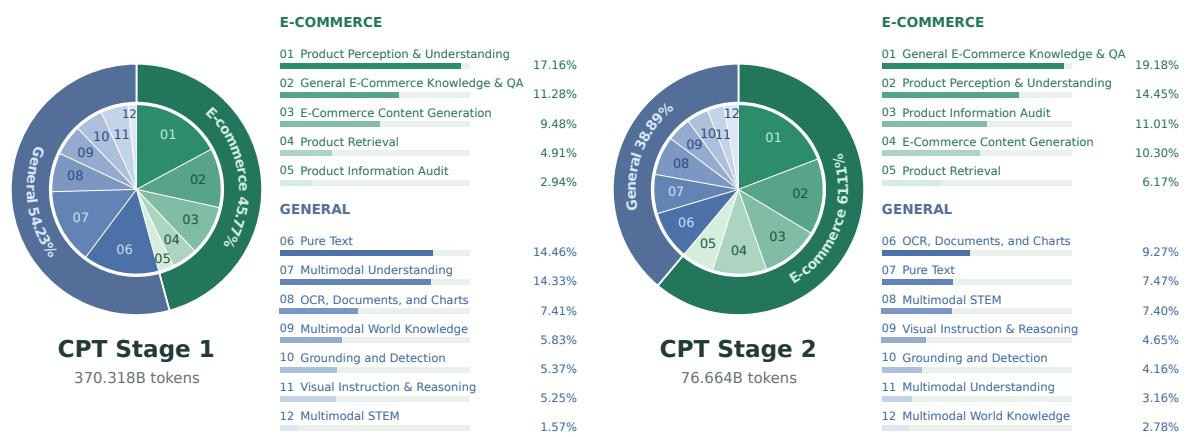
Dataset sources and composition
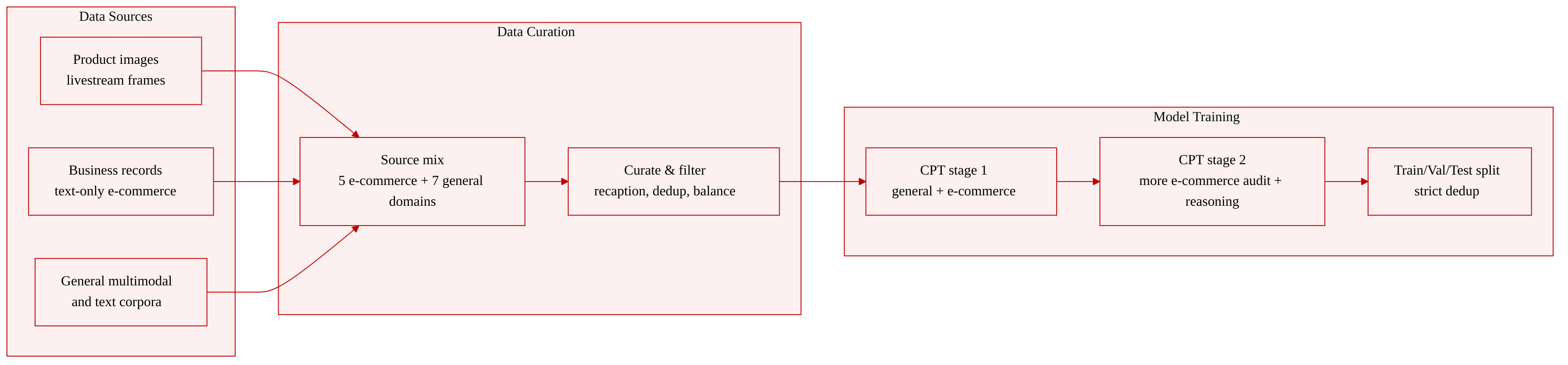
- The authors build the continued pre-training corpus from product images, livestream frames, business records, and general multimodal and text-only corpora.
- The data is organized into five e-commerce domains and seven general domains.
- Both e-commerce and general pools are kept throughout continued pre-training because e-commerce tasks depend on general skills such as OCR, grounding, and product variant knowledge.
- Records with an e-commerce business context, including text-only records, are assigned to the corresponding e-commerce domain.
- The general pool draws on curated sources and task mixtures, including all 162 nonempty sources in OpenBee.
E-commerce data subsets
- Product Perception & Understanding: pairs product images with taxonomy labels, reasoning traces, attributes, visible text, properties, and regions from gallery images, detail strips, and livestream frames. SKU attribute examples specify a variant and an attribute, use relevant views and fields, and treat the recorded value as the target.
- Product Retrieval: pairs two listings, SKU records, or product regions with available images and specifications. Equivalence is defined at the requested level, such as product level, region level, or SKU level, so identical total quantity with different pack configurations can remain distinct SKUs.
- General E-Commerce Knowledge & QA: pairs listing images, descriptions, visible text, and structured fields with questions on product knowledge, commerce OCR, and reasoning. Reference answers are supported by the supplied sources.
- Product Information Audit: pairs listing titles, gallery images, and attribute fields with platform governance rules and annotated compliance decisions. Tasks include detecting restricted goods, finding image-title or category inconsistencies, reviewing product-image quality, screening policy violations, and reviewing short product titles.
- E-Commerce Content Generation: maps structured product specifications to concise, formatted titles that follow platform style guidelines.
- E-commerce supervision emphasizes variant-level granularity, traceable evidence, and rule-conditioned outputs. Bounding-box annotations localize products, logos, certification marks, specification tables, and dimension annotations, and explicitly mark targets that are absent from the image.
General-purpose data subsets
- Multimodal Understanding: pairs images with Chinese or English captions and adds video data for event understanding, temporally grounded tasks, sports event narration, and general video QA.
- OCR, Documents, and Charts: pairs natural images, documents, charts, and tables with transcriptions, reading questions, or structured extraction targets. Sources include ChartNet, multilingual OCR collections, web articles, and table annotations.
- Grounding and Detection: converts object and region annotations from Objects365, SA-1B, and LocateAnything into localization and detection targets conditioned on object names or referring descriptions. GUI examples associate interface instructions with element locations.
- Visual Instruction & Reasoning: combines single-image QA, multi-image comparison, visual quality assessment, and edit-instruction tasks. It also includes risk assessment and content moderation for general content such as short videos.
- Multimodal STEM: pairs diagram-based and video-based mathematics, science, and technical reasoning problems with worked solutions. Sources include Innovator-VL and educational corpora across biology, chemistry, mathematics, and K-12 science.
- Multimodal World Knowledge: associates images with encyclopedic and entity-specific descriptions from online wikis and entity recaption sources, plus specialized knowledge questions.
- Pure Text: provides text-only language and instruction supervision. Mathematical and scientific reasoning dominate, drawing on Nemotron-Math and Chinese STEM sources, with additional instruction dialogues, Wikipedia text, reading-comprehension QA, and curated web text.
Data construction and quality control
- Spatial targets and absent objects: box annotation conversion makes coordinate normalization explicit, preserves source category schemas, and keeps each target linked to its annotated visual entity. E-commerce annotations mark missing targets, while general grounding data includes rejection examples whose queries name objects absent from the image.
- Recaptioning: images are clustered with WeMM-Embedding, sampled across clusters, recaptioned, and deduplicated. For text-rich images, PaddleOCR transcriptions provide textual cues for caption generation.
- Synthesized reasoning: Qwen3.5-122B-A10B generates reasoning for STEM solutions, and Qwen3.5-35B-A3B checks answer agreement. Malformed or truncated solutions are discarded.
- Web article mining: two classifiers identify product-recommendation articles and select comparative reviews or detailed product-use accounts. Qwen3.5-122B-A10B filters promotional or irrelevant material and extracts product and brand facts, which are deduplicated with MinHash.
- Source balancing: each source group receives a token budget. If a group exceeds its budget, its constituent sources are downsampled proportionally so every source remains represented.
- Metadata construction: e-commerce examples retain source image indices and rule or decision fields, and targets are linked to supporting evidence such as images, boxes, visible text, or structured fields.
How the data is used
- Continued pre-training proceeds in two stages. The second stage raises the e-commerce share and shifts emphasis from perception toward auditing and reasoning.
- Both e-commerce and general-purpose pools are used throughout continued pre-training.
- For post-training, all model sizes share a curated pool of 499,998 OPD prompts and 30,976 RL prompts.
- OPD prompts are selected through offline teacher-student comparisons, retaining instances where the teacher achieves a higher mean quality score than the student.
- RL prompts are sampled from the post-OPD merged checkpoint, with prompts kept only if they show positive reward variance; already saturated instances are filtered out.
- The evaluation framework contains 28 benchmarks, including 23 in-house benchmarks and 5 public benchmarks, totaling 207,117 evaluation instances.
- Evaluation covers Product OCR, Product Grounding, Product Knowledge, Product Attributes, Product Retrieval, Product Moderation, E-commerce Reasoning, and public e-commerce benchmarks.
- Strict deduplication between training and business evaluation splits uses product identifiers, exact image hashes, perceptual hashes for near duplicates, and visual embedding similarity.
- Key evaluation sizes include Product OCR with 19,962 instances, Product Grounding with 11,939 instances, Product Attributes with 26,676 instances, Product Retrieval with 21,584 instances, Product Moderation with 6,443 instances, E-commerce Reasoning with 3,500 instances, and public benchmarks with 112,415 instances from ShoppingMMLU, ChineseEcomQA, RAIR, EcomMMMU, and IndustryBench-MIPU.
Method
The authors initialize each WeMM-Ecom model from the corresponding Qwen3.5 Base checkpoint and perform full-parameter optimization across all training stages using the WeChat-YATT framework. The overall pipeline first conducts continued pre-training (CPT) to instill fine-grained knowledge of products, variants, and business rules while preserving broad multimodal capabilities. Subsequently, post-training combines on-policy distillation (OPD) for token-level teacher guidance, a single parameter-space merge with the post-trained Qwen3.5 weights, and reinforcement learning (RL) driven by task-specific verifiable rewards. All five model scales support thinking and non-thinking modes in a unified chat interface.
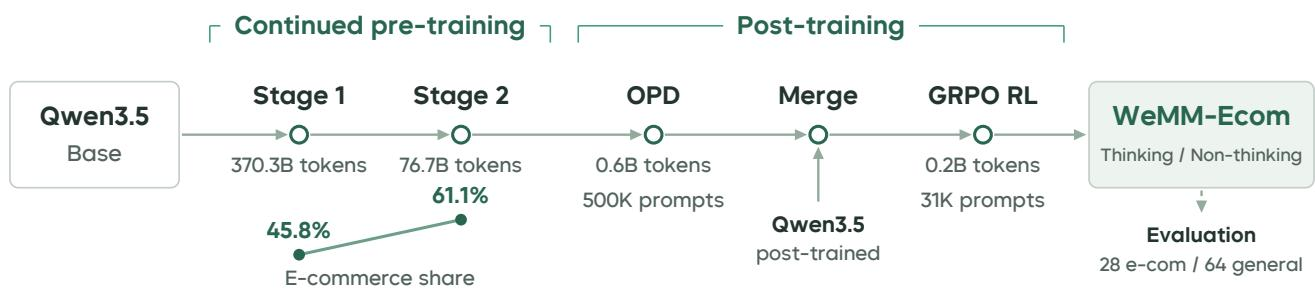
CPT adapts the backbone to e-commerce while preserving its general multimodal capabilities. The authors construct CPT data from product images, livestream frames, business records, and general multimodal and text-only corpora, organizing it into five e-commerce and seven general domains. They retain both pools throughout CPT because e-commerce tasks routinely depend on general skills. Training proceeds in two stages; the second raises the e-commerce share and shifts emphasis from perception toward auditing and reasoning.
The authors adopt a two-stage curriculum that increases domain specialization while maintaining broad general supervision. Stage 1 establishes multimodal and product representations with a 45.8% e-commerce share, training on 370.3B tokens at a 16K sequence length. Stage 2 raises the share to 61.1% and extends the context window to 32K for 76.7B tokens. Within the e-commerce pool, supervision shifts from basic perception toward compliance auditing and knowledge-intensive QA. Within the general pool, supervision shifts from captioning and text-only data toward dense text reading and visually grounded reasoning.
For a training batch B, let vi denote the visual inputs of example i, zi its token sequence, and Mi its supervised response token positions with Ni=∣Mi∣>0. To prevent long responses from dominating gradient updates while still accounting for sequence length, the authors employ square averaging, weighting each supervised token by Ni−1/2:
LCPT(θ;B)=−∑i∈BNi∑i∈BNi−1/2∑t∈Milogπθ(zi,t∣vi,zi,<t)They train with dynamic micro-batching, visual-encoder parallelism, and sequence packing up to each stage context limit, preserving per-example loss masks and image-text alignments.
Following CPT, the post-training pipeline combines OPD, parameter-space model merging, and GRPO-based reinforcement learning. Both post-training stages optimize a single set of weights to support both thinking and non-thinking modes. To support both deliberative chain-of-thought reasoning and low-latency direct responses within a single checkpoint, both OPD and RL assign training prompts to thinking and non-thinking modes at a 4:1 ratio. Because per-response loss averaging assigns lower per-token weight to final answer tokens in longer reasoning traces, allocating a higher proportion of prompts to thinking mode balances supervision across both paradigms.
OPD provides dense, token-level teacher supervision on trajectories sampled from the student policy. Given a student-generated prefix hi,t=(xi,yi,<t) of response i, the teacher evaluates the token yi,t sampled by the rollout policy πθold, yielding a token-level distillation signal applied identically in both modes:
ai,tKD=logπT(yi,t∣hi,t)−logπθold(yi,t∣hi,t)where πT denotes the teacher policy. Holding ai,tKD fixed during gradient updates and letting ρi,t=πθ(yi,t∣hi,t)/πθold(yi,t∣hi,t) denote the importance ratio, the authors minimize the clipped actor objective over batch B and scored token positions Ri:
LOPD(θ)=−∣B∣1i∈B∑∣Ri∣1t∈Ri∑min(ρi,tai,tKD,clip(ρi,t,0.8,1.2)ai,tKD)To combine domain adaptation with the broad instruction-following priors of the backbone, they merge once after OPD and before RL by interpolating the vision and language parameters of the OPD checkpoint with the corresponding post-trained Qwen3.5 checkpoint using equal weights.
The authors further refine the models via GRPO using task-specific verifiable rewards. For a prompt x from task family τ, they sample G responses and compute scalar rewards ri=Rτ(x,yi), normalizing advantages across the group:
Ai=std(r1,…,rG)+ϵAri−rˉ,rˉ=G1i∑riWith ℓi,t=logπθ(yi,t∣hi,t) and a frozen reference policy initialized from the pre-RL checkpoint, each online rollout batch B minimizes:
LRL(θ)=∣B∣1i∈B∑∣Ri∣1t∈Ri∑[−Aiexp(ℓi,t−sg(ℓi,t))+0.01Ki,t]where sg(⋅) denotes the stop-gradient operator and Ki,t penalizes KL divergence from the reference policy. CPT employs hybrid AdamW-Muon optimization, combining AdamW updates with Muon orthogonalized momentum. Across all five model sizes, OPD and RL use a constant learning rate and a global batch size of 2,048 sampled responses.
Experiment
These experiments evaluate WeMM-Ecom across a 28-benchmark e-commerce suite covering evidence extraction, product interpretation, and decision making, plus 64 general-purpose multimodal and text benchmarks, with all model scales tested in both thinking and non-thinking modes. The results validate that domain-grounded e-commerce training yields broad gains over size-matched Qwen3.5 baselines and many larger open-source flagships, especially in product grounding and retrieval, while general capabilities are preserved or improved, particularly for compact models. Ablations confirm that the e-commerce advantages persist even when grounding benchmarks are excluded or scenario weighting changes, with only minor scenario-level trade-offs.
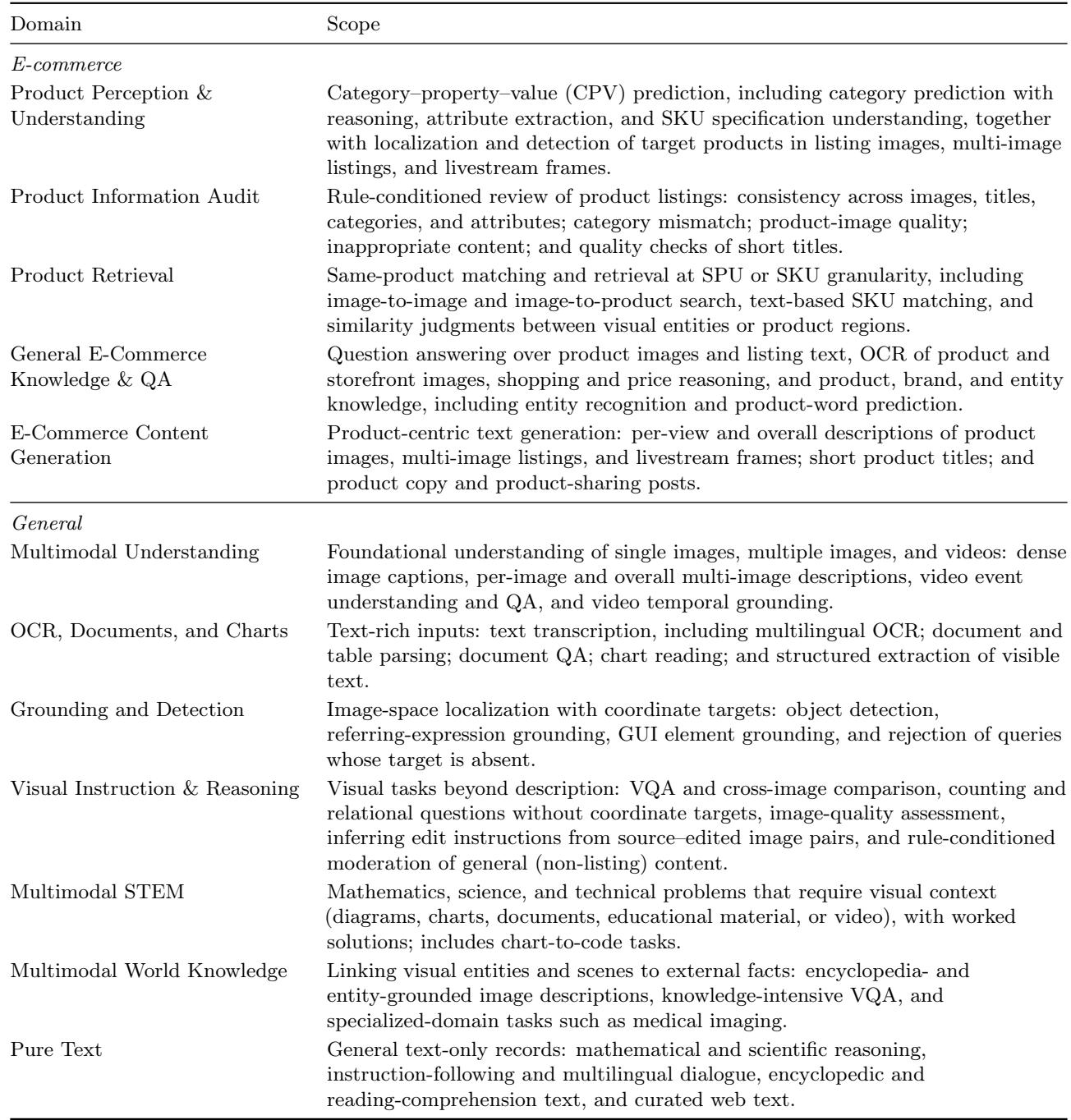
Continued pre-training data is organized into five e-commerce domains covering product perception and understanding, product information audit, product retrieval, general e-commerce knowledge and QA, and e-commerce content generation. Each record is assigned to the domain of its primary supervision objective, and e-commerce business records remain in the e-commerce pool regardless of modality. The domain scopes emphasize variant-level granularity, traceable evidence, and rule-conditioned outputs, with later training shifting toward auditing and reasoning. Records are counted once by their primary supervision objective rather than by source name or number of images, while general text-only records form a separate Pure Text pool. Product Information Audit is rule-conditioned and reviews listing consistency, image quality, inappropriate content, and short-title quality, whereas E-Commerce Content Generation applies rules to product-centric text creation.
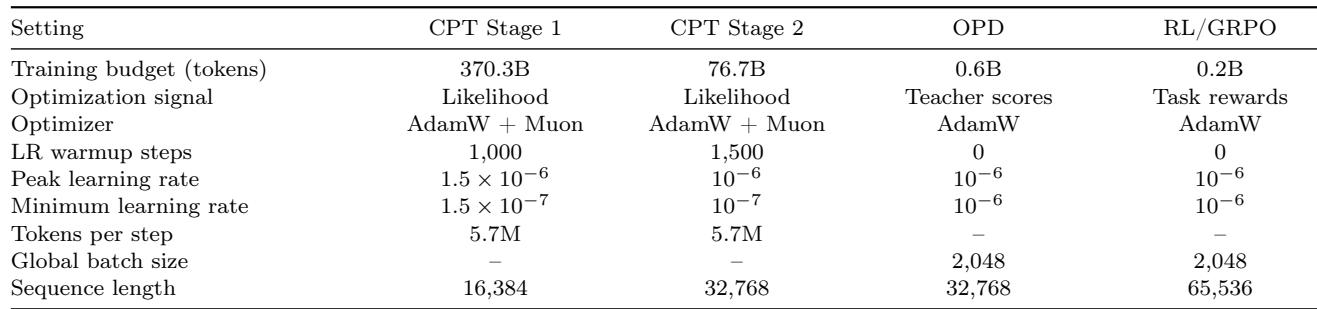
The training setup spans four stages: two CPT stages consume the vast majority of training tokens, while OPD and RL contribute only a small additional budget. CPT stages rely on likelihood optimization with hybrid AdamW + Muon optimization, learning-rate warmup, and decay. OPD and RL switch to AdamW with constant learning rates, no warmup, and optimization signals based on teacher scores and task rewards, respectively. CPT Stage 1 and Stage 2 account for nearly all training tokens, with Stage 1 much larger than Stage 2. CPT uses hybrid AdamW + Muon optimization and learning-rate warmup, while OPD and RL use AdamW and constant learning rates. The optimization signal changes from likelihood during CPT to teacher scores during OPD and task rewards during RL.
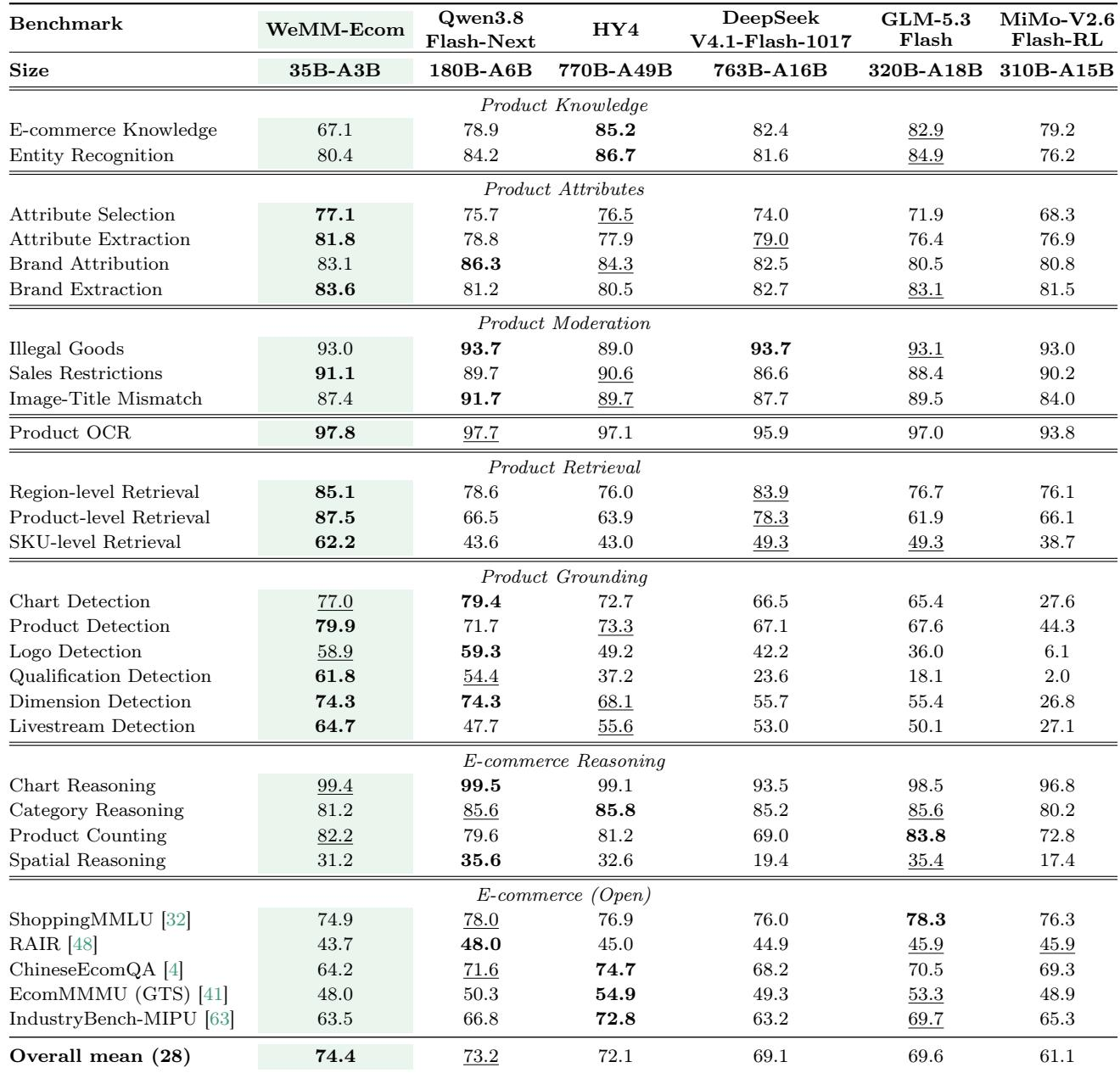
WeMM-Ecom-35B-A3B achieves the highest overall e-commerce benchmark average among the compared flagship open-source models despite using substantially fewer parameters. The overall advantage is driven mainly by Product Retrieval and Product Grounding, and it remains consistent under alternative weighting schemes. Larger baselines still lead on several knowledge and entity-recognition benchmarks. It outperforms the strongest baseline in non-thinking mode by about 1.2 points on the overall average. The lead is maintained despite a parameter disadvantage of roughly 5x to 22x relative to compared models. Product Retrieval and Product Grounding are the main drivers of the overall edge. On Product Knowledge and Entity Recognition, multiple larger baselines score higher.
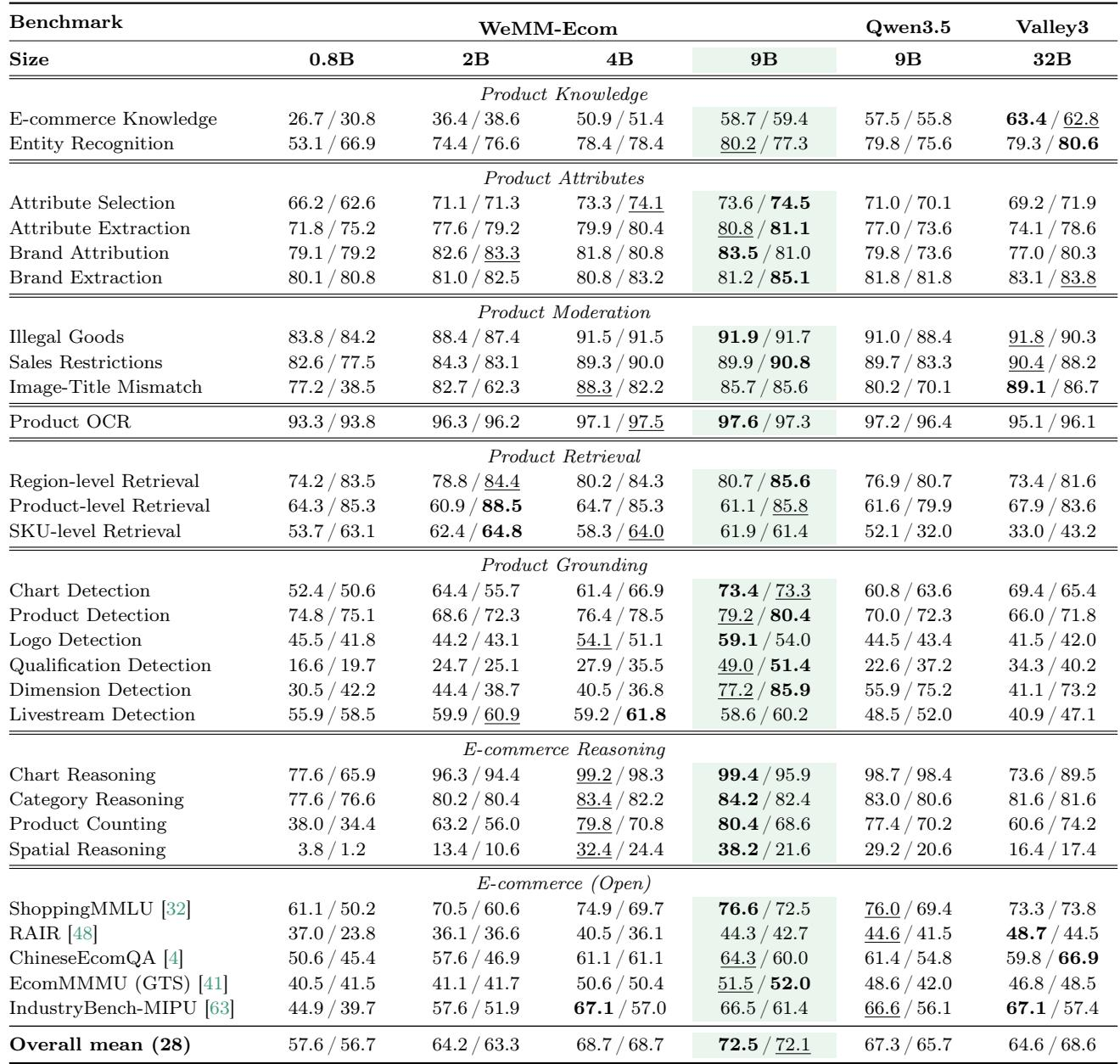
Dense WeMM-Ecom models improve with scale on e-commerce benchmarks, and the 9B model leads overall by outperforming Qwen3.5-9B and Valley3-32B in both thinking and non-thinking averages. Compact models also benefit strongly from scale, with the largest non-thinking gains over size-matched Qwen3.5 at the 0.8B and 2B sizes. Across task families, entity recognition and attribute extraction score much higher than e-commerce knowledge, though larger models substantially improve the weaker knowledge task. The dense 9B model achieves the highest overall e-commerce performance among the compared dense models, surpassing Qwen3.5-9B and Valley3-32B in both thinking and non-thinking modes. The largest non-thinking improvements over size-matched Qwen3.5 occur at the 0.8B and 2B scales. Entity recognition and attribute extraction are much stronger than e-commerce knowledge, and larger WeMM-Ecom models show the largest gains in the lower-scoring knowledge task.
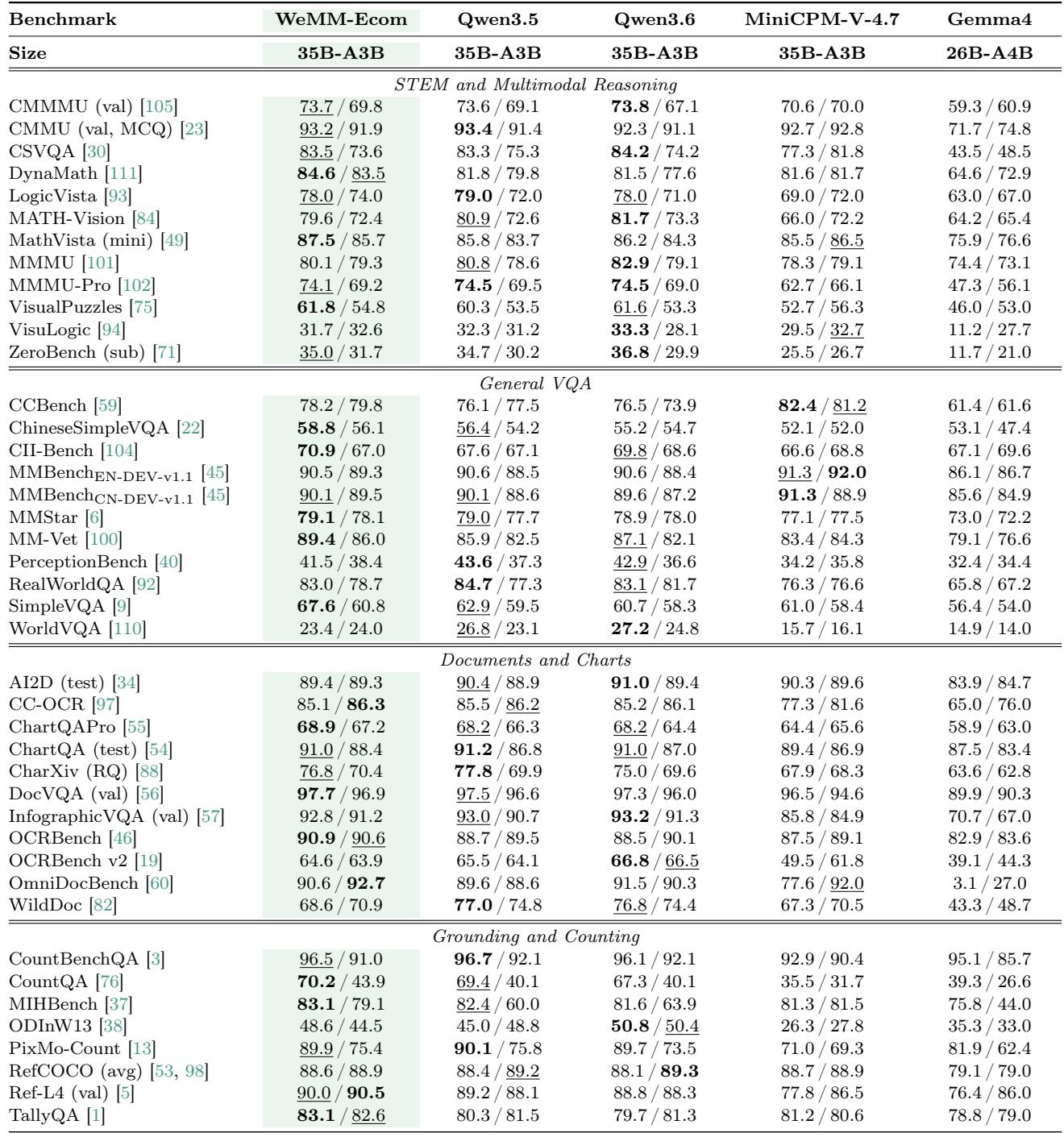
WeMM-Ecom-35B-A3B is competitive with comparable 35B-A3B and 26B-A4B models on general benchmarks. It records the highest overall average in thinking mode and outperforms Qwen3.5-35B-A3B in non-thinking mode, while showing particular strength on DynaMath. Qwen variants occasionally lead on individual datasets, but WeMM-Ecom remains among the top scorers across the reported tasks. In thinking mode, WeMM-Ecom-35B-A3B achieves the highest overall average, narrowly ahead of both Qwen3.5-35B-A3B and Qwen3.6-35B-A3B. In non-thinking mode, WeMM-Ecom-35B-A3B outperforms Qwen3.5-35B-A3B by 1.6 points. On DynaMath, WeMM-Ecom-35B-A3B leads all compared models in both thinking and non-thinking modes; on LogicVista and CMMU (MCQ) it posts the strongest non-thinking score.
The experiments validate a training setup where continued pre-training data spans five e-commerce domains, including product understanding, auditing, retrieval, knowledge QA, and content generation, followed by a four-stage pipeline in which likelihood-based CPT consumes most tokens while OPD and RL use teacher scores and task rewards. The resulting WeMM-Ecom-35B-A3B achieves the highest overall e-commerce benchmark average among open-source flagship models despite using far fewer parameters, with its edge driven mainly by product retrieval and grounding, whereas larger baselines remain stronger on knowledge and entity recognition. Dense model results show consistent gains from scaling, especially for smaller sizes and weaker knowledge tasks. On general benchmarks, the model stays competitive, leading in thinking mode and showing particular strength on DynaMath.