Command Palette
Search for a command to run...
Real2SimLab: A Unified Platform for Real-to-Simulation Transfer
Real2SimLab: A Unified Platform for Real-to-Simulation Transfer
Abstract
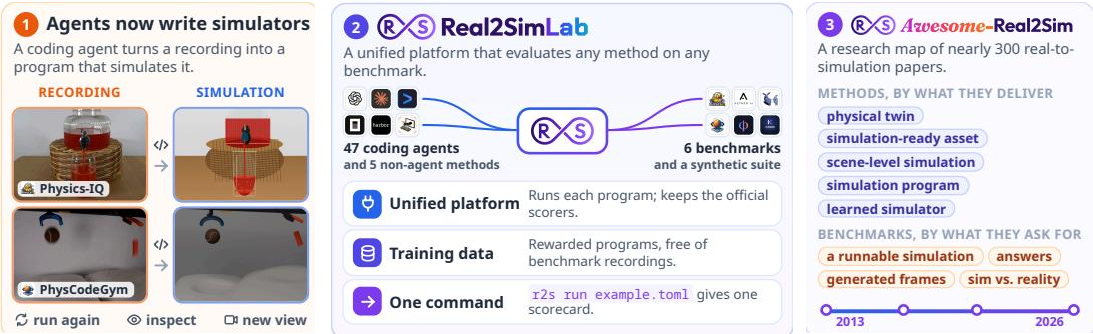
Real-to-simulation transfer, which builds simulations from real-world observations, has long been studied in research and industry. Recently, coding agents have be come capable of generating simulation programs from video recordings, and several benchmarks have been proposed to evaluate them. However, each individual benchmark defines its own inputs, deliverables, and scoring pipeline. This leads to N × M integrations when evaluating N methods on M benchmarks. To this end, we present Real2SimLab, a unified platform for real-to-simulation transfer. It evaluates a method by running its written program and scoring the output simulation with the original scorer of each benchmark. Moreover, Real2SimLab provides a pipeline to create training data and reward annotations for real-to-simulation methods. Our pipeline carefully avoids data contamination by filtering out the video recordings that exist in benchmarks. For each video recording, a program is first produced, and then our pipeline computes its reward with the same code that Real2SimLab uses for evaluation. So far, it supports 47 coding agents and 5 non-agent methods on 6 benchmarks. Both the platform and Awesome-Real2Sim, our research map of nearly 300 real-to-simulation papers, are open source, and we invite the Real2SimHub community to build them together.
One-sentence Summary
Researchers from Peking University, Ngoro Robotics, and The University of Hong Kong propose Real2SimLab, a unified open-source real-to-simulation platform that executes and scores simulation programs using each benchmark's original scorer and provides contamination-filtered training data and reward annotations for 47 coding agents and 5 non-agent methods across 6 benchmarks.
Key Contributions
- Real2SimLab is a unified evaluation platform for real-to-simulation transfer that runs a method’s written program and scores the output simulation with each benchmark’s original scorer, reducing N × M integrations to N + M.
- Its training data and reward annotation pipeline filters out video recordings appearing in any evaluation task to avoid contamination and computes rewards using the same evaluation code as the platform.
- The open-source platform supports 47 coding agents and 5 non-agent methods on 6 benchmarks and includes Awesome-Real2Sim, a research map of nearly 300 real-to-simulation papers.
Introduction
Real-to-simulation transfer converts real-world observations such as videos, images, and 3D scans into runnable simulations, enabling object and scene reproduction, analysis, and reuse across vision, graphics, and robotics. Prior methods are mostly dedicated pipelines built for one input and output type, and existing benchmarks each define their own data formats, deliverables, and scoring environments. As a result, evaluating N methods on M benchmarks requires N×M integrations, which makes cross-benchmark comparison expensive and fragmented. The authors introduce Real2SimLab, a unified platform that treats the simulation program produced by a method as the common interface between methods and benchmarks. It connects each method and benchmark once through adapters, reduces integration cost to N+M, preserves each benchmark’s official scorer, and adds a contamination-filtered training-data pipeline plus an open research map.
Dataset
Dataset description
Task schema and composition
- Each task is a directory with a metadata file and two data directories:
visible/andhidden/. visible/holds everything a method may see: the recording, known camera parameters, and a scene description.hidden/holds scorer-only material: reference output, official scorer inputs, and other recordings of the same event when available.- The hidden part is never mounted into a method sandbox. Task validation rejects tasks whose visible part contains hidden content, names hidden files, or contains symbolic links.
- The metadata file describes the deliverable convention and output format, runtime image, time budget, hardware, and data license.
Sources and benchmark subsets
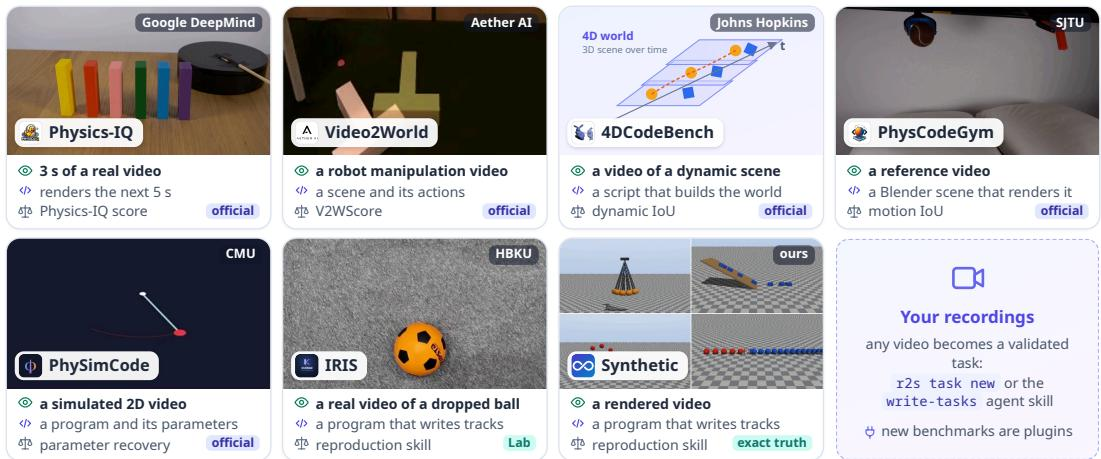
- The dataset is assembled from six existing benchmarks plus a synthetic suite created by the authors.
- Each benchmark adapter downloads the original data at a pinned revision and builds task directories from it. It also states which official protocol it follows and which parts of the benchmark are omitted.
- Five of the six existing benchmarks keep their official scorers through the native protocol.
- IRIS is handled differently: it publishes videos of real physical systems but no trajectories, so the adapter extracts the ball trajectory from each video and scores deliverables with the reproduction protocol. It covers the IRIS ball-drop class, one of eight classes.
- The synthetic suite renders five phenomena with exact ground truth: a bouncing ball, a damped pendulum, a sliding block, a projectile with drag, and a collision between two balls. It serves as a check of the reproduction protocol and as a source of training tasks.
- The paper does not report total task counts, but the synthetic suite can generate any number of training scenes.
- Adapter checks include matching Physics-IQ official pipeline scores on the same videos and reproducing recorded Video2World scores on Push-T. Adapters also document issues such as two duplicated IRIS recordings.
Training data construction
- Training tasks use the same format as evaluation tasks but are marked for training. Their hidden part holds labels such as reference trajectories, true parameters, and the true program.
- Users can convert their own recordings and reference outputs, such as object trajectories, into training tasks.
- A benchmarkwise adapter can build a training split only if a benchmark releases one under terms that allow training. None of the six benchmarks currently does so. For example, Physics-IQ test data is never exported for training because its terms forbid using test data to improve a score.
- The main training data source today is generated synthetic scenes from the five synthetic phenomena, with exact labels and the true program.
- Each synthetic scene is rendered anew from parameters drawn from fixed ranges. A draw is kept only if at least one parameter differs by more than 5% from the evaluation task of the same phenomenon, avoiding near copies.
Processing and filtering
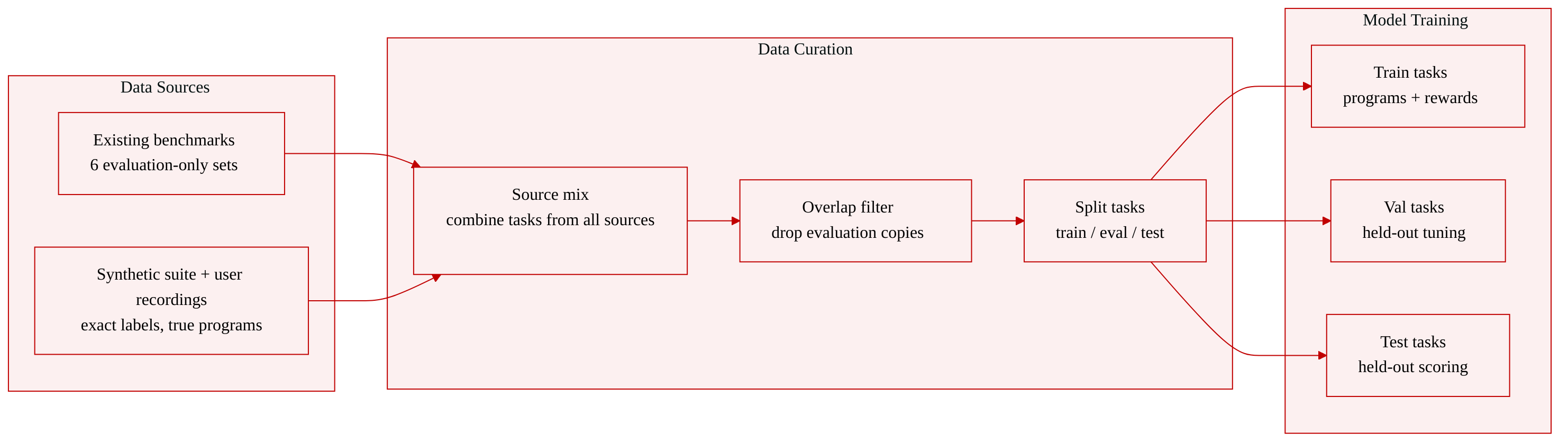
- Each recording serves either training or evaluation, never both.
- Before writing a dataset, every training task is compared with evaluation tasks, and overlapping tasks are left out. Overlap means sharing a file or showing the same recording.
- Same-recording detection reduces frames in which something moves to small thumbnails and compares them at every time offset. This catches copies that are re-encoded, resized, clipped, brightened, or reduced to a lower frame rate.
- In reported tests, this check found 36 of 40 synthetic evaluation video copies and all 27 clips that PhysCodeGym reuses from Physics-IQ. Near its threshold, it errs toward leaving a task out.
- For each training task, a method writes a program as in evaluation. Real2SimLab freezes the program, runs it offline, and scores its output with the same scoring code. The reward is the evaluation score, which for synthetic scenes or user recordings is the reproduction skill.
- Official scorers of the six benchmarks are used only for evaluation because their data are never used for training.
- A failure outside the program, such as a sandbox that does not start, gives no reward rather than a reward of 0.
- The exported dataset contains training tasks and runs. Each run holds the program, its reward, and the redacted agent log.
How the data is used
- Stored rewards support offline training, such as fine-tuning on high-reward programs and preference learning on pairs of programs for the same task.
- Online reinforcement learning can score each new program as soon as it is generated. Because each reward covers a whole program, group-relative methods such as GRPO and RLOO suit this setting.
- The authors state that they have not yet trained a model in these ways.
- When evaluating a trained method, the overlap check runs again. Training-task thumbnails are stored with the trained model, and later evaluation skips overlapping tasks, marks them as not held out, and reports scores only on held-out tasks.
Method
The authors introduce Real2SimLab as a standardized platform that sits between evaluation methods and benchmarks to resolve inconsistencies in inputs, deliverables, and scoring pipelines.
As shown in the figure below:
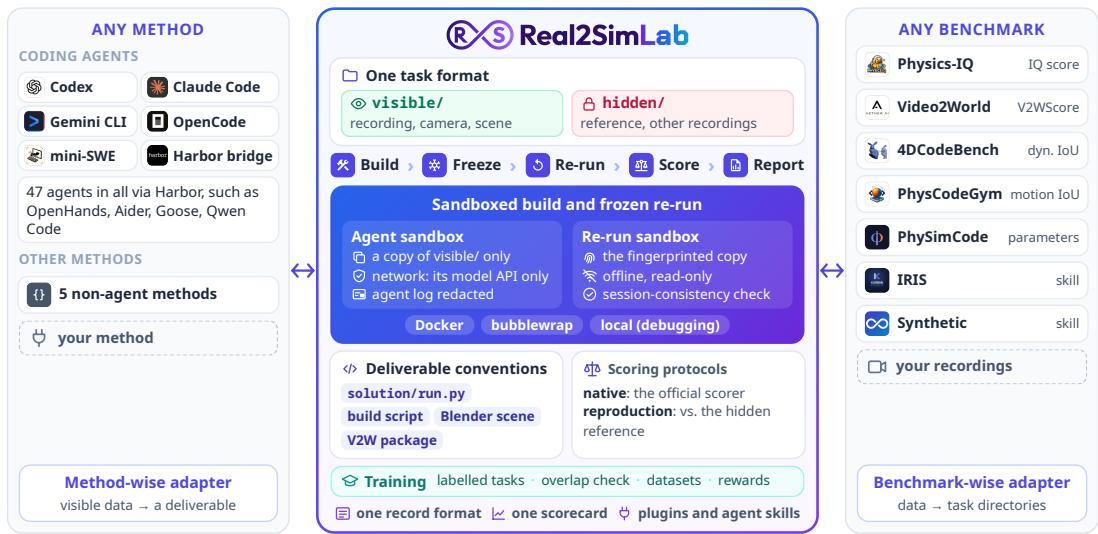
The platform enforces a shared task format where each task is divided into a visible directory, containing data the method can access such as recordings and camera parameters, and a hidden directory, holding reference outputs and inputs for the scorer. A method, which can be a coding agent or a non-agent algorithm, processes the visible data to produce a deliverable. This deliverable typically contains a program, such as a Python script or a simulation package, that generates the required output when executed.
To ensure that evaluation scores reflect the quality of the program itself rather than the specific session in which it was written, the platform implements a rigorous freezing and re-running process. Once a method produces a deliverable, the platform copies and fingerprints it. The frozen program is then executed offline in a read-only sandbox environment, such as Docker or bubblewrap, without access to the hidden data. This process verifies session consistency by comparing the re-run output to the original session output, and checks reproducibility by running the program twice with the same random seed.
Scoring is handled through two primary protocols. The native protocol utilizes the official scorer of a benchmark at a pinned commit. The reproduction protocol is used for data without an official program scorer and computes a reproduction skill defined as 1−e/estatic, where e is the error of the deliverable and estatic is the error of a static scene.
The platform adapts multiple existing benchmarks and provides a synthetic suite, each with specific deliverable conventions and scoring metrics.
As shown in the figure below:
Beyond evaluation, the authors leverage the platform to create a pipeline for generating training data with reward annotations for real-to-simulation methods.
The training data pipeline is illustrated in the figure below:
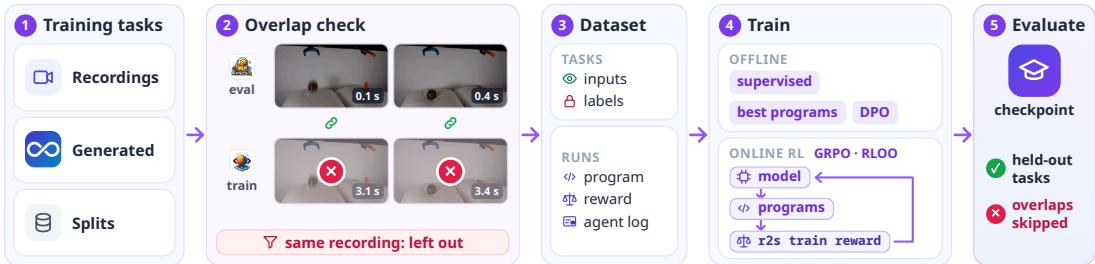
The pipeline constructs training tasks from user recordings, released training splits, or synthetic scene generators. To prevent data contamination, a strict overlap check is performed. The platform reduces frames containing motion to small thumbnails and compares them at every time offset against evaluation tasks. If a training task shares a recording with an evaluation task, it is excluded from the dataset.
For the remaining tasks, a method writes a program which is then annotated with a reward. This reward is computed using the exact same evaluation code as the reproduction protocol, ensuring consistency. Failures caused by infrastructure issues, such as sandbox startup failures, are recorded as no reward rather than a zero score, allowing trainers to distinguish between method failures and platform failures. The resulting dataset, containing tasks, programs, rewards, and redacted agent logs, supports both offline training techniques like fine-tuning and preference learning, as well as online reinforcement learning methods such as GRPO and RLOO. When a trained method is subsequently evaluated, the platform again checks for overlaps with the training data and skips any evaluation tasks that are not held out.
Experiment
Real2SimLab freezes and re-runs deliverables in isolated Docker or bubblewrap sandboxes, checking that outputs are session-consistent and reproducible, and it builds separate session and rerun task variants for benchmarks that officially score session outputs. For scoring, it uses each benchmark's native scorer where possible and otherwise applies a reproduction protocol that compares simulated trajectories against hidden references and static scenes. Infrastructure errors are excluded from statistics, and scorecards report benchmark headline numbers with bootstrap confidence intervals and reference points to clarify whether scores are meaningful.
Shared evaluation platforms give a field a common way to test many systems. Language model platforms score outputs across many tasks, agent platforms verify patches or container states, and robot policy platforms assess policies in simulation or on real robots. Real2SimLab applies this pattern to real-to-simulation transfer, where the tested system delivers a simulation program. Language model platforms run many models on many tasks and score outputs with shared metrics or LLM judges. Agent platforms check coding patches with unit tests or verify final container states with task-specific verifiers. Robot policy platforms either measure task success in simulated versions of real setups or rank real-robot policies through pairwise preferences. Real2SimLab scores delivered simulation programs using native benchmark scorers where available, otherwise comparing simulated object trajectories against a hidden reference.
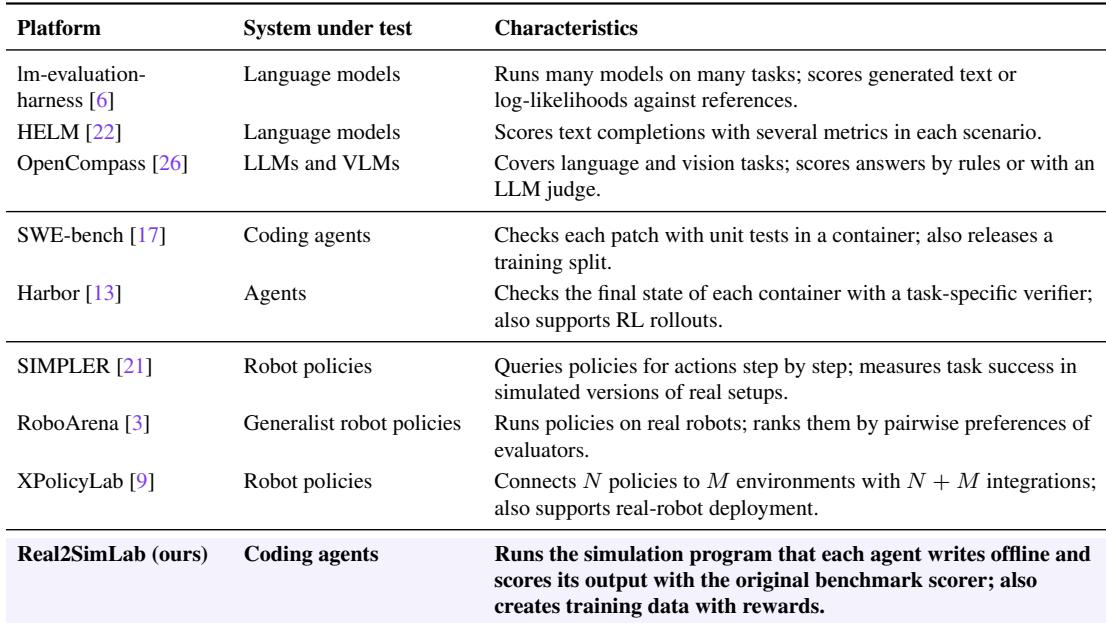
The text compares shared evaluation platforms across language modeling, agent systems, robot policies, and real-to-simulation transfer. It positions Real2SimLab as applying this platform pattern to systems that deliver simulation programs, validating them through native benchmark scorers or trajectory comparison against a hidden reference when such scorers are unavailable. Other platforms rely on shared metrics or LLM judges for language outputs, unit tests or container-state verifiers for agents, and simulated success or pairwise preferences for robot policies.