Command Palette
Search for a command to run...
Unified differentiable learning of electric response
Unified differentiable learning of electric response
Stefano Falletta Andrea Cepellotti Anders Johansson Chuin Wei Tan Marc L. Descoteaux Albert Musaelian Cameron J. Owen Boris Kozinsky
Abstract
Predicting response of materials to external stimuli is a primary objective of computational materials science. However, current methods are limited to small-scale simulations due to the unfavorable scaling of computational costs. Here, we implement an equivariant machine-learning framework where response properties stem from exact differential relationships between a generalized potential function and applied external fields. Focusing on responses to electric fields, the method predicts electric enthalpy, forces, polarization, Born charges, and polarizability within a unified model enforcing the full set of exact physical constraints, symmetries and conservation laws. Through application to α-SiO₂, we demonstrate that our approach can be used for predicting vibrational and dielectric properties of materials, and for conducting large-scale dynamics under arbitrary electric fields at unprecedented accuracy and scale. We apply our method to ferroelectric BaTiO₃ and capture the temperature dependence, frequency dependence, and time evolution of the ferroelectric hysteresis, revealing the underlying intrinsic mechanisms of nucleation and growth that govern ferroelectric domain switching.
One-sentence Summary
The authors propose an equivariant machine-learning framework that unifies the prediction of electric enthalpy, forces, polarization, Born charges, and polarizability by deriving all response properties from exact differential relationships of a generalized potential function, enabling large-scale dynamics under arbitrary electric fields at unprecedented accuracy and revealing the intrinsic mechanisms of nucleation and growth that govern ferroelectric domain switching.
Key Contributions
-
An equivariant machine-learning framework derives response properties from exact differential relationships between a generalized potential function and applied electric fields, unifying electric enthalpy, forces, polarization, Born charges, and polarizability under physical symmetries and conservation laws.
-
Density-functional-theory training on α-SiO₂ enables accurate prediction of vibrational and dielectric properties and supports large-scale dynamics under arbitrary electric fields beyond conventional first-principles simulations.
-
Application to ferroelectric BaTiO₃ reproduces the temperature and frequency dependence of ferroelectric hysteresis and its time evolution, revealing intrinsic nucleation and growth mechanisms governing domain switching.
Introduction
Predicting how materials respond to external stimuli is central to computational materials science because it underpins the design of devices that exploit electric, mechanical, or thermal fields. Prior computational methods, especially first-principles approaches, often remain limited to small systems and short timescales because their cost grows too steeply with system size. The authors address this limitation by implementing an equivariant machine-learning framework for response properties, built from exact differential relationships between a generalized potential function and applied external fields. For electric-field response, their unified model predicts electric enthalpy, forces, polarization, Born charges, and polarizability while enforcing physical constraints, symmetries, and conservation laws, enabling accurate large-scale dynamics and mechanistic studies of ferroelectric switching.
Dataset

-
The authors construct a small DFT-labeled training set for two materials, alpha-SiO2 and BaTiO3, with 275 uncorrelated frames in total.
-
The alpha-SiO2 subset contains 200 frames. These come from classical MD simulations using the Vashishta potential in the NVT ensemble at 300 K and 600 K, each for 100 ps. The authors sample 100 uncorrelated snapshots from each run at 1 ps intervals.
-
The BaTiO3 subset contains 75 frames. These are collected with active-learning MD using FLARE at temperatures from 300 K to 400 K, including 60 frames starting from a pristine structure and 15 frames starting from a domain wall structure.
-
Each frame is labeled with DFT quantities: energy, atomic forces, and polarization without electric field. Born effective charges and polarizability are obtained from additional DFT calculations with a small uniform electric field of 0.36 MV per cm.
-
The electric-field perturbation is kept small to remain in the linear polarization regime. Born charges are extracted from finite differences of forces with respect to field, and polarizability is computed from polarization response.
-
The DFT calculations are performed with Quantum ESPRESSO using a plane-wave density functional approach. The dataset metadata therefore includes structures with associated energy, force, polarization, Born charge, and polarizability labels.
-
The resulting frames are used as training data for supervised learning of structural and polar properties. The paper does not describe any cropping strategy; the main processing step is selecting uncorrelated frames and computing consistent DFT labels for each structure.
-
The generated data is made available in the mir-group allegro-pol GitHub repository.
Method
The authors leverage a unified differentiable framework in which the learned quantity is a scalar generalized potential energy U(riν,Λμ) that depends on atomic coordinates riν and auxiliary parameters Λμ, such as lattice vectors, volume, pressure, electric field, or magnetic field. Instead of training separate models for each response property, the framework relies on exact differential relations between the potential and its conjugate quantities. A Taylor expansion makes this dependence explicit:
U(riν+δriν,Λμ+δΛμ)=U(riν,Λμ)+∂riν∂Uδriν+∂Λμ∂UδΛμ+21∂Λμ∂Λμ′∂2UδΛμδΛμ′+21∂riν∂Λμ∂2UδriνδΛμ+⋯.This formulation connects the learning problem to Sobolev type training, because the targets include not only the potential itself but also derivatives of the potential with respect to its inputs. In the electric field case, the generalized potential is the electric enthalpy
U=U0−E⋅P,where U0 is the zero field energy and P is the polarization. The polarization follows from
Pμ=−∂Eμ∂U.The Born charges are then obtained from derivatives of polarization with respect to atomic displacements,
Ziμν∗=e1∂riν∂PμEμ=0,and the polarizability follows from derivatives of polarization with respect to the electric field,
αμν=∂Eν∂Pμ.Equivalently, because forces are gradients of the electric enthalpy with respect to atomic positions, Born charges can be obtained from the derivative of forces with respect to the electric field,
Ziμν∗=e1∂Eμ∂FiνEμ=0.This chain of derivatives is central to the model design. The network is trained to output the electric enthalpy, while forces, polarization, Born charges, and polarizability are generated by automatic differentiation.
The concrete implementation uses an equivariant local neural network architecture. The atomic environment is represented through interatomic displacements, and the electric field is treated as an additional equivariant vector input. In practice, spherical harmonic embeddings of the electric field and interatomic geometric vectors are concatenated and processed on the same architectural footing. This allows the model to learn the joint dependence of the electric enthalpy on atomic configurations and external fields without changing the core representation into a scalar field model. The scalar output is important for efficiency, because deriving all response quantities from one scalar prediction avoids separately predicting vectorial or tensorial properties.
The architecture emphasizes strict locality. Because the model uses local equivariant descriptors rather than message passing, the receptive field remains controlled by a finite cutoff. This design supports highly parallel large scale molecular dynamics simulations, including systems with very large atomic counts. The equivariant treatment is not required for the formalism to work, but it improves accuracy and data efficiency, especially when expensive labels such as Born charges and polarizabilities are learned from density functional theory calculations under finite electric fields.
The training pipeline begins with uncorrelated atomic configurations collected through molecular dynamics or active learning workflows. For each configuration, density functional theory calculations are performed at zero electric field to obtain the electric enthalpy, atomic forces, and polarization. To generate response labels, small uniform electric fields are applied along the Cartesian directions. Finite differences of forces give Born charges, and finite differences of polarization give polarizabilities. The network is then trained using labels evaluated in the zero electric field limit. This reduces the amount of required finite field data compared with methods that train on electric enthalpies and forces across many explicit electric field values.
The training objective augments the conventional energy, force, and stress loss with response property losses. The additional polarization, Born charge, and polarizability contributions are
ΔL=3NλPμ=1∑3(−∂Eμ∂U^−Pμ)modΔPμ+9NλZi=1∑Nμ=1∑3ν=1∑3−∂Eμ∂riν∂2U^−Ziμν∗+9Nλαμ=1∑3ν=1∑3−∂Eμ∂Eν∂2U^−αμν,where U^ is the predicted electric enthalpy, N is the number of atoms, and λP, λZ, and λα are loss weights. The extensive polarization and polarizability losses are normalized by system size. The polarization term uses a minimum image convention to account for the multivalued nature of polarization in the Berry phase theory. This avoids branch folding complications that can appear when training directly on polarization values. Because Born charges are per atom quantities, they provide many derivative constraints and improve the learning of polarization.
Once trained, the model is used through an interface that evaluates quantities under finite electric fields using the linear response relations. For a constant electric field, the energy, forces, and polarization can be written as
U=U0−E⋅P0−E⋅α⋅E, Fi=Fi0+eZi∗⋅E,and
P=P0+α⋅E.The quantities U0, Fi0, P0, Zi∗, and α are derived from the trained model in the zero electric field limit. This allows molecular dynamics simulations to be run under arbitrary applied fields, including time varying and spatially varying fields, without requiring separate models for different field strengths.
The translation invariance of the learned potential is built into the representation because the descriptors depend on interatomic displacements rather than absolute positions. Forces obtained as gradients of the scalar potential automatically satisfy momentum conservation. Polarization obtained as a gradient with respect to the electric field is conservative, and Born charges obtained as gradients of polarization with respect to atomic positions automatically satisfy the acoustic sum rule,
i∑Ziμν∗=0.The fact that forces are gradients of the electric enthalpy also ensures conservation of the electric enthalpy during molecular dynamics. Similarly, because polarization is a gradient of the electric enthalpy with respect to the electric field, cyclic adiabatic changes of the electric field do no net electric work,
∮P⋅dE=0.These derivative based relations are therefore not approximations imposed after training. They are structural features of the learning formulation, which couples prediction, training, and physical consistency in a single model.
Experiment
The study evaluates a unified machine-learning framework that learns electric enthalpy and derives forces, polarization, Born charges, and polarizability through differentiation, with response accuracy checked against DFT, DFPT, and experimental data. For α-SiO2, machine-learning molecular dynamics reproduces infrared spectra, dielectric response, and electronic-ionic screening, validating the model’s ability to describe field-dependent energies and polarization. For BaTiO3, hysteresis simulations agree with DFT and capture temperature, frequency, and size trends, while dipole dynamics reveal nucleation and growth of polarization domains at near-first-principles accuracy.
The table shows that the machine-learning model reproduces the main infrared vibrational frequencies of alpha-SiO2 very closely to DFT/DFPT reference values, while being somewhat lower than reported experimental frequencies. It also captures both high-frequency and static dielectric constants along and perpendicular to the optic axis, with the computed high-frequency values being close to reference calculations and modestly below experiment. Machine-learning infrared frequencies agree well with DFT/DFPT reference frequencies. High-frequency dielectric constants are reproduced nearly identically for parallel and perpendicular directions relative to reference calculations. Static dielectric constants remain close to reference and experimental values while preserving the parallel-versus-perpendicular anisotropy.
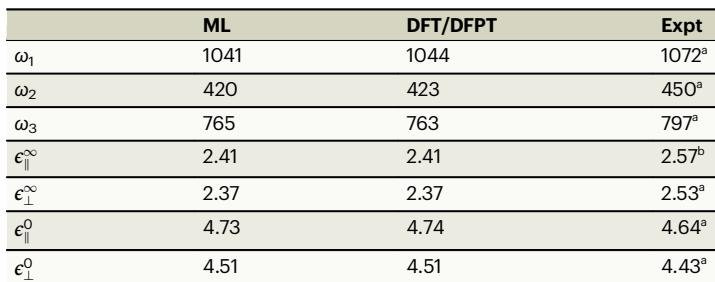
The experiments evaluate machine-learning predictions of infrared vibrational frequencies and dielectric constants for alpha-SiO2 against DFT/DFPT reference calculations and experimental data. The model closely reproduces reference infrared frequencies, with only modest underestimation relative to experiment. It also captures high-frequency and static dielectric constants along and perpendicular to the optic axis while preserving the material’s anisotropic response.