Command Palette
Search for a command to run...
Deep learning-based framework for the on-demand inverse design of metamaterials with arbitrary target band gap
Deep learning-based framework for the on-demand inverse design of metamaterials with arbitrary target band gap
Than V. Tran S. S. Nanthakumar Xiaoying Zhuang
Abstract
This study presents a deep learning framework for the forward prediction of band structures and the inverse design of metamaterials. For forward prediction, a convolutional neural network is trained to estimate the bandgap width and mid-frequency of the bandgap of metamaterials. For inverse design, a conditional variational autoencoder (cVAE) network is employed, where band structure features (bandgap width and mid-frequency of the bandgap) serve as inputs, and the network predicts unit cell topologies. Once trained, the cVAE decoder enables the rapid design of metamaterials with user-defined bandgap properties, requiring no prior knowledge. Results show that this approach accurately predicts bandgap characteristics for topologies and efficiently generates designs tailored to target properties. The method accelerates metamaterial design and optimization, offering scalability to asymmetric 2D and 3D structures, and holds promise for driving innovation in metamaterial research.
One-sentence Summary
Leibniz University Hannover proposes a deep learning framework that uses a convolutional neural network for forward prediction of band gap width and mid-frequency and a conditional variational autoencoder (cVAE) for inverse design, where these band gap features serve as cVAE inputs to rapidly generate unit cell topologies matching arbitrary target band gap properties without requiring prior knowledge.
Key Contributions
- A convolutional neural network is developed to predict the first bandgap width and corresponding mid-frequency from metamaterial unit-cell topologies, capturing the nonlinear mapping between topology and band structure.
- A conditional variational autoencoder is introduced for inverse design, taking target bandgap width and mid-frequency as inputs to generate unit-cell topologies without relying on prior design knowledge.
- Results show that the framework predicts bandgap characteristics and efficiently produces designs for target properties, supporting faster metamaterial design with potential extension to asymmetric 2D, 3D, and multi-material systems.
Introduction
Metamaterial design depends on predicting band structures, especially the first bandgap and its corresponding mid frequency, because these features determine properties relevant to vibration isolation, noise control, energy harvesting, and cloaking. Conventional design workflows often rely on repeated numerical simulations and prior knowledge, making them slow for complex systems with highly nonlinear topology and property relationships. The authors leverage a data driven deep learning framework that uses a CNN for fast forward prediction of band structures and a cVAE for inverse design, enabling efficient generation of metamaterial topologies tailored to target bandgap properties.
Dataset
-
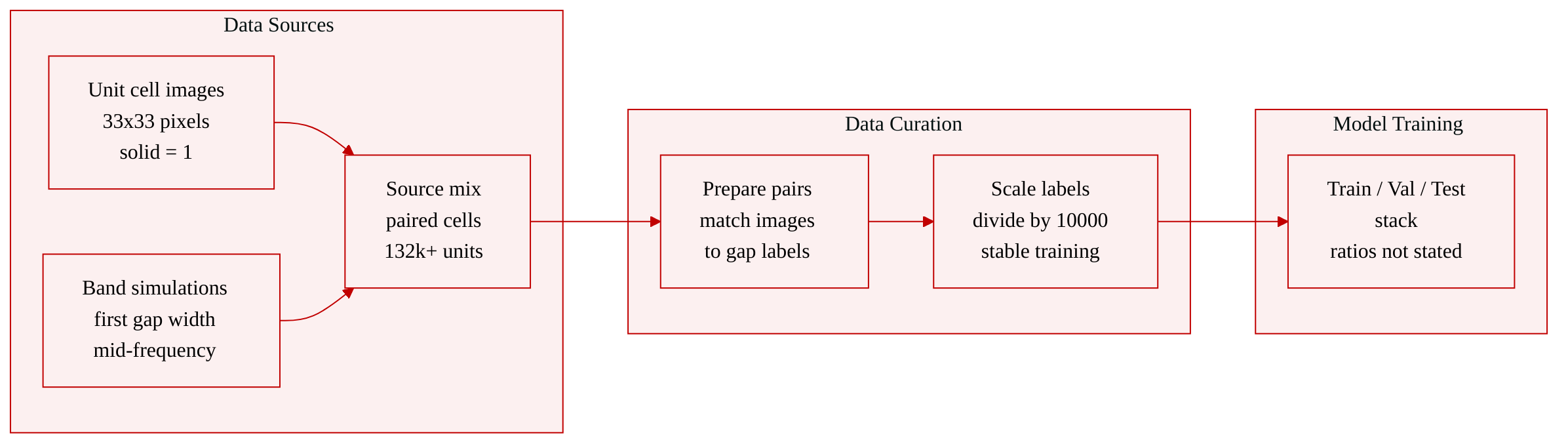
The study builds a simulation-generated dataset of 2D symmetric metamaterial unit cells. Each unit cell is represented as a 33 × 33 binary pixel image, where 1 denotes solid material and 0 denotes void, providing a compact pixel-based design representation.
-
The data are obtained through finite-element-method simulations. Numerical dispersion relations are calculated for the unit cells using elastodynamic theory and Floquet-Bloch boundary conditions along the irreducible Brillouin zone.
-
The dataset contains more than 132,000 unit cells. For each cell, the relevant simulation outcome used as a label is the width of the first bandgap and the corresponding mid-frequency. The paper does not use the full dispersion relation as the target, but computes eigenfrequencies for the first eight bands along the M-Gamma-K-M path.
-
The paired binary images and bandgap labels serve as ground-truth supervision for training and evaluating deep learning models. No explicit train, validation, or test mixture ratios are reported in the provided text.
-
During processing, the frequency-related targets are normalized by dividing by 10^4 to improve numerical stability and convergence during training.
-
The supporting data are stated to be available from the corresponding author upon reasonable request.
Method
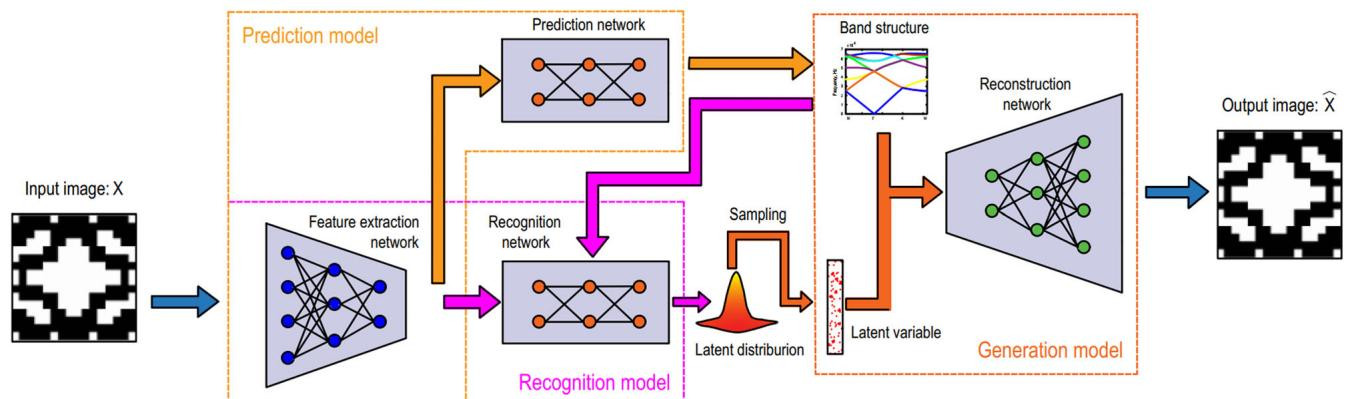
The authors leverage a deep learning framework that couples a deterministic regression model with a conditional generative model to learn the bidirectional mapping between unit cell topologies and band structure characteristics. Each unit cell is represented as a binary image, and the physical response is condensed into scalar band structure objectives such as the width of the first bandgap and its mid-frequency. These scalar targets are normalized during preprocessing to improve numerical stability during training. The overall architecture is decomposed into a feature extraction path, a prediction path, a recognition path, and a generation path. Refer to the framework diagram.
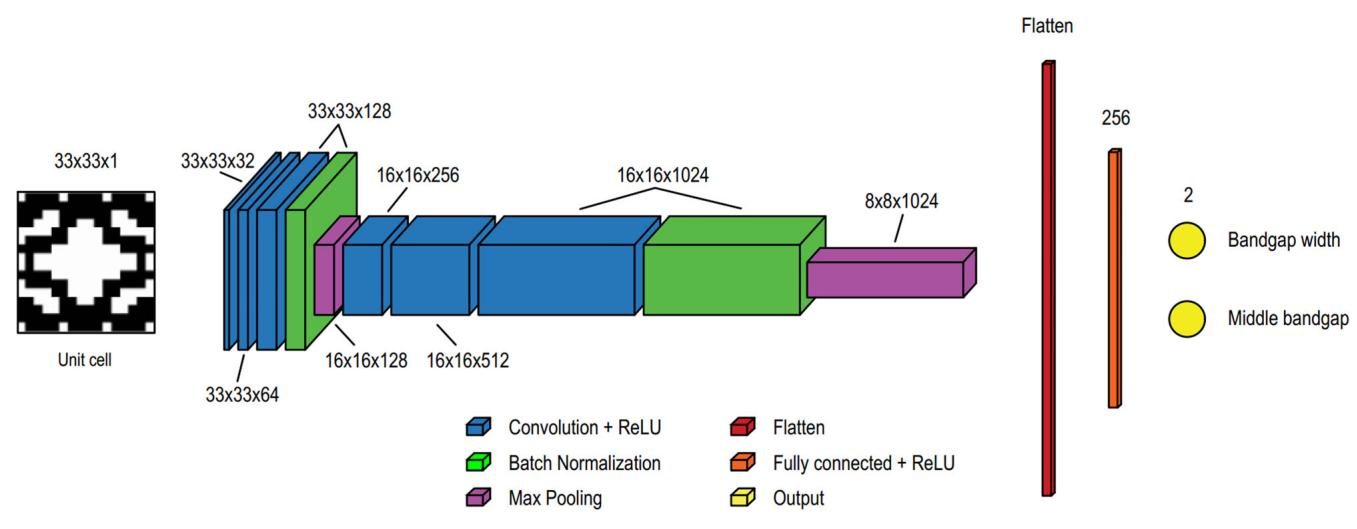
The forward prediction module treats the relationship between topology and band response as a many-to-one regression problem. Given a unit cell topology, the objective is to predict the corresponding band gap width and mid-frequency without explicitly solving the underlying wave propagation problem. The authors implement this module with a convolutional neural network, or CNN, because CNNs can learn compact and abstract representations from high dimensional spatial inputs. The network receives the binary topology image as input, extracts hierarchical features through repeated convolutional operations, and finally maps the learned features to the two continuous outputs. As shown in the CNN architecture diagram, the model uses six convolutional layers with increasing channel widths, 3×3 kernels, rectified linear unit activations, max pooling for downsampling, and batch normalization before pooling to improve convergence and stability. The feature map is then flattened and passed through two fully connected layers, producing the predicted band gap width and mid-frequency.
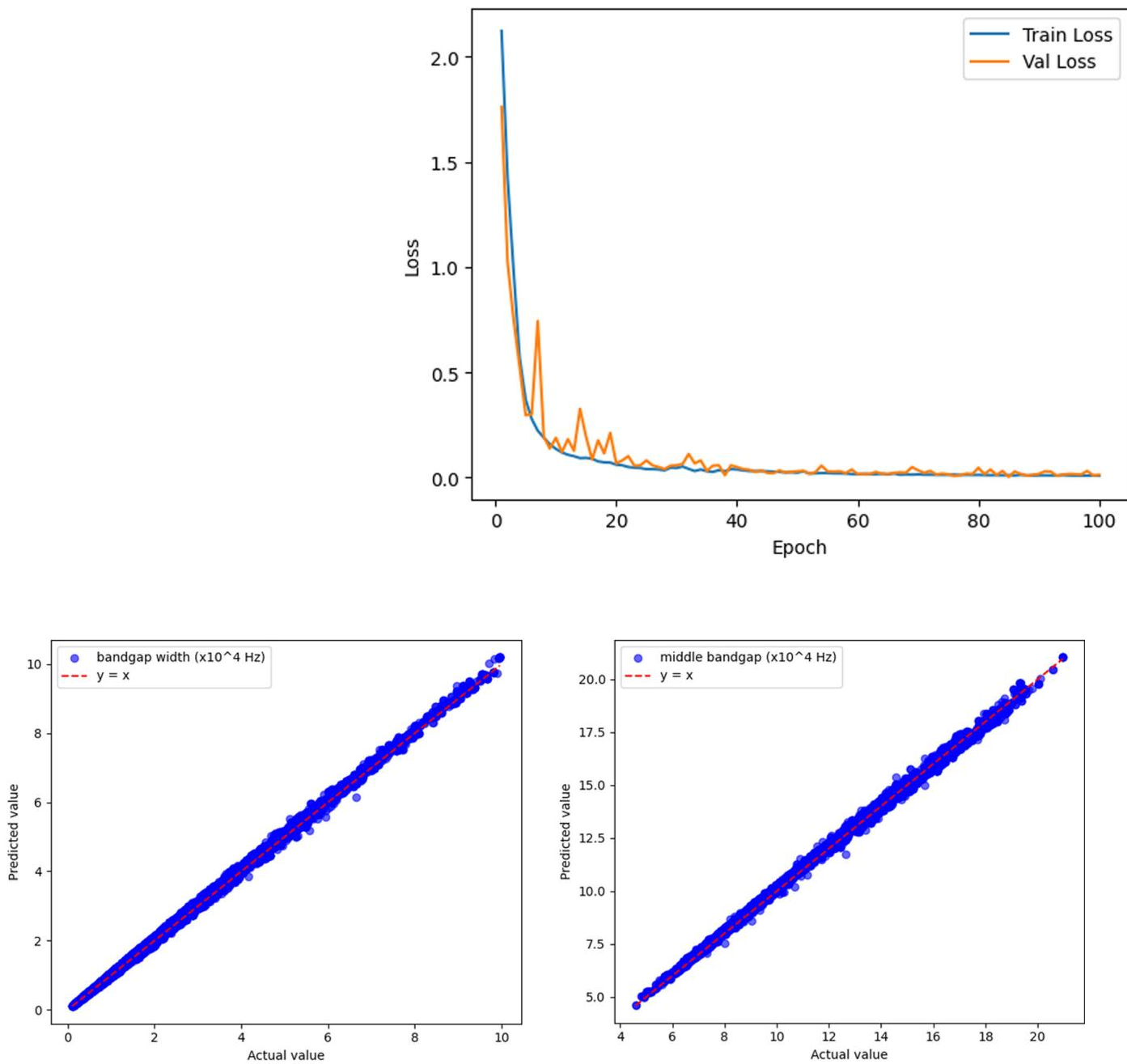
The prediction model is trained by minimizing the mean squared error between the predicted band structure features and the simulated ground truth. The optimization can be performed from scratch using Adam with a small initial learning rate and mini batches. The resulting loss curves show that the model converges quickly during early training epochs and then stabilizes on both the training and validation subsets. The predicted values also concentrate closely around the parity line when compared with the simulated values, indicating that the CNN can approximate the highly nonlinear topology to band response mapping. The training trajectory and predictive agreement are summarized in the combined training and validation figure.
The inverse design module is fundamentally more difficult because it must solve a one-to-many generation problem. Multiple distinct unit cell topologies may satisfy similar band gap requirements, so the model cannot simply regress a single structure from the desired target values. To address this, the authors use a conditional variational autoencoder, or cVAE, which generates topologies conditioned on a latent variable and on the desired band structure attributes. Let X denote the unit cell topology, let c denote the conditional vector containing the target band gap width and mid-frequency, and let z denote the latent variable. The cVAE is trained to maximize a conditional evidence lower bound, which in simplified form can be written as:
logPθ(X∣c)≥EQϕ(z∣X,c)[logPθ(X∣z,c)]−DKL(Qϕ(z∣X,c)∥P(z))Here, Qϕ(z∣X,c) is the encoder, Pθ(X∣z,c) is the decoder, and P(z) is typically chosen as a standard Gaussian prior. Stochastic sampling is handled through the reparameterization trick:
z=μϕ(X,c)+σϕ(X,c)⊙ϵ,ϵ∼N(0,I)where μϕ(X,c) and σϕ(X,c) are predicted by the encoder and ⊙ denotes element-wise multiplication. This formulation allows the latent space to remain smooth and probabilistic, so that different samples from z can produce multiple valid topologies for the same conditional target.
The cVAE operates in two stages. During training, the original topology and its target band structure condition are fed into the encoder, which produces a latent distribution from which z is sampled. The decoder then reconstructs the topology using the sampled latent variable and the same condition. The reconstruction term encourages the generated topology to match the original structure, while the regularization term encourages the latent representation to remain close to a simple prior distribution. During inference or design, the original topology is removed. The desired band structure condition and a randomly sampled latent variable are supplied to the trained decoder, which generates a new unit cell topology. Refer to the generative training and design pipeline diagram.
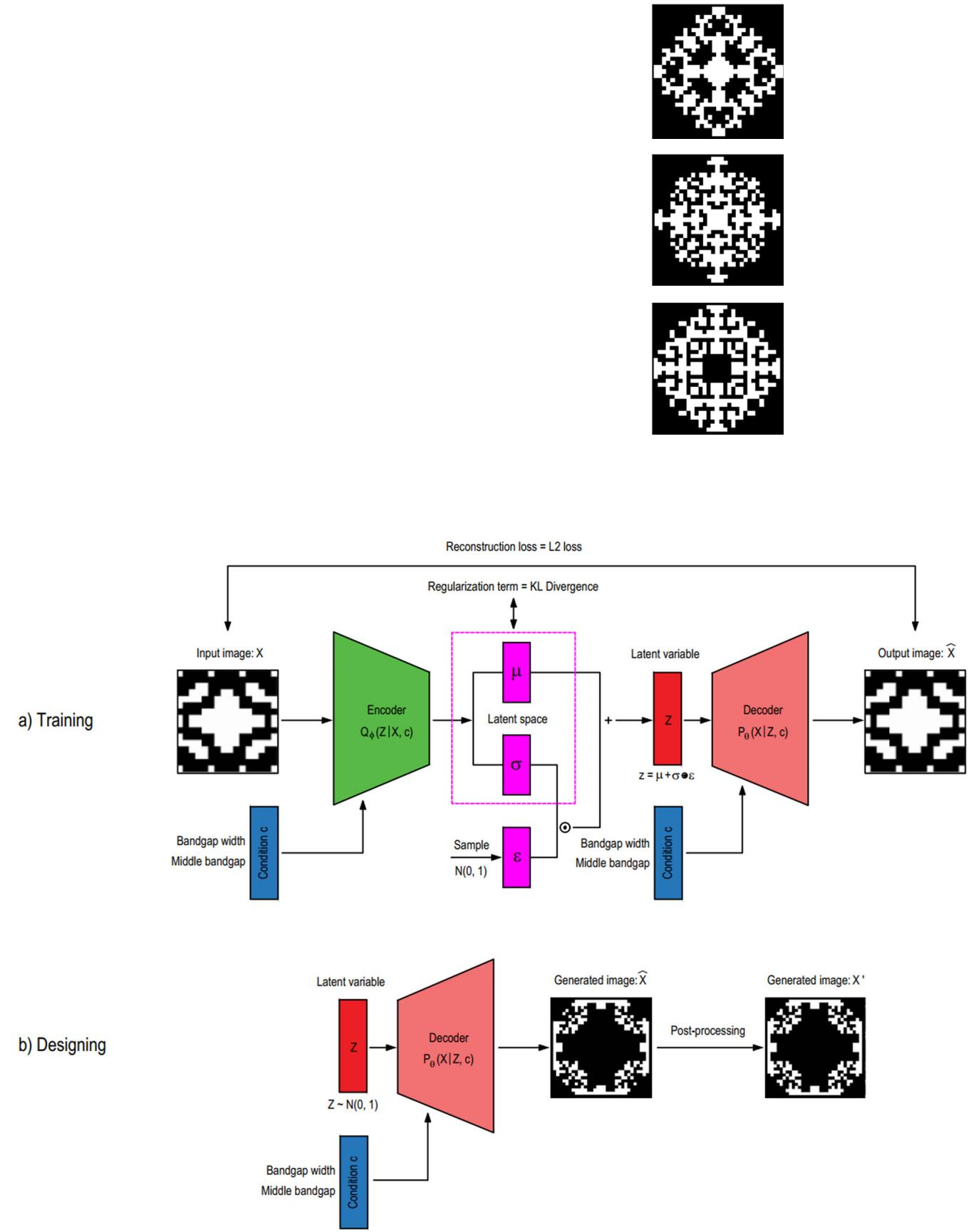
The implementation of the cVAE is asymmetric. The encoder is deeper and more compression oriented, reducing the input image dimension through convolutional layers and fully connected layers until it predicts the mean and variance of a low-dimensional latent code. The decoder is intentionally shallower to reduce the risk of overfitting while still providing sufficient capacity to recover the spatial pattern of the topology. Conditional information is injected at both ends of the model. In the encoder, the band structure condition is concatenated with a fully connected layer before latent parameter prediction. In the decoder, the condition is concatenated with the latent variable before generation. The detailed layer layout, including convolutional, fully connected, flatten, reshape, and transposed convolutional operations, can be understood through the detailed cVAE architecture diagram.
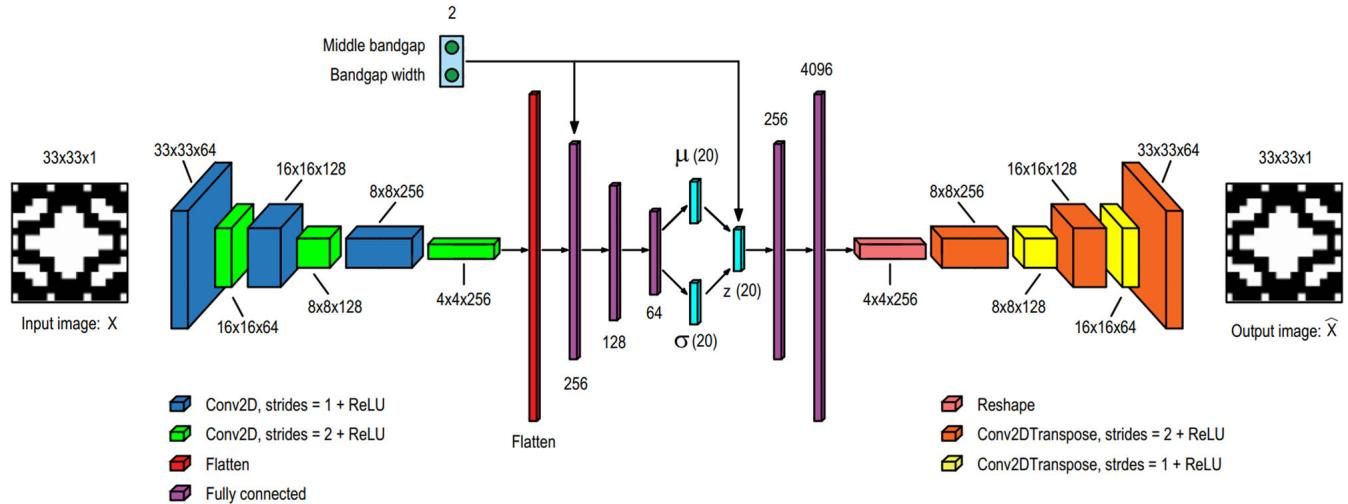
The cVAE is optimized with a combined objective that includes reconstruction loss and KL divergence regularization. The reconstruction loss penalizes mismatches between the input topology and the reconstructed topology, while the KL divergence constrains the latent distribution toward the predefined prior. Adam optimization is used with a small learning rate and a larger batch size than the CNN module. A moderate latent dimension is selected empirically, balancing compact representation with sufficient generative capacity. After generation, a post-processing workflow is applied because small decoding artifacts can appear in the output topology. A thresholding operation binarizes the soft decoded image, and median filtering is used to remove isolated noisy pixels. The generated topology can then be evaluated by feeding it back into the forward CNN model to compare the predicted band structure response with the target response. If multiple candidate topologies are generated for the same condition, the candidates can be ranked using the discrepancy between predicted and required band structure features.
Experiment
The experiments evaluate a deep learning framework for 2D symmetric metamaterials, using FEM-generated bandgap data to train a CNN for forward prediction and a cVAE for inverse topology generation. The CNN reliably maps unit-cell geometries to band-structure targets with good training stability and strong agreement on held-out samples. The cVAE retrieves feasible topologies from desired band structures, and generated designs are visually similar to ground truth and generally reproduce the target band responses after forward verification, though occasional inaccuracies, minor pixel defects, and limited structural diversity remain. Overall, the results show that the coupled prediction and generation pipeline can effectively establish the topology-band structure relationship for metamaterial design.
The prediction model shows strong agreement between predicted and actual band structure responses, with accuracy metrics remaining close to perfect for both bandgap width and mid-frequency prediction. Absolute errors are larger for mid-frequency prediction, but its relative percentage error is lower than that of bandgap width prediction. Predicted band gap metrics align closely with true values for both bandgap width and mid-frequency. Bandgap width prediction has lower absolute error than mid-frequency prediction. Mid-frequency prediction has lower relative error than bandgap width prediction.

The generation model recovers key bandgap properties with close agreement to actual values, reflected by low error metrics and high correlation for bandgap width and mid-frequency. Bandgap width exhibits the strongest overall correlation, while mid-frequency shows a smaller relative error. These results indicate that the model can connect desired band structures to feasible unit cell topologies with good quantitative fidelity. The proposed generative model produces feasible topologies that reproduce desired band structures with high fidelity. Generated topologies are mostly visually similar to original testing samples, although exact multiple topology diversity and symmetry remain limited.

The experiments evaluate a prediction model and a generative model for unit cell band structure. The prediction results show strong agreement for bandgap width and mid-frequency, with bandgap width having lower absolute error and mid-frequency having lower relative error. The generative model also reproduces key bandgap properties and feasible topologies with high fidelity, though exact topology diversity and symmetry remain somewhat limited.