Command Palette
Search for a command to run...
With Investments From SoftBank, Nvidia, Sequoia Capital, Bezos, and Others, Robotics Startup Skild AI Has Raised $1.4 Billion to Develop general-purpose Foundational models.

In mid-January 2026, robotics startup Skild AI announced the completion of a Series C funding round of approximately 14˙billion,valuingthecompanyatover14 billion. The round was led by Japan's SoftBank Group, with participation from strategic investors including Nvidia's NVentures, Macquarie Capital, and Bezos Expeditions (founded by Amazon founder Jeff Bezos). Samsung, LG, Schneider Electric, and Salesforce Ventures also participated.
For readers interested in this field, this list of investors may seem familiar. Several of them recently invested in another star robotics startup, Field AI, which is dedicated to creating a "universal robot intelligent brain" that can work across different types of robots and adapt to various environments. Meanwhile, Skild AI has explicitly declared that it will create an AI-driven robot "brain." The two companies seem to have similar strategic directions.
At a time when robot hardware is still in its formative stages and application scenarios remain highly fragmented, capital has repeatedly and consistently flowed into a few companies that do not only manufacture robots. This, to some extent, reflects the ironclad law of profit-seeking by capital and confirms that this startup, less than three years old, has chosen a promising path.
Company website: https://www.skild.ai
Any robot, any task, one brain
"Any robot. Any task. One brain."
Upon opening the Skild AI website, this ambitious slogan immediately catches the eye. It's also featured on the official X account and in a recent NDTV interview with one of founders, Abhinav Gupta.They repeatedly mentioned the motto they hold dear: "Any robot, any task, one brain," which accurately summarizes Skild AI's uniqueness compared to most robotics companies.
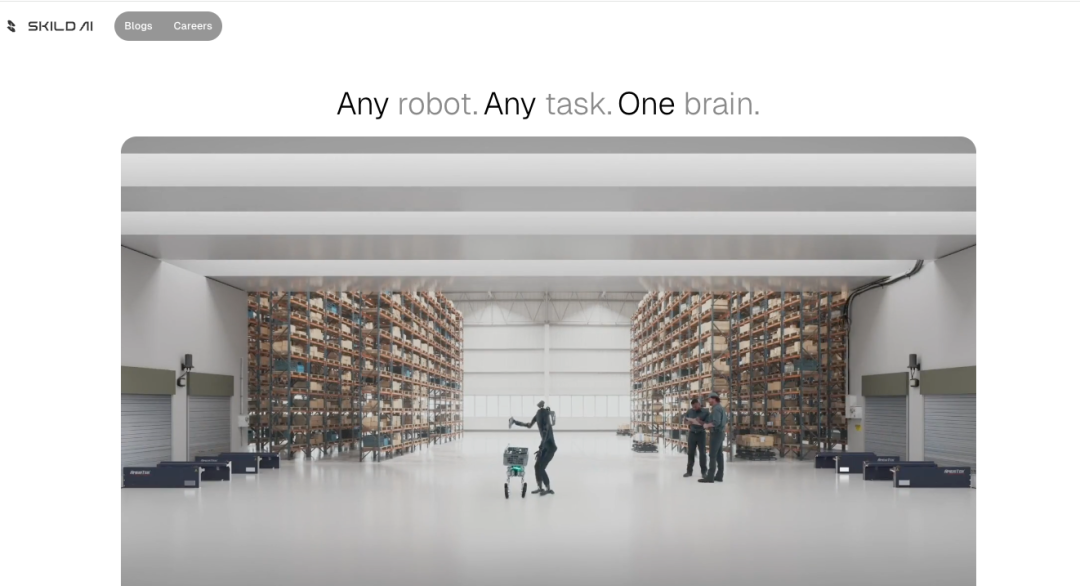
**Therefore, Skild AI's core goal is not to create a specific robot, but to develop a basic model that can be deployed on various robots.**Whether it's a humanoid robot, a quadruped robot, an industrial robotic arm, or a mobile platform, this system can operate across tasks and environments, powering omnidirectional sensory intelligence in robots. Its core value lies in providing a sustainably scalable data solution, enabling robots to adapt to the physical world through observation and learning, just like humans.
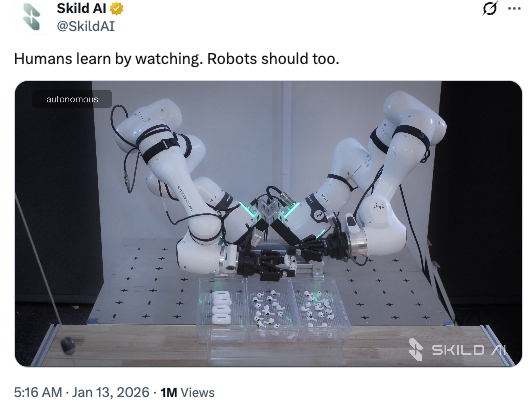
This is an interesting direction. It is well known that the success of large language models is inseparable from the massive data internet behind them, but Deepak Pathak pointed out a key pain point: "Where is the Internet for robots?" In reality, there is no ready-made "Internet for robots" containing massive amounts of physical interaction data.Their unique formula involves transforming the endless human video data on the internet into robot experience, believing that "humans learn through observation, and robots should learn the same way."
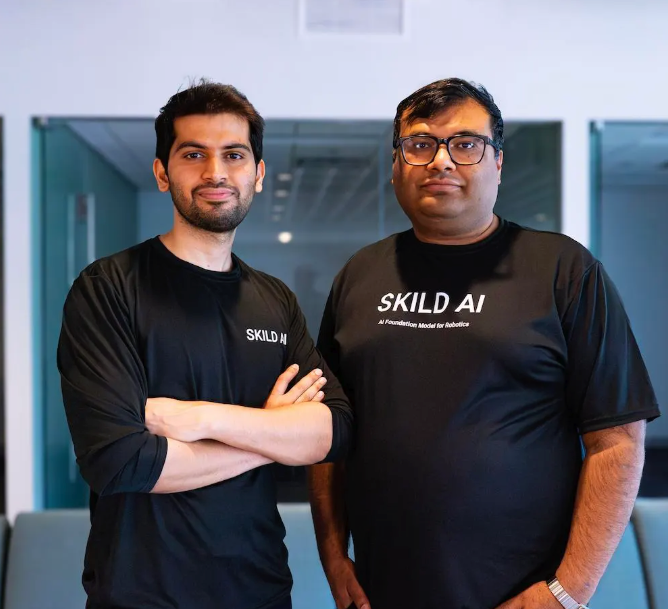
Two "Mentor-Style" Founders: From Academic Research to Industrial Application
Another interesting part of Skild AI's story is its founding team.
The company was founded by Deepak Pathak and Abhinav Gupta, both seasoned researchers in the fields of artificial intelligence and robotics. Deepak Pathak is the current CEO, with extensive experience in the interdisciplinary research of AI and robotics. Abhinav Gupta serves as the company's president and is also an academic with deep expertise in AI self-supervised learning and robot learning. Both co-founders previously taught and conducted research at Carnegie Mellon University, one of the world's earliest institutions to conduct in-depth work on the integration of robotics and AI.
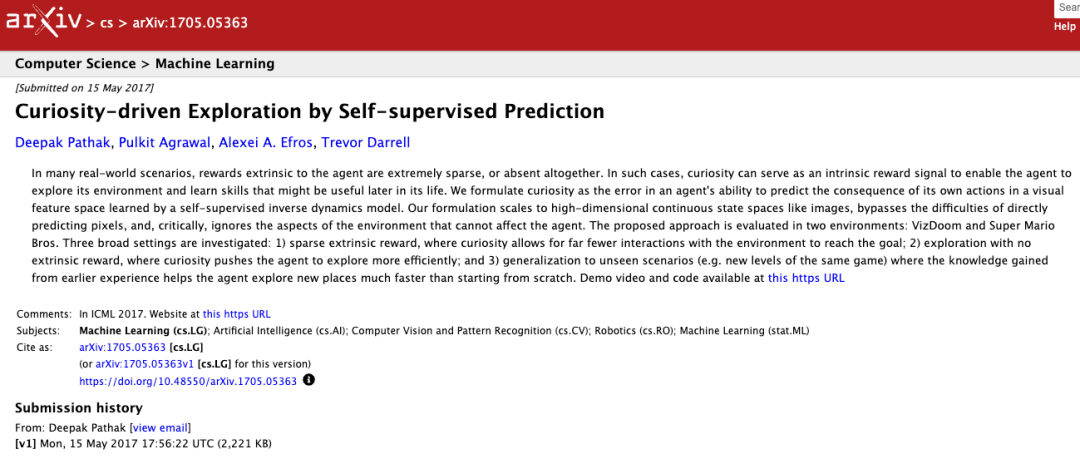
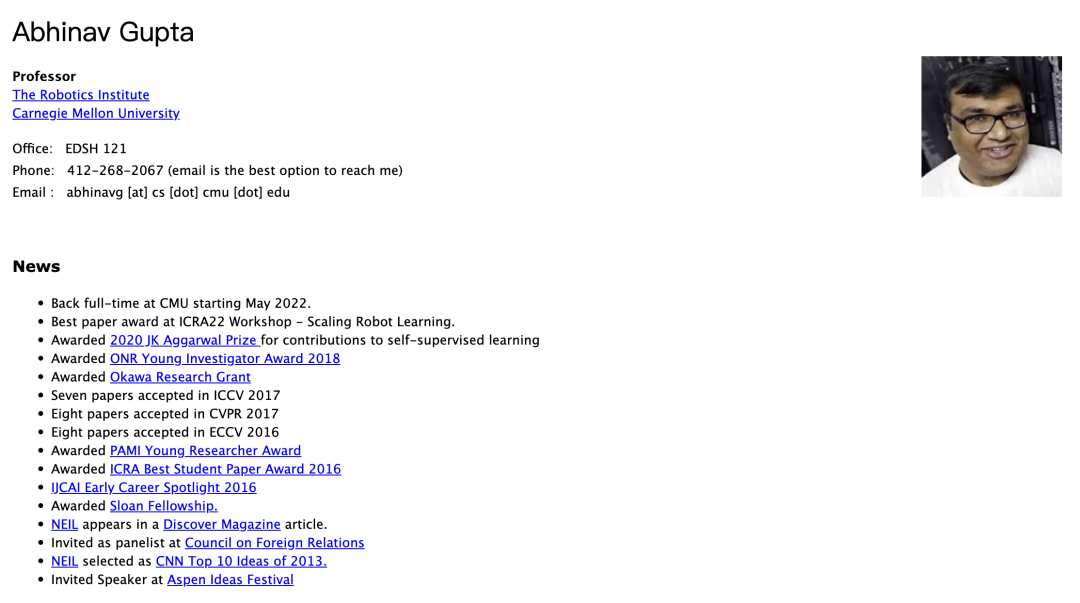
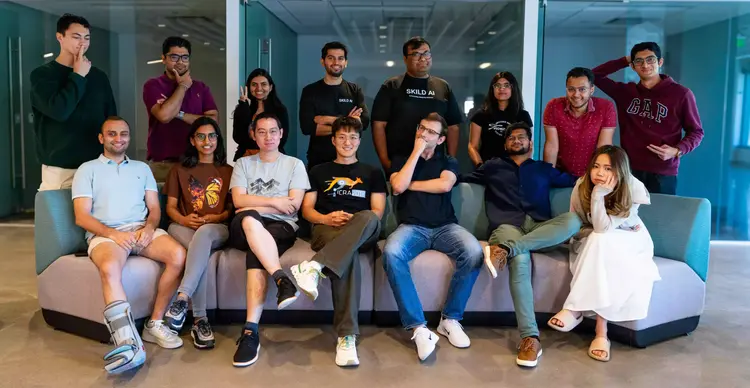
Skild Brain brings the "fundamental model" into the physical world.
If the previous concepts addressed "how robots should learn," then the core product Skild Brain answers a more engineering-oriented question: how can this learning method be truly deployed in real-world robotic systems?
According to the description on Skild AI's official technical blog, Skild Brain is not a control model trained for a single task or a specific robot form, but is positioned as a general intelligent system that can be deployed on different robot bodies. Skild Brain follows a hierarchical architecture, where a low-frequency, high-level action strategy is responsible for understanding environmental semantics and planning goals, providing input for the high-frequency, low-level action strategy. Its underlying control capabilities are achieved through fully end-to-end motion control, driven entirely by online vision and proprioception, realizing a true physical interaction closed loop.
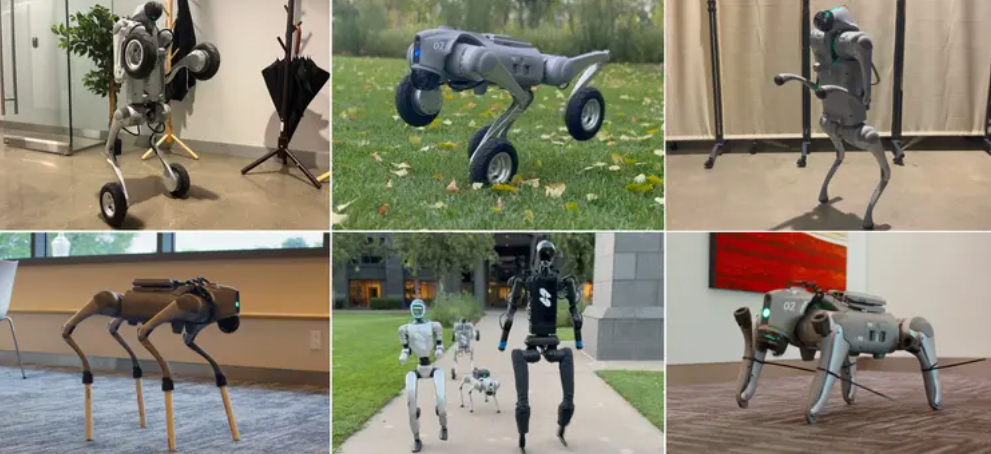
*** Omni-bodied cross-form capabilities:**Traditional robotic algorithms are often "specific to a particular machine," but Skild Brain has proven that the same pre-trained model can simultaneously drive quadruped robots, bipedal robots, and even robotic arms. By training on a large scale using diverse robot morphology data, the system can extract universal physical laws across hardware. This means that the model is no longer limited to specific motor torques or foot structures, but possesses a kind of "universal kinematic intuition."
*** Data scaling for observational learning (Learning by Watching):**Skild AI bypasses expensive human demonstrations, allowing its models to directly draw inspiration from hundreds of millions of videos of human activities on the internet. This technology transforms visual signals into physical experiences for robots, enabling them to build common-sense understanding of the physical world by observing how humans open doors and cross obstacles, thus achieving extremely strong zero-shot generalization capabilities.
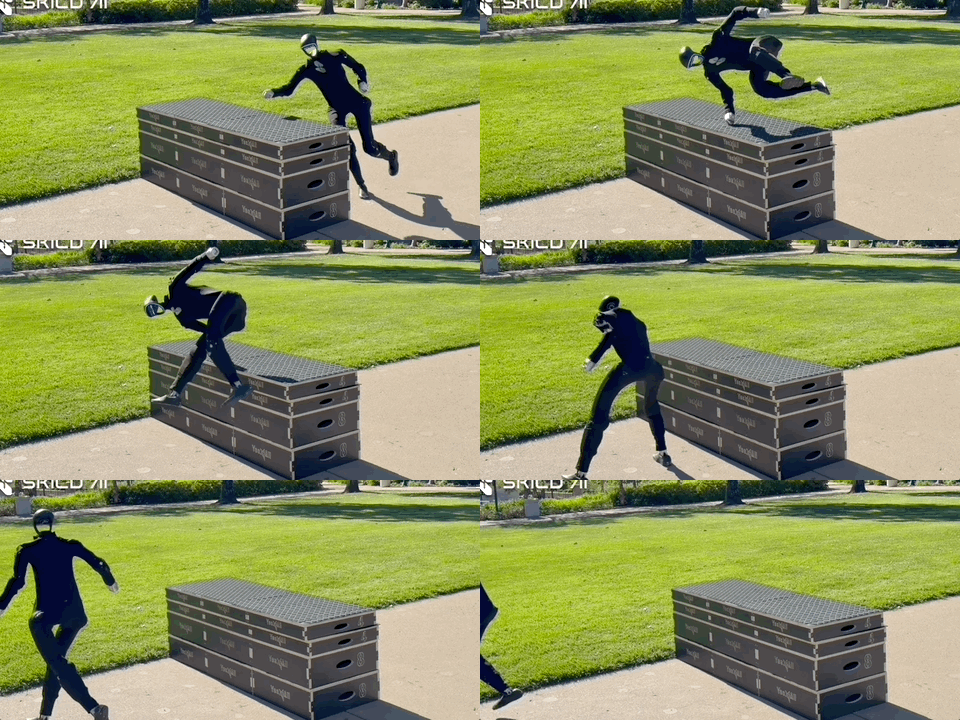
*** One Policy, All Scenarios:**In Skild AI's real-world testing, robots equipped with this system demonstrated exceptional robustness. Whether on a smooth laboratory floor, in a cluttered warehouse, or in a wild forest strewn with rocks and snow, Skild Brain could adjust its posture in real time using the same strategy. This adaptability to unknown environments is the key to enabling robots to leave the laboratory and enter various industries.
Conclusion
Skild AI did not choose the easiest path to verification, but instead bet directly on "general applicability," the most difficult and long-term problem in the field of robotics. In a stage where hardware is not yet finalized and application boundaries are still constantly changing, this choice is inherently high-risk but also offers unlimited prospects for the future. What Skild AI is trying to achieve may be a necessary prerequisite for the next stage of robotics development.
Whether general-purpose robots will truly arrive remains to be seen, but what is certain is that the industry's focus is shifting. For a long time, discussions about robots have revolved around specific forms, single scenarios, or localized performance. Now, more and more capital, researchers, and startups are turning their attention to a more fundamental question: Do robots need a truly universal and transferable intelligent foundation?
References:
1.https://www.bloomberg.com/news/articles/2026-01-14/robotics-startup-skild-valued-above-14-billion-after-softbank-led-funding-round?embedded-checkout=true
2.https://www.forbes.com/sites/rashishrivastava/2024/07/09/this-15-billion-ai-company-is-building-a-general-purpose-brain-for-robots
3.https://www.businesswire.com/news/home/20240709306400/en/Skild-AI-Raises-%24300M-Series-A-To-Build-A-Scalable-AI-Foundation-Model-For-Robotics
4.https://www.youtube.com/watch?v=yesita2zN5c