Command Palette
Search for a command to run...
Google DeepMind's Latest Paper Reveals the Ultimate Goal of AI: From AGI to ASI, There Are 4 Paths and 6 hurdles.

Over the past decade, the development of artificial intelligence has continuously exceeded expectations. AGI, once confined to science fiction, is now a clear goal for many large AI institutions looking towards the next ten years. But a more pressing question is: if AGI truly arrives, will the development of AI stagnate?
A joint research team from Google DeepMind, the University of Waterloo, the Australian National University, and University College London discussed this more distant question in a recent paper. Instead of rushing to declare that "the singularity is imminent" or offering a prediction of a specific year, it broke down the problem more calmly:**After human-level general artificial intelligence, will AI itself continue to evolve along the intelligence continuum?**If so, through what paths might it move from AGI (Artificial General Intelligence) to ASI (Artificial Super Intelligence)? And what bottlenecks might slow down, limit, or even alter this process?
This paper doesn't truly offer a timeline for the future, but rather a map for understanding the subsequent evolution of AI. It reminds us that:AGI may not be the end, but more likely just the beginning of a new phase after AI surpasses the average human level.
The relevant research findings, titled "From AGI to ASI", have been published on the preprint platform arXiv.
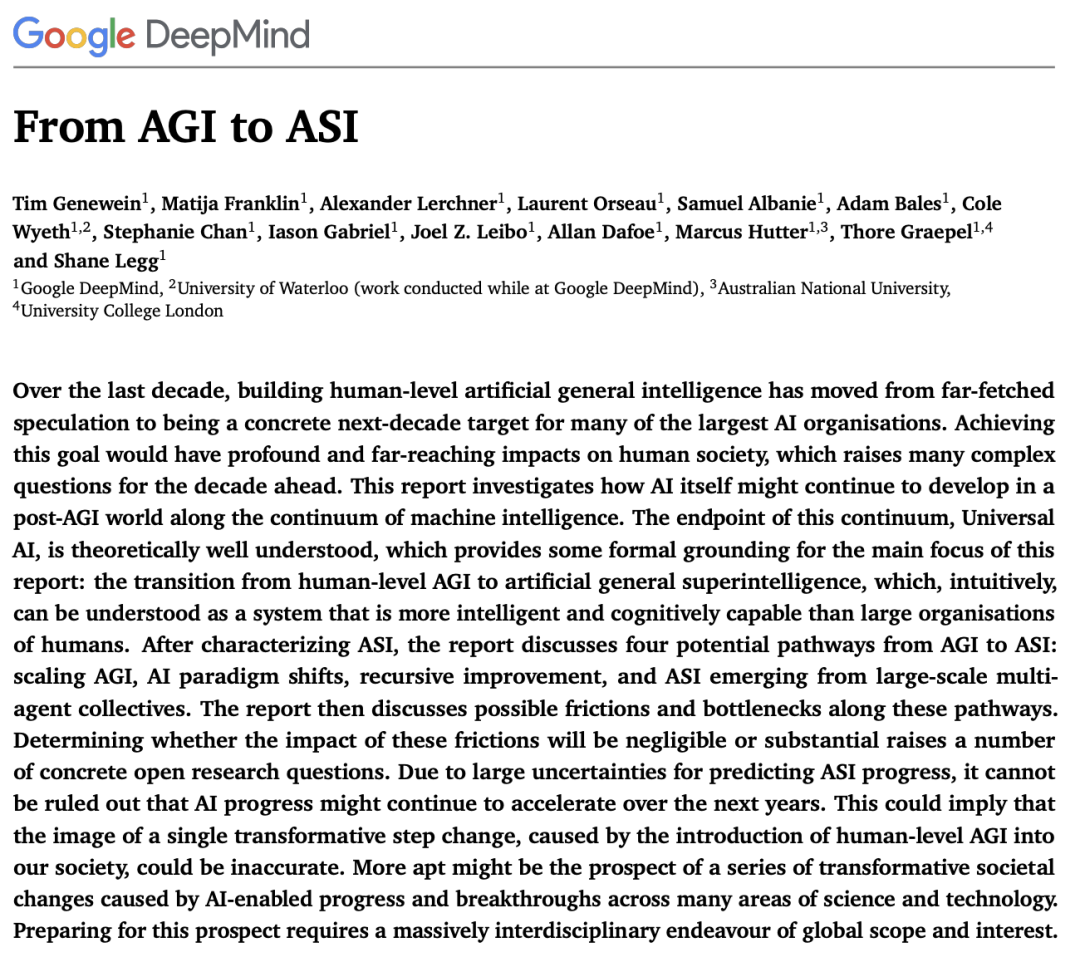 View the paper:
https://hyper.ai/papers/2606.12683/pdf
After AGI, how can intelligence continue to improve?
Before discussing "after AGI", we must first clarify one question: to what extent do we mean when we say AI has become "stronger"?
In everyday discussions, AGI is often simply understood as "AI that is as intelligent as a human." But this statement is not precise. Like whom? Like an ordinary person, or like an expert? Does it approach human-like performance in cognitive tasks such as exams, writing, and programming, or can it act, learn, plan, and self-correct in the real world over the long term? This paper adopts a relatively rough but more easily discussed definition:**AGI refers to Artificial General Intelligence, which is roughly at the level of an average human.**It is not a system that surpasses humans in a narrow task, but rather a system that possesses general abilities close to those of ordinary people in a sufficiently broad range of cognitive tasks.
This definition, though seemingly conservative, is crucial. Today's AI has already surpassed humans in many single-task areas, such as chess, protein structure prediction, code generation, and image recognition. However, surpassing humans in a single area is not the same as AGI (Artificial General Intelligence). AGI emphasizes versatility—the ability to transfer, understand, and adapt to different tasks and situations. AGI is not the end of the intelligence continuum. Continuing upwards along this spectrum leads to ASI (Artificial General Superintelligence), which is the scope of discussion.
The paper sets a very high bar for ASI—it doesn't mean that a particular AI becomes a "world champion" in a single field.**Rather, it refers to a system that possesses capabilities that surpass those of humans in almost all tasks and fields of human interest.**More importantly, it is not just about surpassing a single expert, but about reliably surpassing a large human organization composed of a large number of experts who have collaborated over a long period of time.
in other words,**AGI can be understood as "the general cognitive level of an ordinary person", while ASI is closer to "the general capabilities of a super expert organization".**The former answers whether AI can reach the average level of humans, while the latter asks: once digital intelligence can be replicated, accelerated, collaborated on, and continuously expanded, will it form capabilities far exceeding those of the human collective?
In addition to AGI and ASI, the paper also discusses a theoretical limit: UAI (Universal AI), or AIXI. **AIXI is a mathematically idealized general intelligent agent, representing the theoretical upper limit of machine intelligence. However, it is not computable.**It's not a model that can be trained and deployed today; it's more like a theoretical beacon: it tells us what machine intelligence might look like in extreme cases, and real-world systems can only approach it from below.
Thus, the paper establishes a clear coordinate system:**AGI is general intelligence at the human level, ASI is general superintelligence far exceeding that of human experts, and AIXI is the theoretical limit of intelligence.**This definition is not a conceptual game, but the foundation for all subsequent discussions. Because if AGI merely crosses the threshold of the average human level, then the real question is no longer "whether AGI will emerge," but rather: after crossing this threshold, will digital intelligence continue to climb higher?
There may be more than one path from AGI to ASI.
The paper proposes that,**There are at least four possible technical paths from AGI to ASI.**They are not mutually exclusive, nor do they necessarily occur sequentially; they are more likely to advance in parallel and overlap in the future.
**The first path is to continue expanding computing, models, and data.**Over the past decade, advancements in AI capabilities have largely stemmed from scaling: more computing power, larger models, more data, and more efficient algorithms. The question is, once AI crosses the AGI threshold, will this trend continue? Will making models larger and increasing computing power necessarily lead to a higher level of intelligence? The answer is uncertain.
However, the paper also points out that even if the growth of individual model capabilities slows down, the overall capabilities of AI systems may still continue to improve. This is because digital intelligence possesses advantages that biological intelligence lacks: it can be replicated, accelerated, paused, and resumed, and experiences can be shared with extremely high bandwidth. If an AGI system can be replicated into millions or hundreds of millions of instances, working in parallel, collaborating with each other, and running rapidly,So even if a single instance is only at the "human level", the entire system may still exhibit capabilities far exceeding those of human organizations.
**The second path is a paradigm shift in algorithms.**The mainstream AI paradigm today generally involves training large-scale foundational models on massive amounts of data, and then improving their capabilities through fine-tuning via instructions, reinforcement learning, tool usage, retrieval enhancement, and test-time inference. However, whether this approach is sufficient to achieve ASI remains to be seen.
Existing models still have significant shortcomings. For example, they are not reliable enough in continuous learning, long-term memory, robust planning, real-world interactions, causal understanding, and open-ended task execution. Moving from AGI to ASI in the future may not be as simple as just scaling up existing models.**Instead, it requires a new architecture, new training objectives, new memory mechanisms, and a new world model.**Even new hardware forms.
**The third path is recursive self-improvement.**This is the path most easily associated with the "intelligence explosion." It refers to AI beginning to participate in AI research and development, thereby accelerating the advancement of the next generation of AI. This self-improvement isn't just about AI modifying its own code. It may also include: AI helping to design better model architectures, optimize training processes, generate higher-quality data, design chips and computing systems, and automatically conduct experiments and analyze results. Once AI can significantly improve the efficiency of AI research and development, a positive feedback loop may be formed:More advanced AI helps in the development of even more advanced AI, which in turn further improves research and development efficiency.
However, the paper does not simply assert that such an explosion will definitely happen. Recursive self-improvement will also encounter real-world friction. Larger models require more expensive experiments, more advanced chips rely on the real supply chain, and more complex scientific problems require verification in the physical world. Even if AI researchers can operate at high speeds in the digital world, they may still be slowed down by experimental cycles, manufacturing cycles, and resource constraints.
**The fourth path is for ASI to emerge from large-scale multi-agent systems.**Superintelligence doesn't necessarily originate from a single model; it can also arise from a collective of numerous AGIs. The capabilities of human civilization don't stem from the individual brain, but from language, institutions, organizations, markets, scientific communities, and specialization. If AI agents can also form similar or even more efficient collaborative structures, then ASI might be an emergent result of "organizational intelligence."
In this context, future superintelligence may resemble a fully automated mega-corporation, a digital research community, or a self-organizing system composed of countless specialized intelligent agents. They can divide labor, collaborate, review, replicate, and reorganize, accumulating experience at a rate far exceeding that of human organizations. Therefore,**The evolution from AGI to ASI is not necessarily a sudden qualitative change in a certain model, nor is there necessarily only one technical route.**It is more likely the result of a combination of scaling, paradigm shift, self-improvement, and multi-agent collaboration.
Six bottlenecks: What friction forces determine speed?
If the four paths describe how AI can continue to move forward, then the six bottlenecks discuss where this evolution will encounter resistance and what factors might slow it down.
First, the dataToday's large-scale models rely heavily on training with high-quality human data, but text, code, images, videos, and expertise data are not infinite. If models continue to expand in the future, the demand for data may exceed the rate at which humans naturally produce data. Synthetic data, self-play, and simulation environments may become new data sources, but whether they can consistently provide sufficiently high-quality, fresh, and diverse data remains an open question.
**Secondly, there are resources.**Scaling up computing doesn't happen in an abstract way. It requires chips, data centers, power, cooling systems, supply chains, capital investment, and engineering personnel. If reaching ASI depends on the continued expansion of training and inference computing, then energy, land, advanced manufacturing, network infrastructure, and capital investment will all become real constraints. The growth of AI capabilities ultimately depends not only on algorithms, but also on whether the real world can support increasingly large computing systems.
**Third, is the existing neural network paradigm sufficient?**The large-scale model approach has achieved great success, but success does not mean there are no limits. Current systems may still lack some core capabilities needed to move towards higher general intelligence, such as long-term autonomous action, continuous learning, robust causal reasoning, abstract concept discovery, and reliable planning in complex environments. If these problems cannot be solved by simple scaling, then moving from AGI to ASI is not simply a matter of "getting bigger," but requires further breakthroughs in the capability structure.
**Fourth, the research itself will become increasingly difficult.**In any technological field, there are often many "low-hanging fruits" in the early stages, where some relatively direct improvements can bring significant progress. However, as the field matures, each further step may require higher costs, larger experiments, and more complex research systems. AI may be no exception. The real uncertainty lies in whether AI can improve research efficiency faster than the research itself becomes more difficult.
**Fifth, there is the barrier of abstraction.**Today's AI is primarily trained on vast amounts of human data, learning from concepts, language, knowledge, and reasoning patterns already expressed by humans. But if we move towards ASI (Artificial Intelligence of Things), which requires discovering new concepts, scientific theories, and abstract structures yet to be discovered by humans, can AI truly achieve this? If AI merely reorganizes existing knowledge, it will be difficult for it to truly surpass the human scientific community. It needs the ability to discover new structures, new variables, and new causal relationships from raw data and real-world interactions. More realistically, many new abstractions must be verified through physical experiments. Even if AI can rapidly formulate hypotheses, it may still be limited by experimental cycles, manufacturing conditions, and the speed of real-world feedback.
Finally, there is the deliberate slowdown of human society. AI does not develop in a vacuum. As its capabilities increase, issues related to security, ethics, employment, military affairs, finance, education, information dissemination, and social governance will become more acute. If advanced AI systems cause major accidents, or if society perceives the risks to outweigh the benefits, regulation, international agreements, industry self-regulation, and public opinion may all proactively apply the brakes. Of course, this slowdown will also be counteracted by economic and geopolitical competition, making it a complex variable in itself.
These six bottlenecks collectively determine the speed of evolution from AGI to ASI, and also serve as a reminder that the problem of superintelligence is not only a technical problem, but also a problem of resources, organization, science, and governance.
It is not a singularity, but a series of changes.
Many discussions about superintelligence tend to portray the future as a single, pivotal event: the emergence of AGI one day, instantly rewriting the world. But this paper presents a more complex and realistic picture. **There may not be a clear, dramatic dividing line between AGI and ASI.**More likely, a series of AI-driven scientific, technological, and social changes will accumulate, ultimately leading the world into a completely different state as it continues to evolve.
**The first thing to be changed may be the speed of scientific discovery.**If AI can read literature, formulate hypotheses, design experiments, run simulations, analyze data, and continuously optimize research pathways,**Scientific research will shift from "human researchers using AI tools" to "humans and AI jointly forming a research system".**Future breakthroughs may not necessarily come from a single genius, but may also come from a high-speed, continuously iterating digital research network.
**Secondly, the organizational structure was changed.**Today's companies, laboratories, and government agencies still operate on a human-centric model. Human time, attention span, memory, communication bandwidth, and learning speed all define the boundaries of organizational capabilities. However, AI agents can operate in parallel, replicate seamlessly, share experiences at high speed, and be rapidly generated and recombined when needed.Organizations of the future may no longer be composed of just people, but rather of humans, AI agents, automated processes, knowledge bases, tool systems, and the external environment.
**What may be changed is humanity's understanding of its own role.**If AGI is merely a tool, humans will remain the primary decision-makers and creators. However, if AI systems can continuously learn, collaborate, and improve themselves, surpassing expert organizations in an increasing number of fields, then human society must rethink power, responsibility, labor, education, creativity, and governance structures. At that point, the question will not just be "what can AI do for people," but rather "how do people redefine themselves within a highly intelligent system?"
This does not necessarily imply a pessimistic ending; the paper does not simply portray the future as a utopia or dystopia. What it truly emphasizes is uncertainty:**AI progress may slow down to near human levels, or it may continue to accelerate.**It may become a profound but gradually absorbed general-purpose technology, like the internet and smartphones, or it may bring continuous shocks far exceeding those of previous technological revolutions.
Therefore, the most dangerous attitude towards the world after AGI is not optimism or pessimism, but rather treating AGI as the end goal. If AGI emerges, the real problems will only be beginning. At that time, humanity may face not just a more powerful tool, but a digital intelligence system that can be copied, accelerated, collaborated on, accumulate experience, and in turn drive its own evolution.
Turing once wrote, "We can only see a short distance ahead, but we can see a great deal of work to be done." This statement perhaps aptly describes today's AI era. We may not be able to accurately predict when AGI and ASI will arrive, nor can we be certain which path will ultimately dominate. But what is certain is that if AI continues to evolve along the intelligence continuum, humanity needs to prepare not just for a technological milestone, but for a profound and ongoing transformation.
AGI is not the end. It may just be the first time humanity has truly stood at the threshold of superintelligence.