Command Palette
Search for a command to run...
Online Tutorial | Even a Small 9B Model Can Achieve Complex Reasoning: Based on Qwen 3.5-9B, Qwythos Integrates Claude's Reasoning Experience to Achieve a Leap in Capabilities

Not all scenarios require hundreds of billions of parameters, but almost all scenarios require models that can "infer". How to enable smaller, easier-to-deploy models to have stronger inference capabilities, long-term context understanding capabilities, and tool invocation capabilities has become an important direction for exploration in the open source community.
To address the issue of insufficient processing capabilities for complex tasks in small models,**Empero has open-sourced Qwythos-9B-Claude-Mythos-5-1M, an inference-enhanced language model built on Qwythos3.5-9B.****The model was post-trained using high-quality Claude Mythos and Claude Fable inference trajectory data exceeding 500 million tokens.**While maintaining a scale of 9 billion parameters, improve the model's performance in complex inference tasks.
Compared to the base model Qwen3.5-9B,**Qwythos showed significant improvements across multiple assessments, including a 34-point increase in MMLU and a 30-point increase in gsm8k-strict mathematical reasoning.**This demonstrates that small-parameter models can also achieve a leap in capabilities through high-quality inference data.
In addition to optimizing reasoning ability**Qwythos has also been enhanced for AI Agent scenarios.**The model supports native tool invocation capabilities based on the Qwen 3.5 specification, enabling it to connect to external tools to execute complex tasks. Simultaneously, through YaRN RoPE scaling technology, it supports ultra-long contexts of up to 1 million tokens, handling complex information such as long documents and codebases. Furthermore,**Qwythos inherits the multimodal vision capabilities of Qwen3.5-9B.**Image understanding can be supported through the mmproj module, further expanding the application of the model in scenarios such as multimodal agents.
The release of Qwythos has opened up new avenues for the development of small models: through high-quality data, inference training, and capability optimization, small-parameter models can also overcome scale limitations, providing new possibilities for low-cost, high-efficiency AI applications.
To help developers quickly experience Qwythos, HyperAI (hyper.ai) has compiled relevant model resources to help them deploy models with a single click and quickly get started with inference testing and agent development. ⬇️
Run online:https://go.hyper.ai/25R6k
Laboratory website:https://empero.org/
Demo Run
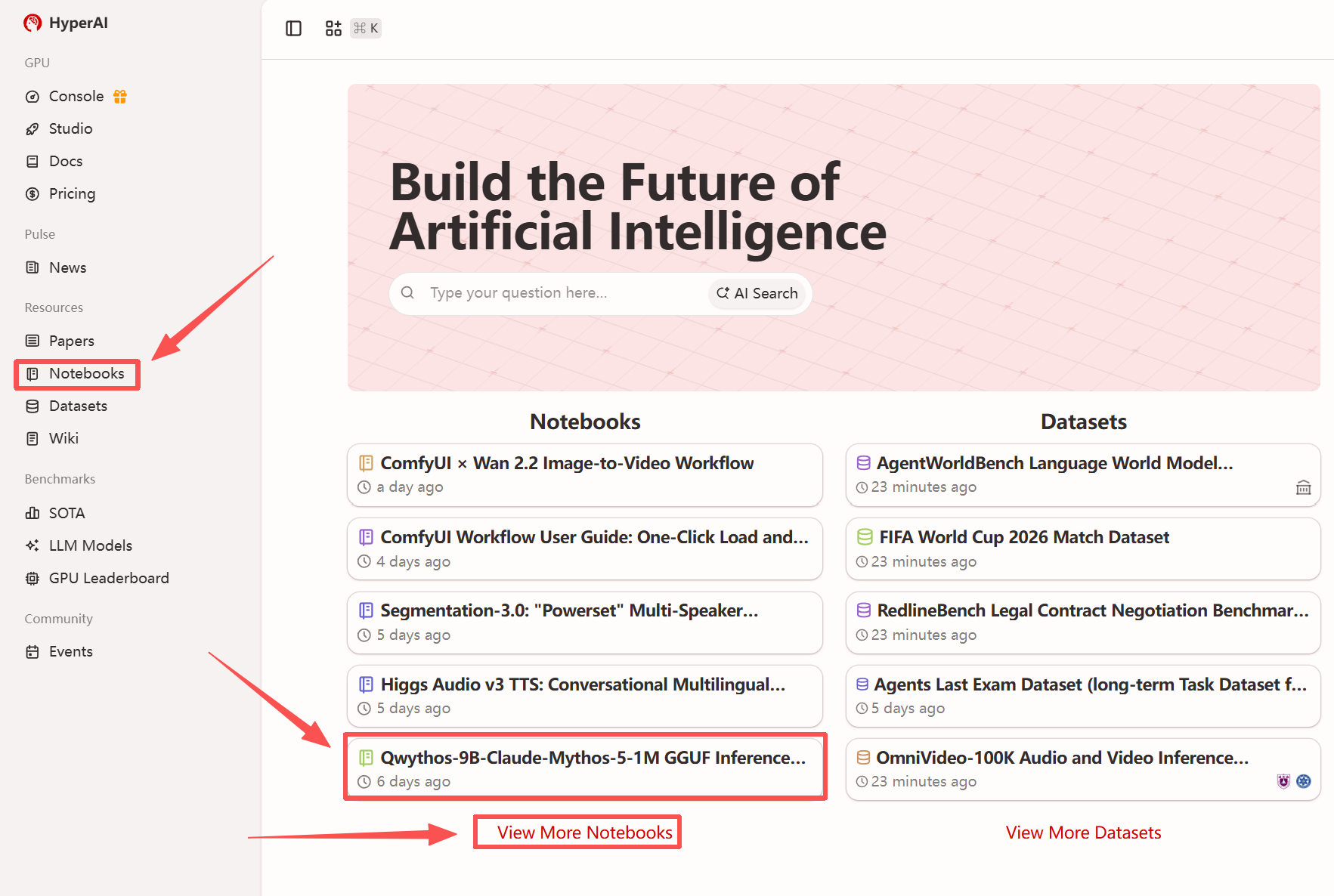
1. After entering the hyper.ai homepage, select the "Tutorials" page, or click "View more tutorials", select "Qwythos-9B-Claude-Mythos-5-1M GGUF Inference Deployment", and click "Run this tutorial".
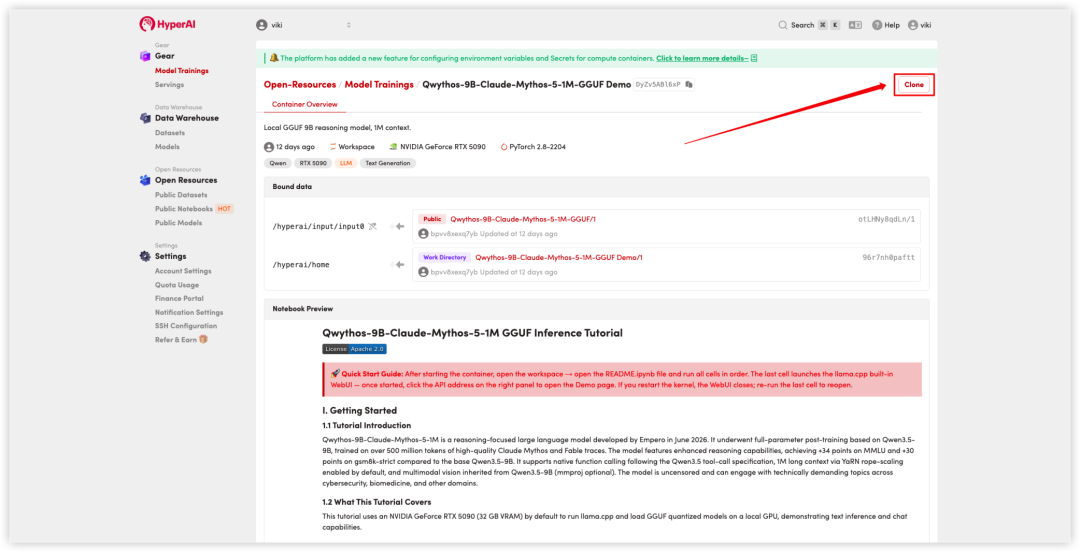
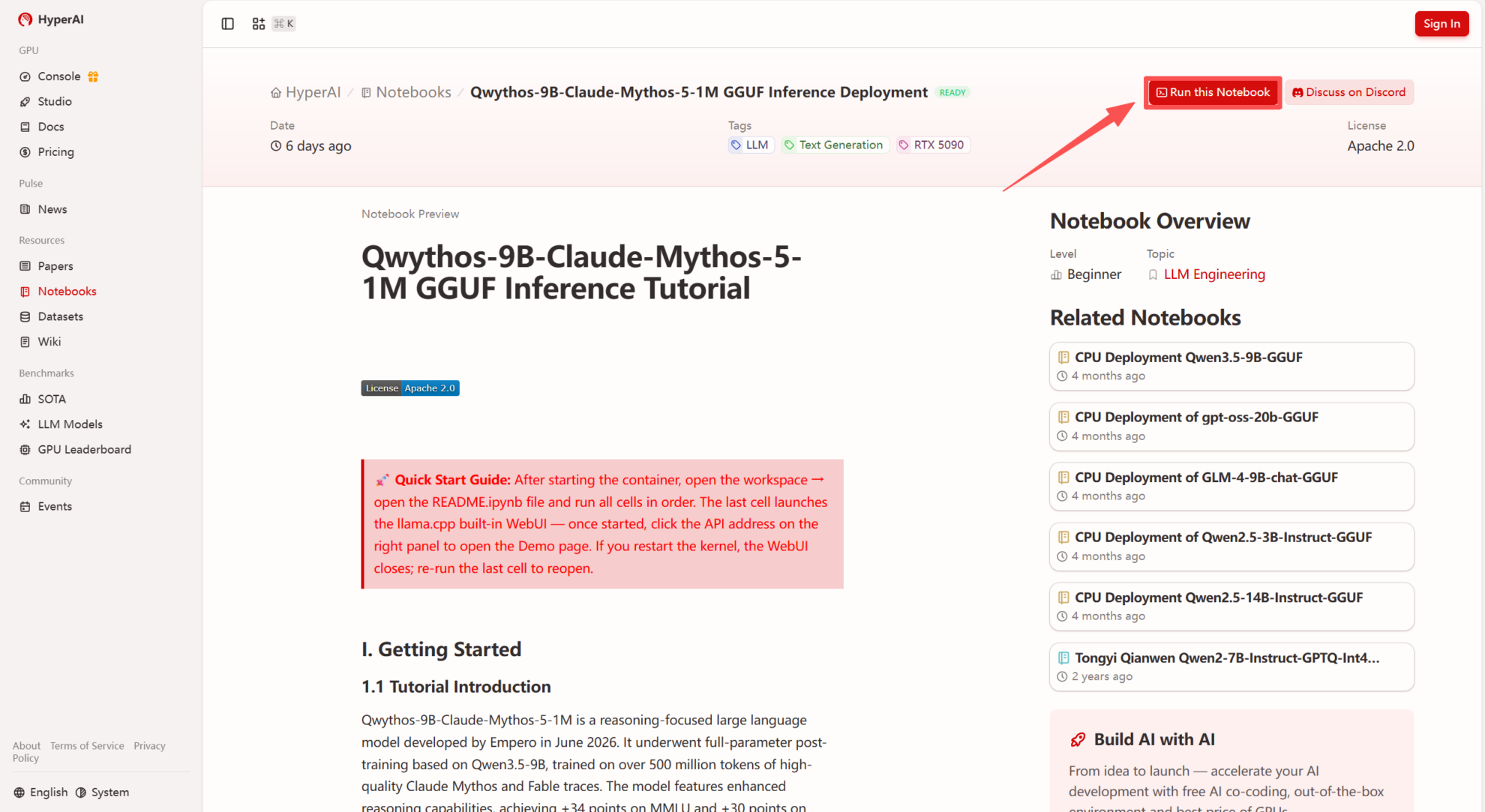 2. After the page redirects, click "Clone" in the upper right corner to clone the tutorial into your own container.
Note: You can switch languages in the upper right corner of the page. Currently, Chinese and English are available. This tutorial will show the steps in English.
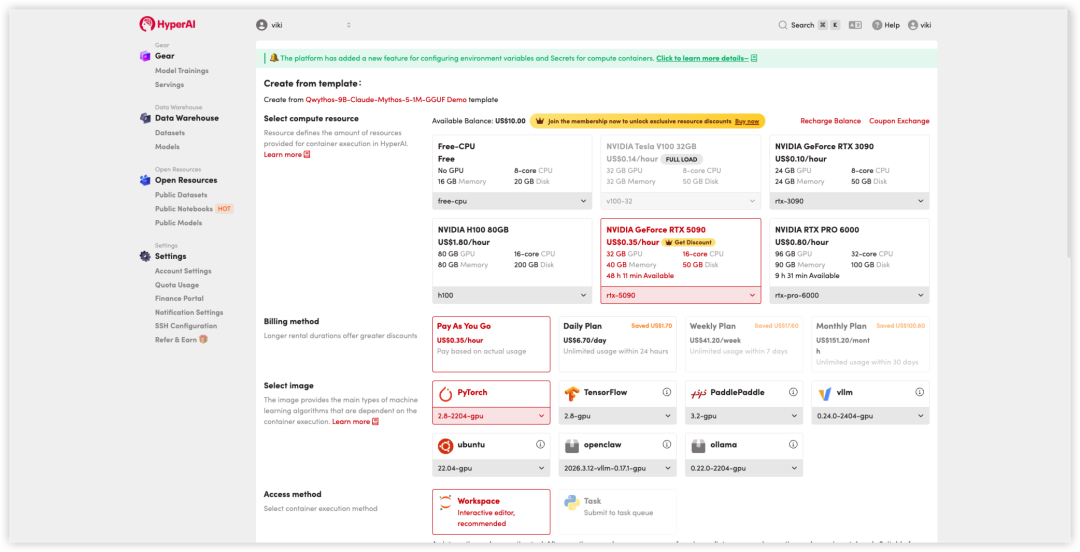
 3. Select the "NVIDIA RTX 5090" and "PyTorch" images, and click "Continue job execution".
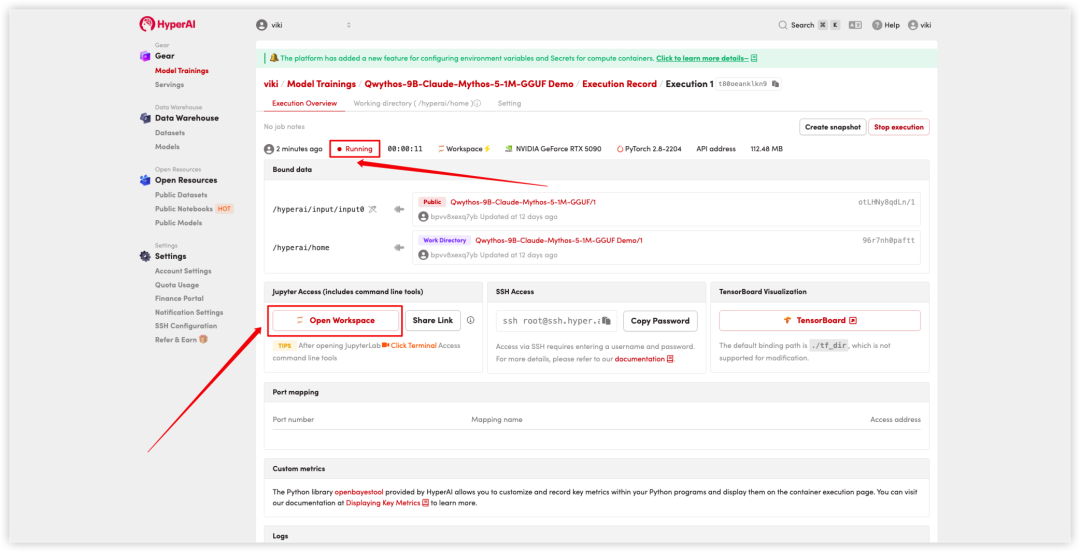
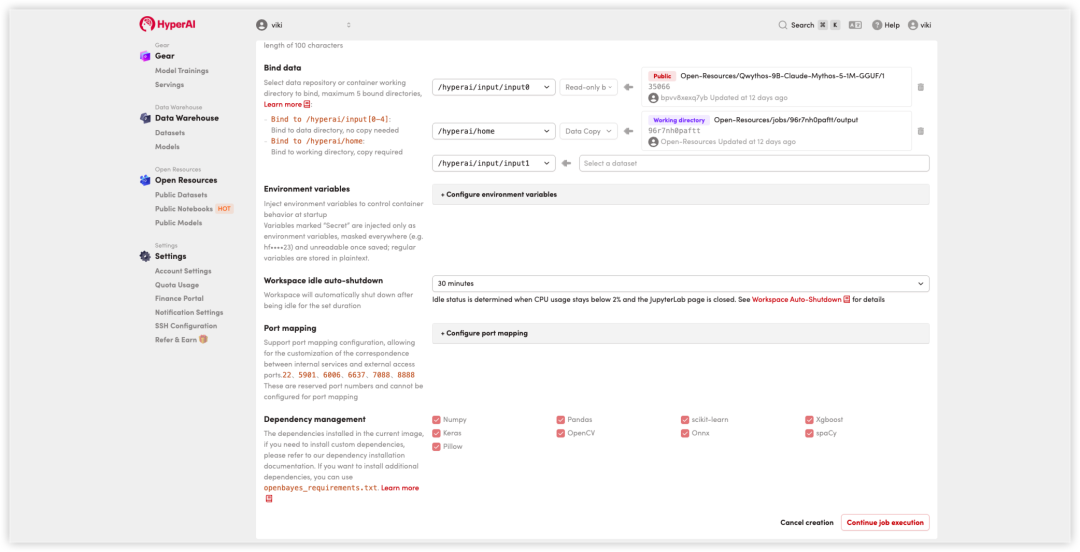 4. Wait for resources to be allocated. Once the status changes to "Running", click "Open Workspace" to enter the Jupyter Workspace.
Effect display
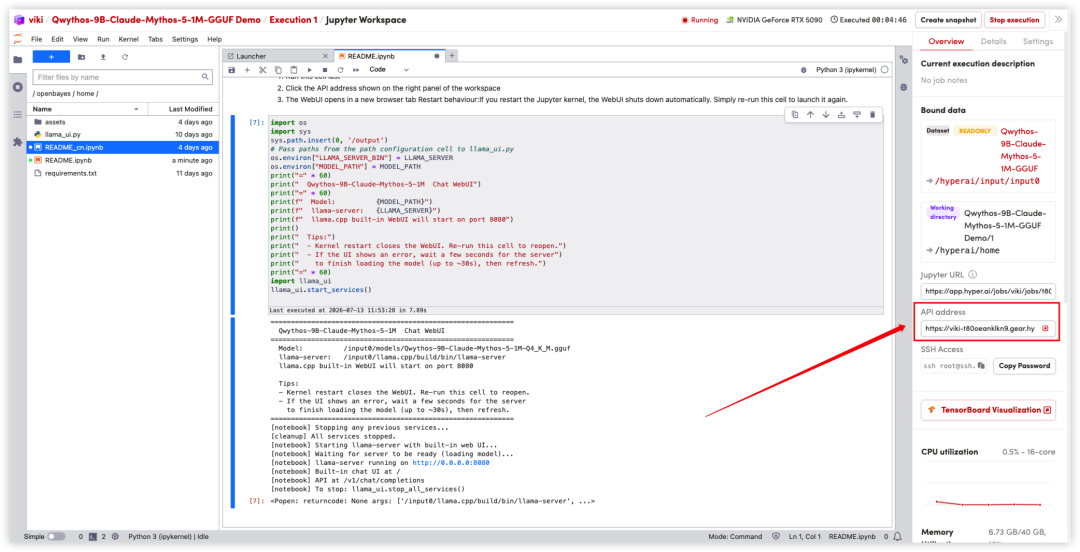
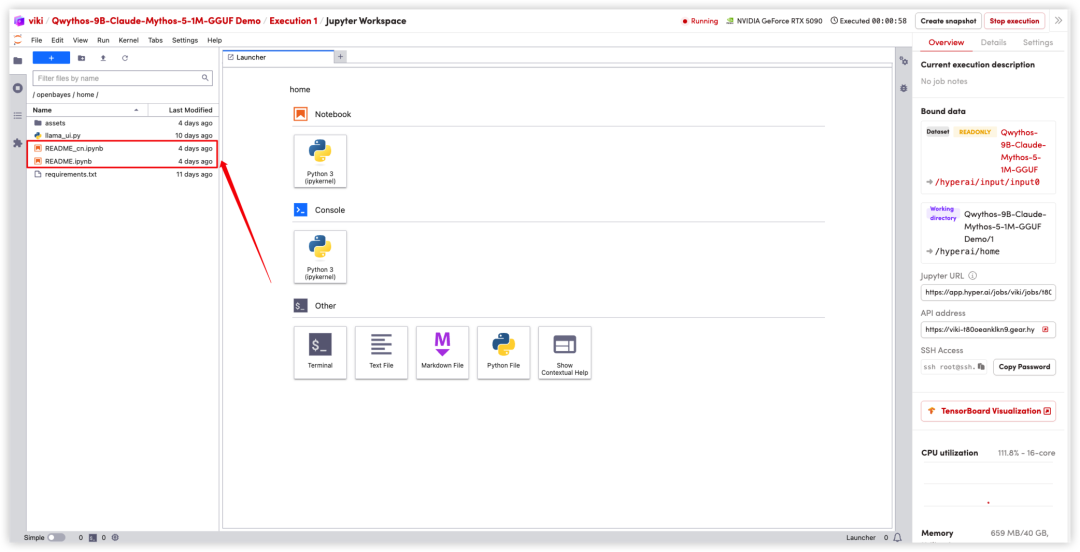
1. After the page redirects, click on the README file on the left, and then click on Run at the top.
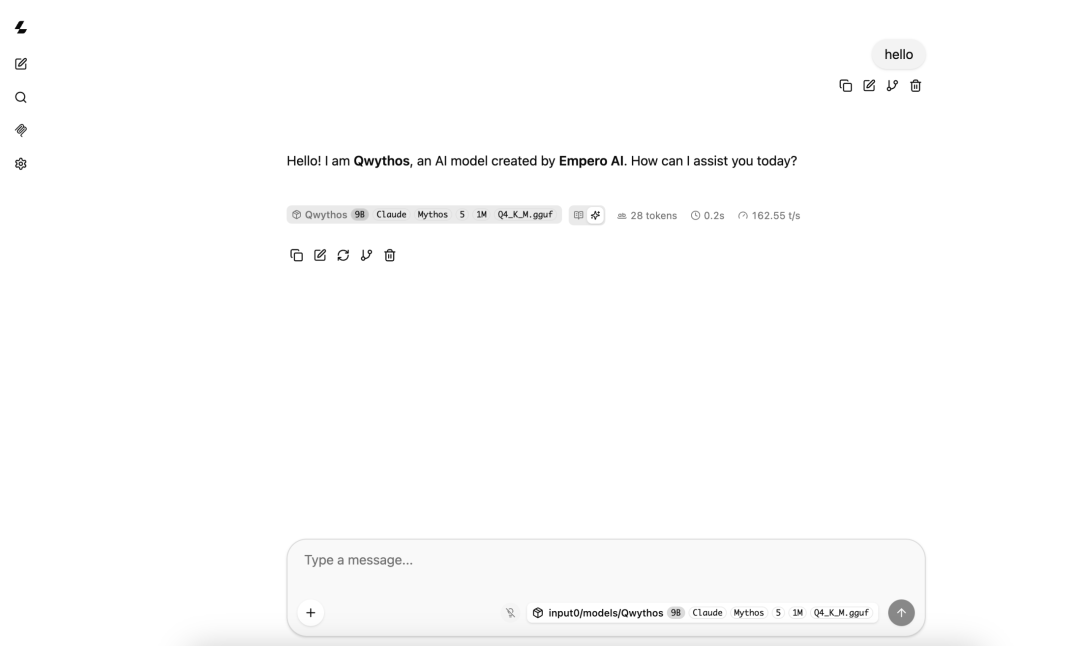
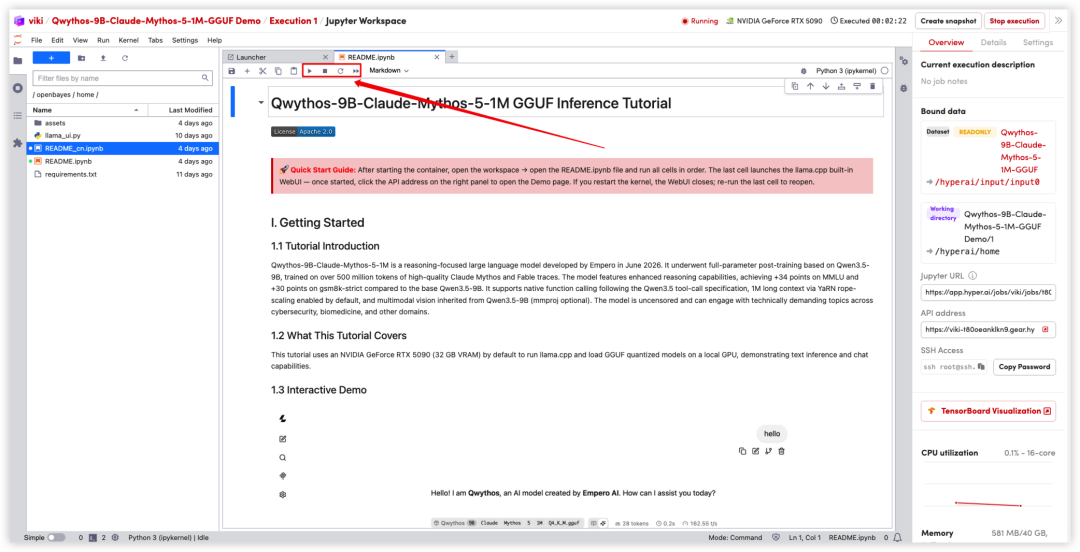 2. After the process is complete, click the API address on the right to open the Demo interface.