Command Palette
Search for a command to run...
First! Four Universities Jointly Launched the Drug Development Language Model Y-Mol, Which Is Ahead of LLaMA2 in Performance

Large language models represented by ChatGPT, ChatGLM and LLaMA have become powerful tools for people to explore the unknown world. These models with billions of parameters have demonstrated strong capabilities in generating text and understanding context through careful training of large-scale text corpora. However, most of these models perform well in general tasks, but face considerable challenges in certain specific fields, especially drug research and development.
Unlike the field of natural language processing, the field of drug development lacks a unified standard paradigm, and the development process is complex and costly. In addition, it involves multiple disciplines such as computational chemistry, structural biology, and bioinformatics. Relevant data is difficult to obtain, and the interaction data between drug-related entities requires sophisticated domain knowledge to be labeled.These factors together limit the application of large language models in drug research and development.
In response to this, research teams from Hunan University, Central South University, Hunan Normal University, and Xiangtan University jointly proposed a large language model Y-Mol guided by multi-scale biomedical knowledge. Y-Mol is an autoregressive sequence-to-sequence model that can be fine-tuned on different text corpora and instructions, greatly enhancing the performance and potential of the model in drug development. This is a new breakthrough in the field of drug development using large language models.
The study, titled "Y-Mol: A Multiscale Biomedical Knowledge-Guided Large Language Model for Drug Development", has been published as a preprint on arxiv.
Research highlights:
* Y-Mol is the first large language model built for drug discovery
* Y-Mol builds an information-rich instruction dataset by integrating multi-scale biomedical knowledge
* Y-Mol excels in drug-drug interactions, drug-target interactions, molecular property prediction, and demonstrates strong capabilities in understanding and versatility in various drug development tasks
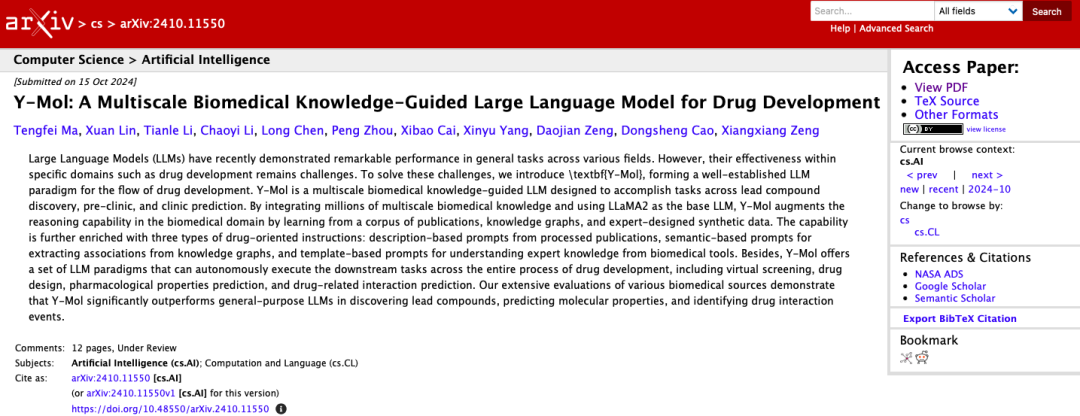 Paper address:
https://doi.org/10.48550/arXiv.2410.11550
Paper address:
https://doi.org/10.48550/arXiv.2410.11550
Follow the official account and reply "drug development model" to get the complete PDF
The open source project "awesome-ai4s" brings together more than 100 AI4S paper interpretations and provides massive data sets and tools:
https://github.com/hyperai/awesome-ai4s
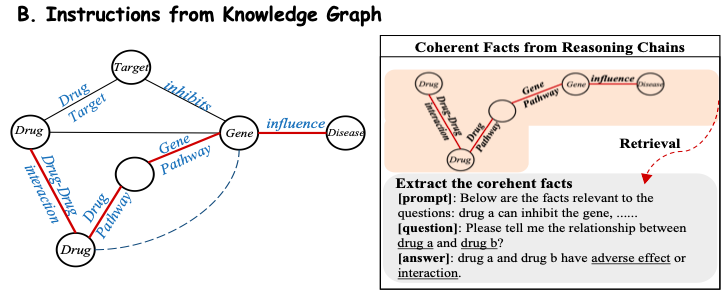
Fully explore two types of data sets to build a comprehensive biomedical corpus
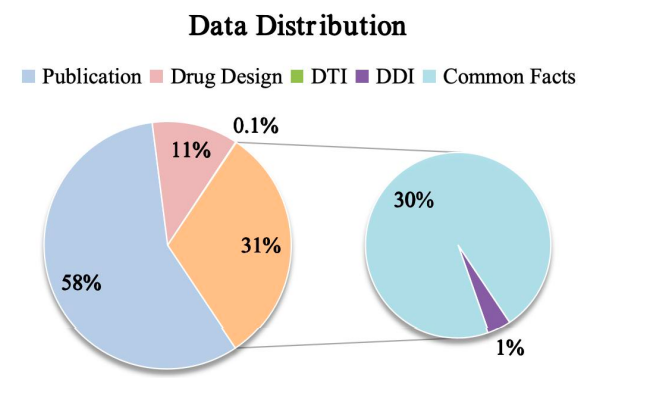
**In terms of constructing the pre-training dataset for Y-Mol, the study selected two types of datasets:**A text corpus from biomedical PubMed publications; supervised instructions built on a biomedical knowledge graph, and inference data extracted from expert models.
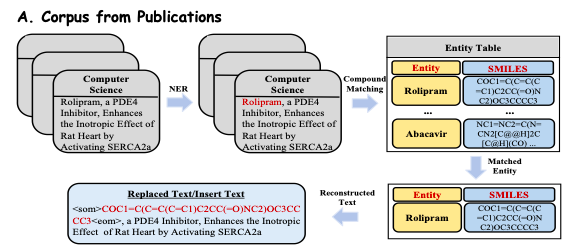
In order to deeply explore the rich biomedical knowledge in publications,**The study extracted and pre-processed more than 33 million publications covering multiple disciplines from online publishing platforms such as PubMed.**As shown in Figure A below, the researchers extracted visible abstracts and introductions from these publications as biomedical text data (Reconstructed Text) to ensure the quality and relevance of the corpus.
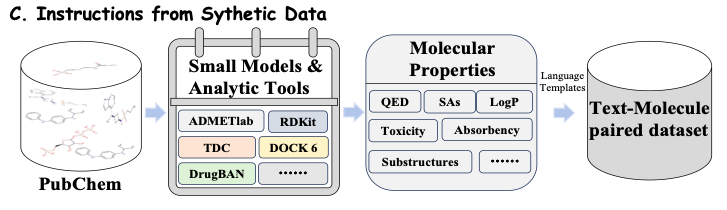
As shown in Figure C below, for a given drug molecule, in order to extract more comprehensive molecular properties (Molecular Properties), this study brings together a series of advanced molecular tools and computational models, such as ADMETlab, RDKit, TDC and DrugBAN. These tools and models extract molecular information with different characteristics from publicly available data sets, including QED, SAs, LogP, toxicity (Toxicity), absorbency (Absorbency) and substructures (Substructures). In this way, the study can continuously integrate the latest models and tools and use their prediction data to train the model, so that Y-Mol can evolve in real time and maintain its leading position in the field of drug research and development.
Ryu's dataset:https://doi.org/10.1073/pnas.1803294115
Deng's dataset:https://doi.org/10.1093/bioinformatics/btaa501
Y-Mol: Based on LLaMA2-7b, dedicated to drug development
This study selected LLaMA2-7b as the basic large language model to build an advanced training and reasoning framework specifically for drug development - Y-Mol. As shown in the figure below,The development of Y-Mol was divided into two key phases:
**first,**Y-Mol is pre-trained on a large-scale corpus of biomedical publications and fine-tunes LLaMA2 through self-supervised pretraining, enabling Y-Mol to have a basic grasp of the background knowledge of drug development.**then,**LLaMA2 was further supervised and fine-tuned using drug-related domain knowledge and expert synthetic data. This process input a large amount of drug-related information into Y-Mol, enhancing the model's understanding of the interaction mechanisms in the drug development process.
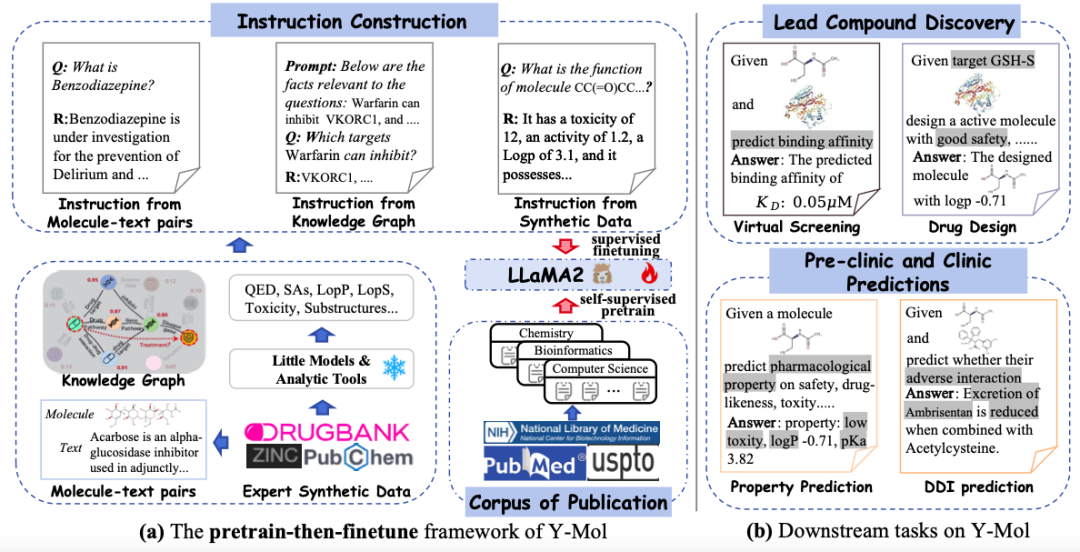
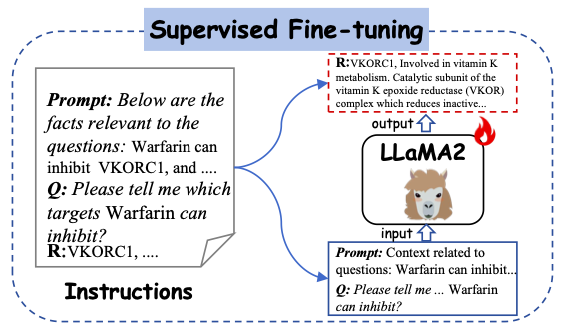
As shown in the figure below, the study uses the generated instructions as the input for supervised learning and feeds them into Y-Mol. Specifically, the constructed prompt contexts and questions are input into Y-Mol, and these constructed answers are used to supervise the output generated by the model.
Research results: Y-Mol has the best prediction performance
In order to fully verify the effectiveness of Y-Mol in the field of drug research and development, the study carefully designed a series of tasks covering different stages such as lead compound discovery, pre-clinical research and clinical predictions.Specifically, the different key tasks are as follows: (1) virtual screening and drug design for lead compound discovery; (2) prediction of the physical and chemical properties of discovered lead compounds in the preclinical stage; and (3) prediction of potential adverse drug events in the clinical stage.
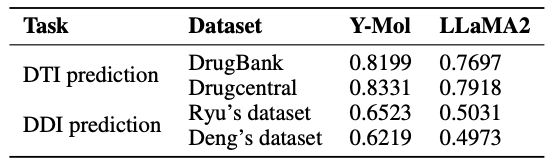
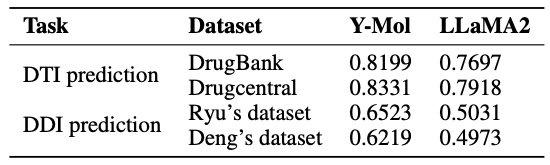
**In virtual screening,**Identifying unknown drug-target interactions is crucial. As shown in the table below, compared with LLaMA2, Y-Mol's AUC scores on DrugBank and DrugCentral datasets increased by 5.02% and 4.13%, respectively. This shows that Y-Mol performs well in DTI prediction of multi-scale data sources, demonstrating its superior performance in virtual screening.
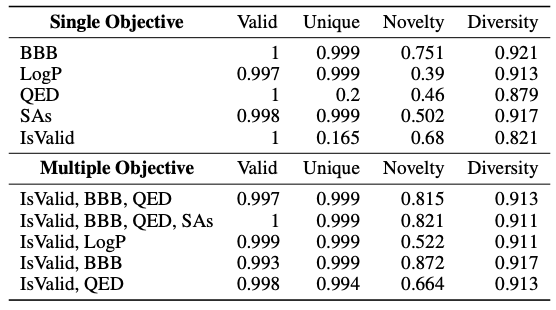
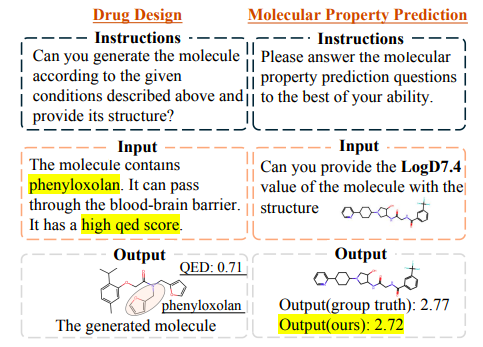
As shown in the table below, this study introduced standard indicators such as Valid, Unique, Novelty, and Diversity to predict different single objectives such as BBB and LogP. The results show that Y-Mol has better overall performance. In contrast, only the domain adaptability of the LLaMA2-7b model is poor and cannot generate effective molecules. At the same time, the study also tested the drug design performance of Y-Mol under multiple objectives. The results show that Y-Mol also performs well in this case.
AI technology: a new engine in drug development
In fact, in the long journey of drug development, scientists have been looking for new technologies that can accelerate the process. In recent years, AI technology has shown great application potential in this field. They can not only deeply understand the disease mechanism, but also play an important role in key stages such as drug discovery and clinical trials.
**In the business world,**Some companies have achieved remarkable results in AI drug development. For example, AI drug development company Insilico Medicine announced earlier this year that they had discovered a new clinical candidate drug for the treatment of idiopathic pulmonary fibrosis with a completely new mechanism, which has been verified by multiple human cell and animal model experiments. In addition, Huawei Cloud has cooperated with the Shanghai Institute of Materia Medica, Chinese Academy of Sciences, to launch the Pangu Drug Molecular Model, which can realize AI-assisted drug design for the entire process of small molecule drugs and improve the efficiency and accuracy of drug development.
**In the field of scientific research,**One of the authors of this study, Professor Zeng Xiangxiang's team at Hunan University, also designed a large language model for peptide sequences, and trained the model by gradually adding calculation and screening conditions. In just three months, the model successfully designed and synthesized 29 potential antimicrobial peptides, 26 of which showed broad-spectrum antimicrobial activity. In mouse experiments, three antimicrobial peptides showed antibacterial effects comparable to FDA-approved antibiotics, and no obvious drug resistance was observed during 25 days of continuous culture and monitoring. This achievement has been formally accepted by Nature Communications.
Paper link:
https://www.nature.com/articles/s41467-024-51933-2
In addition, another author of this study, Professor Cao Dongsheng of Central South University, together with Professor Hou Tingjun and Professor Xie Changyu of Zhejiang University, recently developed the molecular optimization tool Prompt-MolOpt. This algorithm uses the training strategy of prompt learning to realize the application of zero-shot learning and few-shot learning in multi-property optimization.
Paper link:
https://www.nature.com/articles/s42256-024-00916-5
From in-depth understanding of disease mechanisms to accelerating drug discovery and optimizing clinical trial design, AI technology is becoming a new engine for drug research and development. As technology continues to advance, it will play an increasingly critical role in future medical research.